

Message From A Mad Black Woman: Y’all Keep The Blue Bracelets, We’ll Take Our Rest.

Mere hours after the 2024 presidential election results made it clear that the United States would need to gird its loins for a second Trump presidency, a gaggle of women ran over to social media to announce that blue bracelets would serve as a new sign of solidarity. A safe space, if you will.
This declaration came about in response to Black women openly voicing their disappointment in both the election results and exit poll data that showed that not just white people, but Latinos and women of “all other races” had played a surprising role in the now President-Elect, Donald Trump’s reelection.
These exit polls quickly became the object of Black women’s attention and ultimate disappointment. Because while Black women went out and reliably voted for Vice President Kamala Harris to the tune of 91%, white women handed Trump 53% of their collective vote, Latino women 36%, and women of “other races” 46%.
On the night of November 5, 2024, Black women were left in shock. This shock would morph into disappointment, and the disappointment was a consequence of what, some would begin to argue, felt like, well, betrayal.
Like Rome, though, this heart-wrenching disappointment wasn’t built in a day.
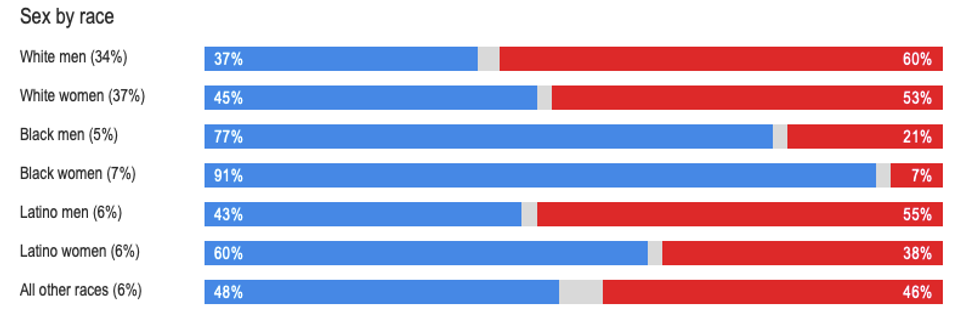
Screenshot from "2024 Exit Polls," NBC News, accessed Nov. 12, 2024.
The Set-Up
On Sunday, July 21, President Joe Biden announced that he would not be seeking reelection - a decision that followed the disastrous one-and-done debate against former president Donald Trump, the subsequent wavering of major donors, and growing calls for a new candidate to run on the Democrat’s ticket. Hours after Biden’s announcement, Vice President Kamala Harris would send Beyoncé's internet into a frenzy by announcing that she would seek the party’s nomination.
That July night, 44,000 Black women assembled via Zoom to stress test the limits of the meeting app, break historical fundraising records, and strategize - subsequently setting into motion a series of virtual meet-ups. As a result, more Zoom meetings cropped up, bringing together attendees connected through countless combinations of backgrounds, orientations, and genders.
One said meeting was held by and for 164,000 “White Women for Kamala” who’d come together to publicly declare that they’d regretted not doing more in 2016 and were ready to use their privilege for the sake of advocacy and allyship.

A woman wearing an anti-Trump button as she listens to Democratic presidential nominee VP Kamala Harris speak at a campaign event on Oct. 18, 2024.
Bill Pugliano/Getty Images
For months, white women made it a point to convince Black women that they were on board - ensuring us that they were ready to seize their second chance at pushing back on the pillars of the patriarchy. The same group who’d failed to answer the call of rejecting Trump’s racist, sexist, and xenophobic antics before swore, for months, that they’d seen the error of their ways and were looking for redemption. The alleged fix? Betting better. Doing more. Voting differently.
While there was an understanding undertone of apprehension from Black women, the rhetoric began to lend itself to hope — with some going so far as to lift the moratorium on cookout invites. There seemed to be a collective sigh. A brief moment of unity.
The Let-Down
Little did Black women know, they were about to be played like a fiddle by the same group who, like in 2016 and 2020, were more interested in their own self-preservation than in actual change. This short-lived hope was dashed on Nov. 5 as the true nature of performative allyship became evident.
Turns out, the Black women who’d served at the helm of the movement, bless their hearts, had been bamboozled. Hoodwinked. Swindled. Like a modern-day Boo Boo the Fool. Believing the hook, line, and sinker, it was almost cute, in a tragic sort of way. They saw the potential, the hope, and the promise, drinking the red Kool-Aid, so to speak, eagerly awaiting the revolution.
The excessive blue hearts and social media commentary pledging solidarity had turned out to be performative or had over-indexed the voices of the 44% who were actually in solidarity. Either way, the seemingly overwhelming allyship wasn’t there, reminding Black women that while they are constantly expected to stand on the front lines for so many, rarely is there any ally who will actually show up for them.
A History of Short-Lived, Self-Serving Allyship
The 2024 election wasn’t the first time we’d seen this type of performative allyship, though. While a noble concept in theory, the kinds of allyship that have been displayed in many movements across The States have far too often missed the actual point. In fact, throughout U.S. history, allyship has actually been used more as a tool to bolster a single group’s positioning in the social hierarchy rather than genuinely advocating for the progression of marginalized groups.
Think back to 2020. Just months after the COVID-19 pandemic forced much of the country into isolation, remote work, the acknowledgment of essential workers as, well, essential, and, for some reason, bread-making. For 9 minutes and 29 seconds, the world watched, helplessly, as a powerless George Floyd was slowly pulled away from the world, drained by Officer Derek Chauvin's knee to his nape. In a traumatic 8 minutes and 46 seconds, the world seemingly changed.
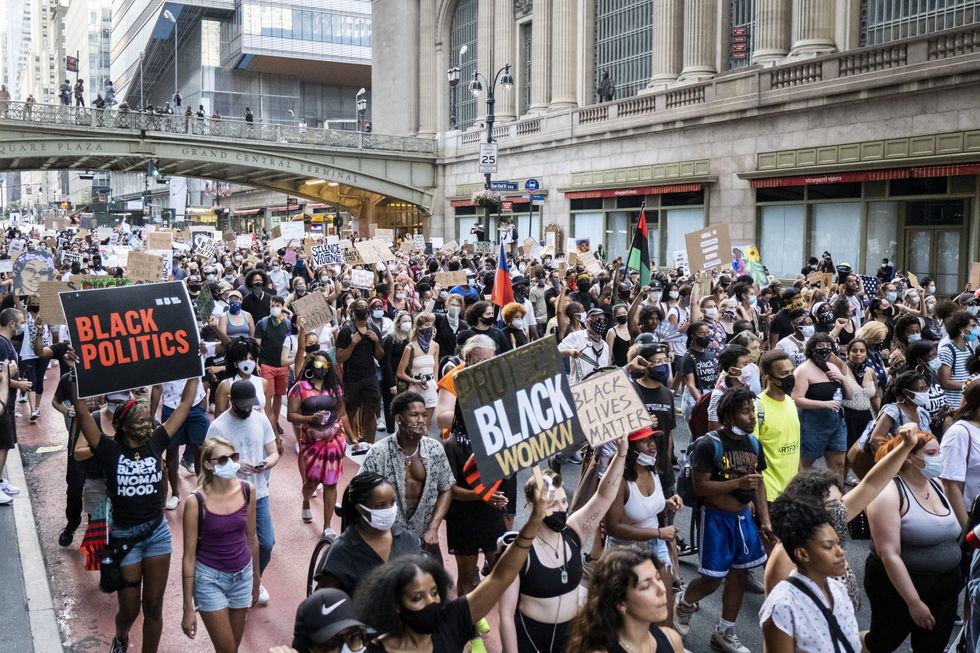
Ira L. Black/Corbis via Getty Images
Protests quickly spread across the globe, and along with it, a wave of “allyship” swept across America. Large corporations, scrambling to answer the calls of Black employees, consumers, and investors demanding that they use their financial prowess to do more to prevent the next Floyd, almost instantly began releasing statements of solidarity, pledging donations to “racial justice” causes, and promising to promote more Black employees.
However, as quickly as these gestures showed up, most were forgotten, with almost all proving to have provided minimal impact on the groups they’d pledged to help. While some companies, like Target, increased their spending on Black-owned businesses, others faced scrutiny for their lack of substantive change.
A study by Color Of Change found that only 17% of companies that pledged donations after Floyd's death had fulfilled their commitments. Data compiled by the Washington Post found that two years after America’s 50 largest publicly traded companies pledged a collective $50 billion to racial justice causes, just 37 had disbursed a collective $1.7 billion. What’s worse?
Ninety percent of the pledged amount - or $45.2 billion - had been allocated in the form of mortgages, loans, and investments that the companies themselves would more than likely benefit from. These companies said one thing and did another and still found a way to benefit from the delta.
Performative Allyship: Civil Rights & Women’s Liberation Movements
This type of allyship is new, though. It didn’t take long for powerful groups to figure out that the simple appearance of allyship was, for the most part, good for business and the bottom line. For decades, powerful entities have publicly supported movements only to be later found to have engaged in discriminatory practices, highlighting the consistent disconnect.
During the Civil Rights Movement, companies issued statements of solidarity and even donated to civil rights organizations, but behind the scenes, they continued to segregate their workforces and refuse to hire Black employees for higher-level positions. During the Women's Liberation Movement, advertisers capitalized on the feminist moment by incorporating imagery and slogans associated with women's empowerment into their campaigns, while the underlying message of many advertisements reinforced traditional gender roles and stereotypes.
The difference between what is said and what is done has time after time exposed the shallowness of allyship, highlighting how it has mostly served as a tool for public relations rather than a genuine commitment to social justice and to the marginalized groups who are most at risk by the upholding of the status quo.
For two election cycles straight, white women posed as allies and still voted in a way that upheld the power structure that they benefit from - with many understanding that the survival of white supremacy is of more value to them than sexism and misogyny is a threat. In 2016 and 2020, 52% and 55% of white women, respectively, decided that they’d rather keep their position of second place in the social hierarchy than risk dismantling it and being forced to find a new place in society.
Latino women and women of “all of the races” followed the trend - blatantly ignoring the warnings of the same Black women who have not only been on the front lines of social justice but who are often called into the lead movements in communities that are not there own - increasing their support for Trump between 2016 and 2025 by 13% and 15% respectively.
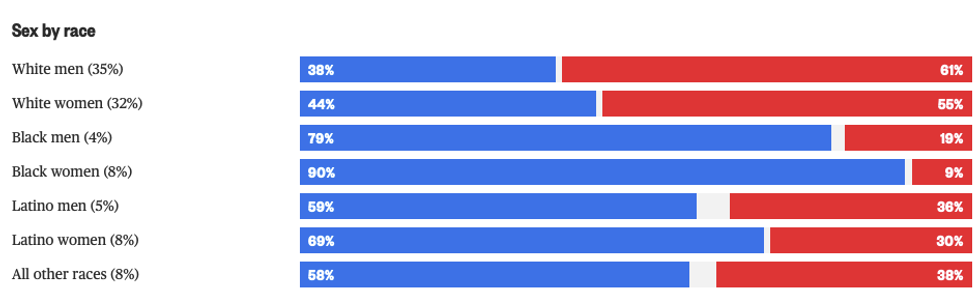
Screenshot from "2020 Exit Polls," NBC News, accessed Nov. 12, 2024.
The Blue Bracelets are Going to Be A “No”
On the night of Nov. 5, 2024, Black women watched their country look at a qualified, experienced, capable, and willing Black woman and say, “Nah, we good.” It was on this night that a group that had been denied democratic rights for centuries, but had still attempted to rescue American democracy far too many times, only to be let down, put away the warnings, and began issuing a new declaration - they were opting out.
Black women have decided to lean into rest and recuperation - uninterested in any additional work that will, more than likely, end in disappointment and betrayal. For many Black women, the suggestion to wear blue bracelets as a symbol of solidarity is patronizing and dismissive of a greater and more complex issue. It’s a way to absolve the women who let Black women down for failing to keep promises made while simultaneously positioning the wearer as morally superior.
It fails to address the historically deep betrayal that Black women have experienced at the hands of their country and, more specifically, their own countrywomen. The request reduces the fight for equality to a simple, superficial gesture when allyship isn’t aesthetic and Black women deserve more than a symbol.
While the blue bracelets may be the new fashion choice for white women attempting to set themselves apart, to symbolize that they were on the right side of history, for many Black women, it’ll always be difficult to trust. In fact, it may serve as a symbol of a hollow and fleeting promise for the Black women who have done the tireless and thankless work for justice and equality.
For now, Black women are choosing themselves. Anywhere between a few days and the next four years should be enough time to reset and recoup. And who knows, they may even find the excess capacity means energy to train as pilots, restart forgotten yoga practices, expand the business, or earn that second Ph.D.
Let’s make things inbox official! Sign up for the xoNecole newsletter for love, wellness, career, and exclusive content delivered straight to your inbox.
Featured illustration by nadia_bormotova/Getty Images
Exclusive: Viral It Girl Kayla Nicole Is Reclaiming The Mic—And The Narrative
It’s nice to have a podcast when you’re constantly trending online. One week after setting timelines ablaze on Halloween, Kayla Nicole released an episode of her Dear Media pop culture podcast, The Pre-Game, where she took listeners behind the scenes of her viral costume.
The 34-year-old had been torn between dressing up as Beyoncé or Toni Braxton, she says in the episode. She couldn’t decide which version of Bey she’d be, though. Two days before the holiday, she locked in her choice, filming a short recreation of Braxton’s “He Wasn’t Man Enough for Me” music video that has since garnered nearly 6.5M views on TikTok.
Kayla Nicole says she wore a dress that was once worn by Braxton herself for the Halloween costume. “It’s not a secret Toni is more on the petite side. I’m obsessed with all 5’2” of her,” she tells xoNecole via email. “But I’m 5’10'' and not missing any meals, honey, so to my surprise, when I got the dress and it actually fit, I knew it was destiny.”
The episode was the perfect way for the multihyphenate to take control of her own narrative. By addressing the viral moment on her own platform, she was able to stir the conversation and keep the focus on her adoration for Braxton, an artist she says she grew up listening to and who still makes her most-played playlist every year. Elsewhere, she likely would’ve received questions about whether or not the costume was a subliminal aimed at her ex-boyfriend and his pop star fiancée. “I think that people will try to project their own narratives, right?” she said, hinting at this in the episode. “But, for me personally – I think it’s very important to say this in this moment – I’m not in the business of tearing other women down. I’m in the business of celebrating them.”
Kayla Nicole is among xoNecole’s It Girl 100 Class of 2025, powered by SheaMoisture, recognized in the Viral Voices category for her work in media and the trends she sets on our timelines, all while prioritizing her own mental and physical health. As she puts it: “Yes, I’m curating conversations on my podcast The Pre-Game, and cultivating community with my wellness brand Tribe Therepē.”
Despite being the frequent topic of conversation online, Kayla Nicole says she’s learning to take advantage of her growing social media platform without becoming consumed by it. “I refuse to let the internet consume me. It’s supposed to be a resource and tool for connection, so if it becomes anything beyond that I will log out,” she says.
On The Pre-Game, which launched earlier this year, she has positioned herself as listeners “homegirl.” “There’s definitely a delicate dance between being genuine and oversharing, and I’ve had to learn that the hard way. Now I share from a place of reflection, not reaction,” she says. “If it can help someone feel seen or less alone, I’ll talk about it within reason. But I’ve certainly learned to protect parts of my life that I cherish most. I share what serves connection but doesn’t cost me peace.
"I refuse to let the internet consume me. It’s supposed to be a resource and tool for connection, so if it becomes anything beyond that I will log out."

Credit: Malcolm Roberson
Throughout each episode, she sips a cocktail and addresses trending topics (even when they involve herself). It’s a platform the Pepperdine University alumnus has been preparing to have since she graduated with a degree in broadcast journalism, with a concentration in political science.
“I just knew I was going to end up on a local news network at the head anchor table, breaking high speed chases, and tossing it to the weather girl,” she says. Instead, she ended up working as an assistant at TMZ before covering sports as a freelance reporter. (She’s said she didn’t work for ESPN, despite previous reports saying otherwise.) The Pre-Game combines her love for pop culture and sports in a way that once felt inaccessible to her in traditional media.
She’s not just a podcaster, though. When she’s not behind the mic, taking acting classes or making her New York Fashion Week debut, Kayla Nicole is also busy elevating her wellness brand Tribe Therepē, where she shares her workouts and the workout equipment that helps her look chic while staying fit. She says the brand will add apparel to its line up in early 2026.
“Tribe Therepē has evolved into exactly what I have always envisioned. A community of women who care about being fit not just for the aesthetic, but for their mental and emotional well-being too. It’s grounded. It’s feminine. It’s strong,” she says. “And honestly, it's a reflection of where I am in my life right now. I feel so damn good - mentally, emotionally, and physically. And I am grateful to be in a space where I can pour that love and light back into the community that continues to pour into me.”
Tap into the full It Girl 100 Class of 2025 and meet all the women changing game this year and beyond. See the full list here.
Featured image by Malcolm Roberson
More Than Gratitude: 7 Signs You're Struggling With Contentment In Your Life
If Thanksgiving happens to be your favorite holiday — or you just happen to be a longstanding participant of it — then there is one tradition that you are probably familiar with. Usually, before everyone eats, each individual expresses at least one thing that they are grateful for. I actually think that is one of the best things about the holiday because it reminds people to slow down and really reflect on how to be in the moment and think about the blessings that they have. And that, my friend, is what gets folks into the mindset of knowing how to be…content — even if it’s just for a brief moment.
Contentment. By definition, it’s the state of not only being “satisfied with what one is or has” but also “not wanting more or anything else.” And you know what? Although it might not be a popular aspiration of many, it is a sign of spiritual maturity on certain levels. After all, it is the Apostle Paul who once said, “Not that I speak in regard to need, for I have learned in whatever state I am, to be content…” (Philippians 4:19 — NKJV).
Being content is about not complaining. Being content is about learning to be comfortable in your present circumstances. Being content is about choosing to find joy and fulfillment, on some level, and in some way, on a daily basis.
Personally, I dig all of this so much because when you have mastered true inner contentment, it creates stability, self-awareness, and a type of resilience that makes you…shoot, powerful beyond measure, if you ask me. Because when someone knows how to “find the good” and “make peace,” regardless of what is going on around them, they truly are unstoppable. Yeah, on so many levels, contentment is the ultimate life hack. It’s something that each and every one of us should aspire to become: completely and genuinely content.
Thanksgiving is basically moments away at this point. In preparation for that time of self-reflection, pour yourself a glass of wine, turn on some soft music, sit on your coach, and then ask yourself, “Am I content?” If you’re not sure (or you need the definition unpacked for you just a bit more), here are seven signs that you may not be…and yet, there is no time like the present to do something about it.
1. You’re Super Impatient
GiphyHonestly, putting another Scripture right here could be all that is needed in order to bring this point to a swift and abrupt end. Which one? I Corinthians 13, the Love Chapter, starts off with “Love is patient” (I Corinthians 13:4). Yeah, if you want to know if you love yourself and love yourself well, how patient are you…including with yourself? Throughout the years, I have shared one of my favorite definitions of "patient" in several different articles: “bearing provocation, annoyance, misfortune, delay, hardship, pain, etc., with fortitude and calm and without complaint, anger, or the like.” For me, it’s a blaring reminder that mastering patience isn’t just about waiting (more on that in a sec); it’s about waiting with grace.
Content people can do this because, on some level, they know how to apply the John Piper quote, "God is always doing 10,000 things in your life, and you may be aware of three of them." Another way of looking at this is people who can wait well — without complaining or getting annoyed by delays or challenges in the meantime — get that in order for things to truly come together, there are lots of moving parts…some that they don’t even know about. And so, if they want the best outcome, yes, waiting well is oftentimes not just involved; it is required.
Impatient people don’t get any of this. That’s why they are so stressed out all of the time.
2. You’re Worried About Things You Can’t Control
GiphyThis. Past. Election. Chile. And then the cabinet that that man is putting together as we speak? I don’t even want to get my blood pressure up, expounding on it. Let me just pivot by adding one more Scripture — because it is beyond fitting: “Therefore do not worry about tomorrow, for tomorrow will worry about its own things. Sufficient for the day is its own trouble.” (Matthew 6:34 — NKJV)
Although worrying is something that pretty much everyone does at one point or another, one of my favorite quotes on it is by an American humorist by the name of Erma Bombeck: “Worry is like a rocking chair: it gives you something to do but never gets you anywhere.” And really, when you stop to really think about worrying, isn’t that the truth? For one thing, all worrying does, by definition, is cause you to torment yourself by focusing on things that aren’t even going to happen (somewhere between 85-90 percent of the time, in fact; there is actually a science on that) or trying to control things that are beyond your control.
If being a worry wart is your internal struggle, my advice would be to look at life this way: If you’re worried that you’re about to get written up for getting to work late again, leave your house earlier — you can control that. On the other hand, if you’re worried that you’re going to get laid off before the holiday season ends, so long as you’ve been doing your best (which is also something that you can control), please put your energy elsewhere because that is something that you can’t control.
And I promise that when you choose to be calm and confident over worrying yourself to death, that can help you to manage what you can’t control so much easier. Oh, and your health will thank you, too, because worry is attached to things like insomnia, muscle tension, headaches, overeating, and drinking too much. All this over things that probably won’t happen in the first place? Yeah, sis…(choose to) relax.
And by choosing to chill out, there is some contentment that follows because you will see the good as much as, if not more than, the potential bad. Trust me.
3. The Past and/or Future Consume You
GiphyOn the heels of the Scripture that I just provided for the previous point, it also applies to this one. You know, back when I was doing some intentional research on forgiveness, I always appreciated the insight of author Gary Zukav: “Forgiveness is accepting that the past cannot change.” While this doesn’t mean that you shouldn’t hold people accountable for what they have done, it does help you to be compassionate with those who are truly sorry (check out “Heads Up: It's NOT An Apology If An Amend Isn't Made”) because, no matter what has transpired between you and them, one thing they can’t do is go back into a time machine and change it.
And you know what? When it comes to the mistakes — or, let’s be real, sometimes they are conscious poor decisions — you have made, you can’t either. So, why let their misdeeds or your own consume you to the point of internally destroying you?
Then there’s the future. What if you get robbed? What if your mom gets cancer? What if your husband files for divorce? Girl, if you are caught up in the future that hasn’t even happened yet, you are definitely gonna drive yourself up the wall! And this is why so many mental health experts and platforms are all about encouraging individuals to live in the moment. You can do this by meditating, taking breaks from social media (and the news), journaling, doing things that you enjoy (instead of waiting to put them off), and resting.
Listen, one of the best things about choosing to only focus on the here and now is you can find little things about it to be content with — and that helps you to be/become more content overall.
4. You Always Think About Wanting More
GiphyAlthough it certainly wasn’t my plan for this piece to be so Scripture-heavy, I’ve got to flow with what immediately comes to mind and, for this point, the verse, “So are the ways of everyone who is greedy for gain; It takes away the life of its owners” (Proverbs 1:19 — NKJV) is it. And just what does it mean to be greedy? A greedy individual isn’t just low-key obsessed with getting and having more — please catch it — they are also quite EAGER.
Eager folks also tend to be impatient. Eager folks are perceived by others as being very intense (and not in a good way). More times than not, eager folks haven’t really mastered how to take a moment to appreciate what they do have because all they care about is what’s next. And when you’re in a state of that kind of, well, anxiety…how could it not affect your quality of life? I mean, really.
And what if you read all of that and said, “I’m not greedy; I’m just ambitious” — listen, there is nothing wrong with having goals and wanting to obtain them. However, an ambitious individual knows how to find balance. If they get a promotion, they will schedule a vacation to celebrate it. If they just got a new car, they are not in a rush to get a new house until they can financially afford it. If they were just proposed to with a really nice ring, they aren’t hounding their new fiancé about setting a date within the next two weeks.
People who always want more, without taking the time to enjoy what they already have, are never going to be content. Why? Because there is always something else that you can want…even if you don’t need it or it really isn’t the time for it. Meanwhile, content people get that it’s a good thing to not go after everything all of the time; that it’s far wiser to embrace what is already before them — because some folks don’t even have…that.
5. You Compare Yourself to Others
GiphySomething that I actually get asked fairly often is, do I feel “some type of way” that I do so much work in the realm of marriage when I’ve never been married myself. The short answer is “absolutely not” because I know that I could’ve been married, a few times over, at this point; however, I am just as intentional about not wanting to be divorced as I am about being in a healthy marriage, not just “a marriage.”
I’m grateful to be in that head and heart space too; otherwise, I would be out here comparing myself to other people — and there is nothing good, healthy, wise, profitable, or beneficial about doing that. In fact, science isn’t a fan of playing the “keeping up with the Joneses” game, either.
According to science, that can ultimately do things like lower your self-esteem, cause you to only see the bad/negative things in your world (in comparison to other people), and it can jack up your perception of what’s really going on with other people. For instance, if you’re 33 and comparing yourself to your friends who are already married and parents, you might want to talk to them about what their day-to-day, beyond their IG posts, is like.
Because while prayerfully, their life is filled with many blessings, if they are being totally honest with you, they will also share that you’ve got some “pros” to your life too (honey, there are some real benefits to being single; check out “If You're Not In Love With Being Single, Ask Yourself These 6 Questions.,” “10 Bona Fide Benefits Of Being Single,” and “10 Words That'll Make You Totally Rethink The Word 'Single'”). Content people get that every season does — because it’s true.
6. You Don’t Verbalize Gratitude Often
GiphyThere is someone in my world who I actually try to avoid as much as possible. It’s not that she’s not smart, and honestly, she’s one of the funniest individuals that I’ve ever known (and I’ve known her for most of my adult life). It’s just that…she is always wanting something, and I find that to make her a very draining individual. Lawd, even as I am typing all of this out, I’m trying to recall a time when I’ve heard her say, “thank you” for something (no joke), let alone express any form of genuine gratitude. She’s just got such a sense of entitlement that whatever she does receive, she thinks she’s owed and what she doesn’t have, she believes that something is wrong if it hasn’t arrived yet. Geeze, what a horrible type of existence.
You don’t have to take my word for it either because there is plenty of data out here to support that people who don’t take the time to be grateful for what they have ended up being unhappy, more stressed out, in more physical pain (yes, literally) and definitely more negative than everyone else — which would explain why people don’t like hanging out with them as much.
So, since this is the time when gratitude is the theme of the season, think about what you are grateful for when it comes to what you’ve accomplished this year, then write it down and post it up somewhere. Then, as far as the individuals, for whom you are grateful for — send them a handwritten note, get them a gift card to their favorite coffee shop, or even just call to tell them.
One of the most beautiful things about being in a state of contentment is it reminds you of a lot of what you already have. It really is enough…for now…in this very moment.
7. Being (and Living) Satisfied Is a Foreign Concept to You
Giphy“Tubi movies” really is a complete sentence. LOL. And yes, sometimes, when I’m taking a writing break, I will check out some of the most…I-wouldn’t-normally ones, just to lend my support. In walks Never Satisfied with its own self-explanatory meaning. Y’all, it really is oh so true that there are folks out here dealing with some unpredictable and sometimes even truly dire consequences — and it’s all because they didn’t know how to sit down somewhere and learn how to be satisfied with the people, places, things, and ideas that they already have.
That said, I am indeed a quotes gal, and one of my favorites on the topic of satisfaction is by actor Christopher Reeve: “Success is finding satisfaction in giving a little more than you take,” and although I don’t do what I’m about to do often (because I try to take Matthew 6:1-4 very literally and seriously), I’m going to illustrate what he said about satisfaction by sharing a recent situation.
This past week, a nurse practitioner (I prefer those to doctors) diagnosed me with wrist tendonitis for the first time in my life. If you knew how many keystrokes that I do a day, you’d probably be shocked that it took this long. Anyway, as I was waiting in line to get a prescription, a young Black man was basically freaking out because his insurance was refusing to cover his own meds. According to what he was telling the pharmacist, he always only pays $5; however, this time, they were charging $62, he simply didn’t have it, and the insurance company was not picking up.
As I watched him shaking and sweating while saying that he really needed it today and fretting while talking to his mom on the phone, I offered to cover it — and after going back and forth with him for about three minutes, I did. In my mind, although I didn’t plan on spending about $85 (total) that day, the little inconvenience that it was costing me was nothing in comparison to how much it was going to benefit him — I could tell from how he and his mother reacted (even the pharmacist mouthed “thank you so much”), and that is what made it money well spent.
To help someone who had no way of helping themselves in the moment? That brought me a lot of satisfaction because it’s nice to lighten someone’s load while leaving it to karma to handle it. ALL OF IT.
And that’s why I thought it was best to wrap all of this up with a reminder that being satisfied is being content. And when you can be so satisfied with your life that you want to help others? That is a level of contentment that is truly unmatched because you start looking for ways to bless others simply so that they can feel just as content as you do.
____
Our culture? It really is never satisfied, which explains why a lot of people are so miserable. SMDH. You don’t have to be like the masses, though. This Thanksgiving, please purpose in your mind (and heart) to be(come) more content. It will make you a rare gem that benefits everyone and everything around you.
Including yourself, sis. No doubt about it.
Let’s make things inbox official! Sign up for the xoNecole newsletter for love, wellness, career, and exclusive content delivered straight to your inbox.
Featured image by Shutterstock
Originally published on November 28, 2024