

If someone had told me I’d be working toward my third fibroid surgery in less than six years, I would have had a hard time believing them. First, because obviously, no one wants to ever hear the word "surgery" (unless it’s cosmetic surgery you’re opting for). But the more significant reason is I’d never heard any of the women in my life talk about fibroids, so the idea of having all of the complex issues because of them, on top of surgeries, was truly a foreign concept.
After my doctor told me I’d need a second surgery in March of 2023—a hysteroscopic myomectomy—after bleeding every day for over six months, I was over it. Not just over the symptoms. But I was done feeling siloed on an island dealing with the pain, feeling tired all the time, and the heaviness of what felt like endless trips to the doctor for ultrasounds, blood transfusions, blood count checks, MRIs, etc.
I would try to explain what I was feeling, and my pain was written off because I guess period pain is just supposed to be normal. I’m here to tell you it is not. And because we’ve been conditioned to just deal, that’s the way things should stay. Yeah, no.
What is a hysteroscopic myomectomy? Hysteroscopic myomectomy is the most minimally invasive procedure to treat fibroids. A surgeon removes fibroids by inserting a hysteroscope into the uterine cavity through the vagina and cervix.
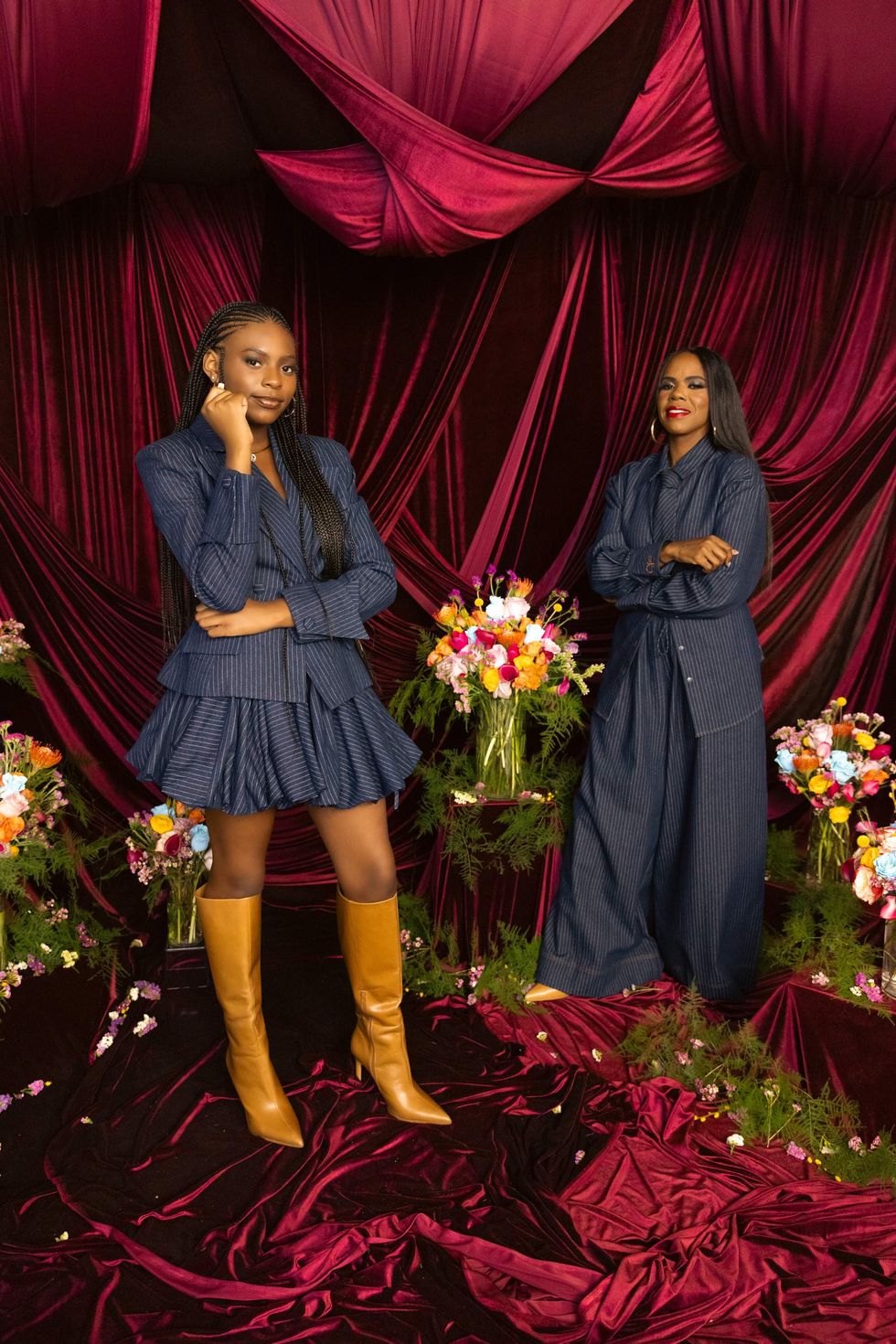
So, I wrote and directed an animated short film to bring educational and entertainment value to helping the world learn about fibroids. With $25,000 of my own money, I went forth and made the film titled Super High: A Period Piece. Now, it’s making its rounds on the festival circuit, even gaining entry into two Oscar-qualifying festivals: the Chicago International Film Festival and the New Orleans Film Festival. We even won Best Narrative Short at the Morehouse Human Rights Film Festival in Atlanta.
As I was venturing onto the festival circuit, my editor asked me to write a piece highlighting the experiences of Black women with fibroids. Initially, I planned to highlight up to 15 stories. However, as I started working on this story, I thought hearing the experiences more in-depth would be equally impactful. So, we chatted with four women about their fibroid journeys.
The one thing we all had in common, which made me sad but also made me feel seen, was that none of us knew much about them beforehand. However, our willingness to openly share our stories will hopefully change that for many women now and beyond.
Keep reading for four women’s stories about their journey with fibroids.
Rosco Spears, artist and creative director
Before your journey with fibroids, did you know much about them?
Before my journey with fibroids, I didn't know much about them. I'd never heard of fibroids until women around me started getting diagnosed. I was dealing with heavy, painful periods long before I was privy to any of these diagnoses.
Shortly before I was officially diagnosed with having fibroids (2012), I learned that my sister and other women in my family also had fibroids. As I've grown older, I've learned that my three sisters, many cousins, aunts, etc, have also had fibroids. It's simply an issue that was never discussed.
How did you find out you had fibroids?
I found out that I had fibroids while living in NYC. I was fed up with the pain and discomfort from my period, so I shopped around until I got an answer that I thought made sense. I met a wonderful woman doctor who finally diagnosed me, and she offered me several options for easing the discomfort. During this time, I would often bleed between periods.
In 2013, one of my "in-between" moments was more than the spotting that I was used to, so I took myself to the emergency [room]. I learned that my hemoglobin [levels] were at seven, and the doctors wouldn't let me leave the hospital without getting a blood transfusion. They also highly recommended that I get surgery to remove the fibroids. Once I officially got the diagnosis, it was scary, but it also felt amazing to know that I could begin planning a path forward.
What are hemoglobin levels? To ensure adequate tissue oxygenation—a very important complex dance between the lungs, blood, and cardiovascular system—a sufficient hemoglobin level has to be maintained. The normal Hb level for women is 12 to 16 g/dl. Low hemoglobin levels mean your body isn’t getting enough oxygen, which is why you feel very tired and weak.
If you're comfortable, we'd love to hear about your treatment. Did things go as planned? Were you nervous about what your doctor suggested?
I've had two abdominal myomectomies, one in 2013 (16 fibroids were removed) and another in 2020 (51 fibroids were removed). I was nervous about the idea of being cut open during the myomectomy, but I didn't think that the outcome could be any worse than the pain that I was already dealing with. Both surgeries went just as planned (aside from the 2nd surgery being rescheduled due to COVID-19), and my recovery from both was amazing.
In 2013, I was a bit unhinged. I went location scouting for a photo shoot for The Lip Bar three days after I got home from the hospital. My family was very upset, but I honestly felt fine. I had some abdominal pain, but within two weeks, I was back in the studio on my feet all day. After my second surgery, the plan was to try and have a child shortly after recovery. I took my time with healing and did things according to the book.
What is a myomectomy? A myomectomy is surgery to remove uterine fibroids. There are several types of myomectomies, but the procedure you and your doctor decide is right for you will depend on factors like location, number, and size of your fibroids.
How did you feel post-treatment? How has getting treatment changed your quality of life?
I felt/feel amazing post-treatment! For about 2-3 years after both surgeries, my periods were much lighter, and the pain was light [and] much more bearable than it was with the fibroids. My quality of life is much different post-surgery.
There have been years [when] I simply did not have any energy while I was on my period. The most I could do was get up to go to the bathroom and get right back in bed. Or I'd have to carry a change of clothes with me when traveling to work because I couldn't afford to take off during my period, but I knew that at some point, I would bleed through everything. So, in that regard, life is beautiful. I'm no longer passing out, nor do I feel the need to bring an extra set of pants along on the ride.
While my quality of life has improved tremendously, I often joke and say that I have PTSD from having bad periods. What I mean is that I still check my pants often when I'm on my period. And I still get anxiety if I'm in public and I'm on day two or three of my period because who knows if it is just a little blood that I feel coming down or it's a huge clot that's going to ruin my pants. And I still know better than to try and wash my hair on my heavy days because there isn't enough energy to do both.
For someone just starting their fibroid journey, what are two pieces of advice you'd give them?
You got this, sis! It's a difficult journey, but please seek advice from other women on the journey. If one doctor is not giving you sufficient information, find a new doctor. Make sure you're exploring all of the options for fibroid removal/shrinking treatments [because] it is not one size fits all. And take your iron supplements, boo.
How important do you think it is for us to share our fibroid stories with each other and talk about this openly?
Oh God, if I could pay women to share their fibroid stories, I would. It's imperative that we talk with one another about our experiences in health. I shared my fibroid story years ago because I was so lost when I was on my journey. One of my sisters had the surgery before I did, but other than her, I didn't have anyone to talk to about fibroids.
I felt very alone, isolated, and somewhat embarrassed because it felt like this wasn't happening to anyone else around me. It makes a world of difference when you can talk with someone about an issue they are also facing. We will learn a lot more by discussing shared experiences—much of which you cannot learn from talking to your doctor or Google.
La-Anna Douglas, women’s advocate and motivational speaker
Before your journey with fibroids, did you know much about them?
Being someone who started my period at the age of 10, I was in the dark when it pertained to fibroids and other reproductive health issues. I had never heard of fibroids, and I didn’t know that the pain I was experiencing, along with fertility delays, was because of the fibroids sitting in between my two uteruses. The pelvic pain, excruciating periods, fatigue, and protruding belly to someone else would have been a dead giveaway. But I had no idea what was going on with my body. I also did not know of anyone in my family dealing with fibroids.
How did you find out you had fibroids?
I was diagnosed with fibroids by a reproductive endocrinologist [and] was finally properly diagnosed after suffering for 16 years. I finally found a doctor willing to listen to my concerns and, most of all, believed that I wasn’t making it up. She scheduled me for a thorough examination, and I was soon scheduled for laparoscopic surgery. I was diagnosed with three fibroids, endometriosis, and a uterus didelphys (two uteruses and two cervixes).
Uterus didelphys is a rare congenital condition where you're born with two uteruses. It's commonly called a double uterus.
Again, I was misdiagnosed for years, and my pain was minimized. I was labeled as the girl with bad periods. I would have cramps for 3-4 days on my left side of my belly and then cramps for 3-4 days on my right. In actuality, I was having two periods from two different uteruses with three fibroids pressing on my wombs with endometriosis wrapped around my fallopian tubes and my uterus. When I heard all of the different diagnoses, I was angry, overwhelmed, scared, and confused. But the worst thing is that I was unprepared mentally and emotionally for the diagnosis and the journey ahead.
"I was misdiagnosed for years, and my pain was minimized. I was labeled as the girl with bad periods. In actuality, I was having two periods from two different uteruses with three fibroids pressing on my wombs with endometriosis wrapped around my fallopian tubes and my uterus."
If you're comfortable, we'd love to hear about your treatment. Did things go as planned? Were you nervous about what your doctor suggested?
I was told not to worry about removing the fibroids surgically after being diagnosed in my 20s back in 2008. But in 2020, during the pandemic, my pain started to escalate again. So, I was scheduled for an ultrasound, an MRI, and then a double-balloon procedure. I was told that my fibroids had grown and they were contributing to the secondary infertility I was experiencing. My doctor gave me two options. Would I rather have a hysterectomy?
I had already gone through 30 years of horrible periods, eight years of infertility [and] finally having a miracle baby in 2013 by God’s grace, and I had already gone through multiple procedures. Or I could do the robotic laparoscopic myomectomy, where they would remove the fibroids and open my two cervixes by also doing a hysteroscopy. At first, [I] wanted to do a hysterectomy, but [after] talking to my family and praying about it, I decided on having the robotic laparoscopic myomectomy. I was a little nervous but knew I was in good hands.
What is a laparoscopic myomectomy? A laparoscopic myomectomy is a minimally invasive procedure to remove uterine fibroids. A surgeon makes four tiny incisions in your abdomen and then uses a laparoscope, which is a special instrument that contains a light and video camera, to operate through the incisions.
How did you feel post-treatment? How has getting treatment changed your quality of life?
Post-treatment, I felt relieved and grateful. The healing journey was okay. I had a lot of support from my family, especially my husband. After the healing, [I am] loving on my body because the many scars on my belly are my beauty marks. I started to get more confident in who I was. The doctor who did the robotic laparoscopic myomectomy believed that I would get pregnant again.
Well, six months after the surgery, I became pregnant with our second miracle baby girl after eight years of secondary infertility at the age of 40. And to think, [had] I decided on the hysterectomy, she would not be here. Our surprise baby has brought so much happiness to our family.
For someone just starting their fibroid journey, what are two pieces of advice you'd give them?
For anyone just beginning their fibroid journey, my advice would be to advocate for yourself no matter what the diagnosis may be. Your voice matters, and you control your narrative. If the doctor is not listening to you or your concerns, you have every right to seek a second, third, fourth, or as many opinions as you wish until you are heard and properly cared for. KNOW YOUR WORTH!
[And,] to always love on yourself through the journey with fibroids and anything else you may be going through. YOU ARE ENOUGH. The physical scars and the invisible scars are your beauty marks. And share with others how you are feeling and what you are going through. Please do not suffer in silence!
How important do you think it is for us to share our fibroid stories with each other and talk about this openly?
It is so important that we share our journey with fibroids because there is power in supportive stories. We all must realize that we are not alone. There are so many of us who have similar situations going on or may be feeling the same feelings you may be feeling.
Sharing your story also helps to heal those hurts that happen on the road to diagnosis. Healing taps into the strength that has been lying dormant inside of us, and when that strength is ignited, there is nothing that can stop you from advocating for yourself and others who begin to share their stories with you.
Dawn Heels, award-winning fibroid advocate and campaigner
Before your journey with fibroids, did you know much about them?
I knew absolutely nothing about fibroids apart from the fact that my mum had one (she found out when she was pregnant with me), but even with this information, she didn't know anything about them.
How did you find out you had fibroids?
I had always suffered [from] extremely heavy, painful periods. I thought [this] was normal, [so] I didn't link it to the fact that something could be wrong with me. I first discovered I had fibroids after experiencing constant pain in the left-hand side of my abdomen in 2016. During an ultrasound scan, I was told I had 2 x 4 cm fibroids by the sonographer.
Two types of ultrasound scan can be used to help diagnose fibroids: an abdominal ultrasound scan – where the ultrasound probe is moved over the outside of your tummy (abdomen) a transvaginal ultrasound scan – where a small ultrasound probe is inserted into your vagina.
I hadn’t a clue what they were, and when I went back to see my doctor, he told me that I had nothing to worry about because fibroids were common, normal, and I should deal with any pain with a hot water bottle and ibuprofen. And because he told me I had nothing to worry about, at that moment, I didn’t worry.
If you're comfortable, we'd love to hear about your treatment. Did things go as planned? Were you nervous about what your doctor suggested?
Over the next six years, my pain and suffering got worse. I displayed horrendous fibroid symptoms: bum cheek pain, leg pain, painful, heavy, clotty periods, lower back pain, extreme pain, abdominal/pelvic pain, early pregnancy symptoms, tiredness, ‘preggo belly,’ painful sex, long periods and was infertile. I finally saw a consultant who changed my life, as he was the first person to listen to me and put a plan in place.
"He transvaginally scanned me and told me I actually had at least six fibroids, the biggest being the size of a grapefruit, and with that, I would have to have an open myomectomy."
He transvaginally scanned me and told me I actually had at least six fibroids, the biggest being the size of a grapefruit, and with that, I would have to have an open myomectomy. I cried so many tears because I thought if I was to ever have an operation that resembled the C-section, I would be giving birth to a baby, not tumors! The operation was a success, and he removed 16 fibroids and left 2 in to give me a chance at conceiving. I lost a lot of blood and had an emergency blood transfusion one week later.
After eight weeks of healing, I started to feel much better.
How did you feel post-treatment? How has getting treatment changed your quality of life?
The open myomectomy gave me my life back—a good quality of life. I wasn’t in pain anymore. My periods were shorter and significantly lighter, and best of all, I fell pregnant six months after surgery!
What is an open myomectomy? An abdominal, or open, myomectomy removes fibroids through an incision in the abdomen, typically on the bikini line. The recovery time generally lasts up to six weeks.
For someone just starting their fibroid journey, what are two pieces of advice you'd give them?
Educate yourself on the condition so you can guide the conversation and ask relevant questions when going into your consultations. Advocate for yourself, too! Too many of us will just agree to all sorts of nonsense just because the medical professional says so! You are the expert over your own body, so speak up!
How important do you think it is for us to share our fibroid stories with each other and talk about this openly?
I became an ‘accidental’ advocate because I shared my story. My inbox was inundated with messages from other ladies who had suffered or were currently suffering. That’s how powerful a share is.
Camille Austin, model and content creator
Before your journey with fibroids, did you know much about them? For example, did you know what symptoms to look out for?
I did not know much, if not anything at all. So, I did not know what symptoms to look out for.
Did you know if anyone in your family had ever dealt with them?
Yes, my mother, but she was already going through menopause, so our symptoms did not seem comparable.
How did you find out you had fibroids?
[I went] to my primary care physician, who is also a WOC. She performed a pelvic exam, and when I told her about all of my symptoms, she thought it was fibroids. It took a while and [was] frankly [an] annoying process to finally get to an MRI where they found three fibroids, one the size of 15cm.
And how did you feel once you got the official diagnosis?
I felt relieved and scared—scared about what this meant about my fertility. [But,] relieved that I had answers and I was going to get better.
If you're comfortable, we'd love to hear about your treatment. Did things go as planned? Were you nervous about what your doctor suggested?
I had to have surgery due to the size [of my fibroid.] I had an open and laparoscopic procedure done and was on the table for eight hours. I did not initially trust my surgeon as she wanted to jump straight into a hysterectomy. Common practice says that the only way to stop them from ever coming back is through a hysterectomy, which I find to be a bit extreme. To me, it sounds like it's just under-researched, and not enough efforts are being made because this largely impacts WOC, but I digress.
"My surgeon thought because I'm so young, healthy, and strong, she did not put me on a hospital list, which gives another doctor the ability to treat me overnight should something happen. Well, something happened."
My surgeon thought because I'm so young, healthy, and strong, she did not put me on a hospital list, which gives another doctor the ability to treat me overnight should something happen. Well, something happened. I found out I'm allergic to Dilaudid (a common pain med). I broke out and had a third-degree chemical burn around my stomach from the adhesive, and my skin completely broke out. There was not a doctor available to give me even so much as a Benadryl to ease the discomfort. Nurses can't prescribe meds.
It wasn't until I threatened to leave the hospital—I got up and packed my bags—that I received a pink Benadryl pill after waiting for about 6 hours. About a week after I got home, I broke into a fever and was septic. I was rushed back to the hospital and had to spend an additional four days. In short, the healing process did not go according to plan.
After your difficult hospital experience and healing journey, how did you feel post-treatment? How has getting treatment changed your quality of life?
After treatment, I felt so much better after everything was said and done. I would still get the surgery if I had to do it again. When I eventually healed, my periods were shorter. I could fit my clothes again, and I just had more energy to do things since I was not as anemic.
For someone just starting their fibroid journey, what are two pieces of advice you'd give them?
[First,] push for that MRI sooner than later. If you catch them when they are small, you can look into non-invasive ways to get rid of them.
Make sure your doctor has a hospital list, and ask who will be in charge of taking care of you when your doctor is not around.
What does an MRI mean for fibroids? An MRI uses a magnetic field and radio waves to create computerized, 3D images of the uterus. These images can help your doctor decide which treatment is best for you and rule out other issues like adenomyosis and endometriosis.
How important do you think it is for us to share our fibroid stories with each other and talk about this openly?
I think it's important because we can all learn from each other, and this is not just becoming a "woman over 30" problem. According to my doctors, I was far too young, and due to my age, this was something that went unnoticed. Frankly, it should not have been a far stretch because I have fibroids in my breast tissue as well, but somehow, no correlation has been made.
So we have to press the issue, so hopefully, we can look into why this is happening to so many women and not allow a hysterectomy to be the first response.
Let’s make things inbox official! Sign up for the xoNecole newsletter for love, wellness, career, and exclusive content delivered straight to your inbox.
Featured image by Shutterstock
Originally published on October, 2, 2024