
Black women emcees have been an essential part of sculpting hip-hop music since the late '70s. The genre has grown from the streets of New York City to become one of the most influential musical genres in the world. Though hip-hop is still a very male-dominated industry, women have made their way of snatching the sound and owning their place in the industry.
When female rappers entered the scene, they showed up with bars as prolific or better than their male counterparts — dressed from head to toe in a sexy tomboy flair that was beyond captivating on stage. Black women emcees have created their own lane, starting from battle rapping about systemic challenges in the Bronx, N.Y., to going all the way "Up" with Cardi B celebrating sexual liberation.
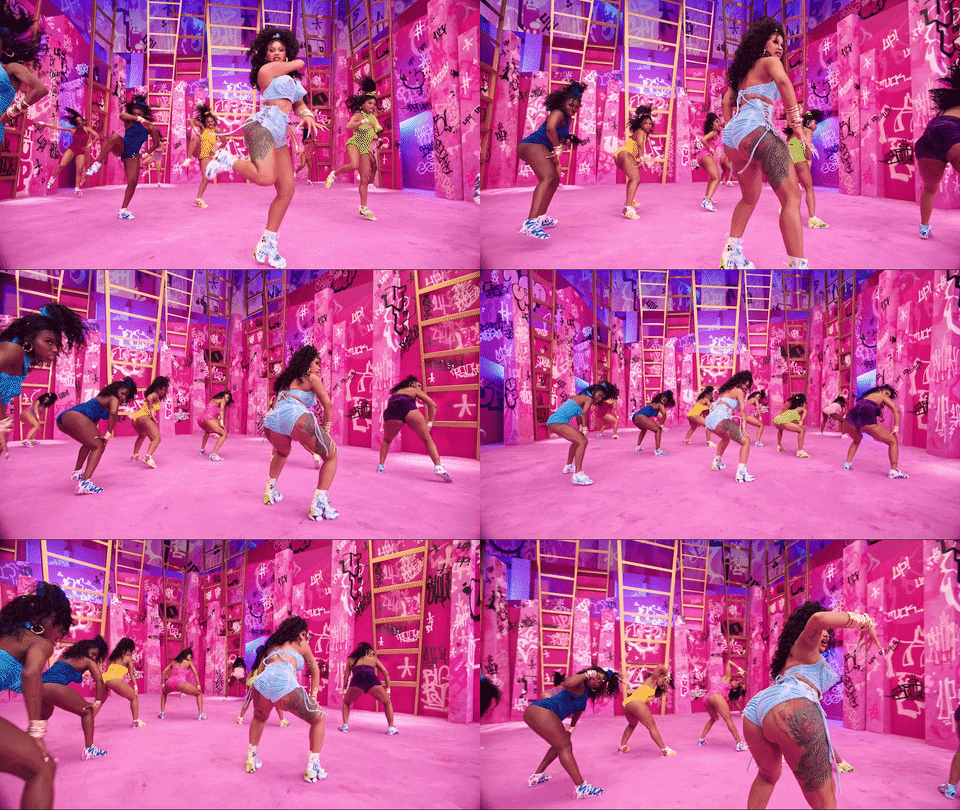 Bardi Gang GIF by Cardi B Giphy
However, some of the biggest challenges in hip-hop music lie in the lack of radical feminism in the genre that shows a vast display of Black women artists of every shade, size, and sexuality—without being hypersexualized. They all need to be seen and celebrated as a mass-market artist.
Over the last few generations, the evolution of hip-hop's purpose and sound has changed dramatically—mainly for mass production and consumption. That's expected because change is inevitable in every form of music, but hip-hop is unique. It was used to amplify the voice of the unheard and highlight systemic oppression related to race and class issues. However, its hypermasculine aspect has always made combating sexism one of the most complex areas to address and has posed a challenge to forging progressive, long-term opportunities for Black women rappers.
Hip-hop scholar Kylie Thompson states in the analysis, When Feminism Meets Hip-Hop, "Some female hip-hop emcees have been able to challenge the sexist culture of the industry and assert a black feminist voice; albeit the large-scale commercialization of hip-hop makes it especially difficult for women's voices to be heard in a political context that runs counter to pervasive patriarchal structures. Thus, women must carefully adapt, form, and manipulate language in order to make their music both marketable and political."
These circumstances have made it significantly more difficult for women rappers to compete in a market that could care less about women succeeding in it because a high percentage of the content is about objectifying them.
 Cardi B Megan Thee Stallion GIF by Recording Academy / GRAMMYs Giphy
 Black women emcees carry a different burden on their shoulders: to be Black, female, get the same opportunities as their male counterparts, and remain in high demand on the global charts. Black artists shouldn't just be the backbone to the sound. They should also be the face of the evolved sound.
This is a tribute to icons and holds them accountable so we can all show up better for all Black female hip-hop artists in the game, respectfully!
Let's take a deep dive into the evolution of hip-hop, amplifying the various forms of feminism throughout the genre's history, addressing hypersexuality, colorism, pretty privilege, and body positivity:
Black Feminism in Hip-Hop: Radical vs. Liberal
Before we can talk about the state of Black women artists in hip-hop, we must first broach the subject of feminism and the essence it carries in the music. Though every Black women artist isn't as intentional about being a feminist, most of the world automatically perceives them to be because of the lineage that several Black women iconic emcees started prior. There are two primary forms of feminism that are often conveyed in hip-hop; radical and liberal feminism, they are both needed, but the bigger question is whether they are both as appreciated by today's society.
Radical Black feminism came first because it was the only acceptable way to compete in the market with their male counterparts in the 70s. Hip-hop feminism centers Black women's voices via hip-hop as a means to increase agency, self-definition, and self-determination. Self-definition, according to scholar Patrick D. Bennett, refers to how Black women express their identities and experiences for themselves, while self-determination allows for Black women to choose who or what they want to be. In the documentary My Mic Sounds Nice: The Truth About Women and Hip-Hop, legendary hip-hop artist Roxanne Shantel said, "It wasn't about make-up or having outfits ready, I rapped in whatever I had on when I had a show or battle rap because it was about talent not looks."
In this timeframe of hip-hop, if you weren't a lyricist as a women emcee, you couldn't compete. And Black women rap artists like MC Lyte, Salt-N-Pepa, J.J.Fad, Queen Latifah, and the one-and-only Ms. Lauryn Hill, didn't hesitate to challenge sexism, addressing men and how they talk to or talk about women.
 Queen Latifah GIF by VH1 Hip Hop Honors Giphy
 Hip-hop thought leader Imani Perry has written about this struggle within the male-dominated field, stating, "As a masculinist form with masculinist aesthetics, hip-hop and the art form's masculinist ideals of excellence and competitiveness have often forced women to occupy roles gendered male."
And the freedom men have to be anything they want to be, and most of society enables them without question, isn't the same expectation that applies to women—who are more likely to get harshly criticized by society collectively.
As hip-hop evolved in the 90s, the sound changed dramatically from women hip-hop artists, and liberal feminism became more mainstream and left radical feminism a bit in the shadows of hip-hop instead of it being its main focus. Kylie further states that "liberal feminism boils down to individualism, positing the individual as the 'be-all, end-all of social life. This line of reasoning essentially aims to change or undo the socialization of individuals so that women can have and do what men can have and do." Liberal feminism brought forth undeniable individuality but took away from perpetuating social change and ignored the more significant issue of patriarchy.
In comparison, radical feminism addresses the collective issues the patriarchal system often looks away from. There is space for both radical and liberal feminism. But when it becomes too much of one versus the other, it often becomes detrimental to Black women rappers' progression in the industry.
 Booty GIF by Doja Cat
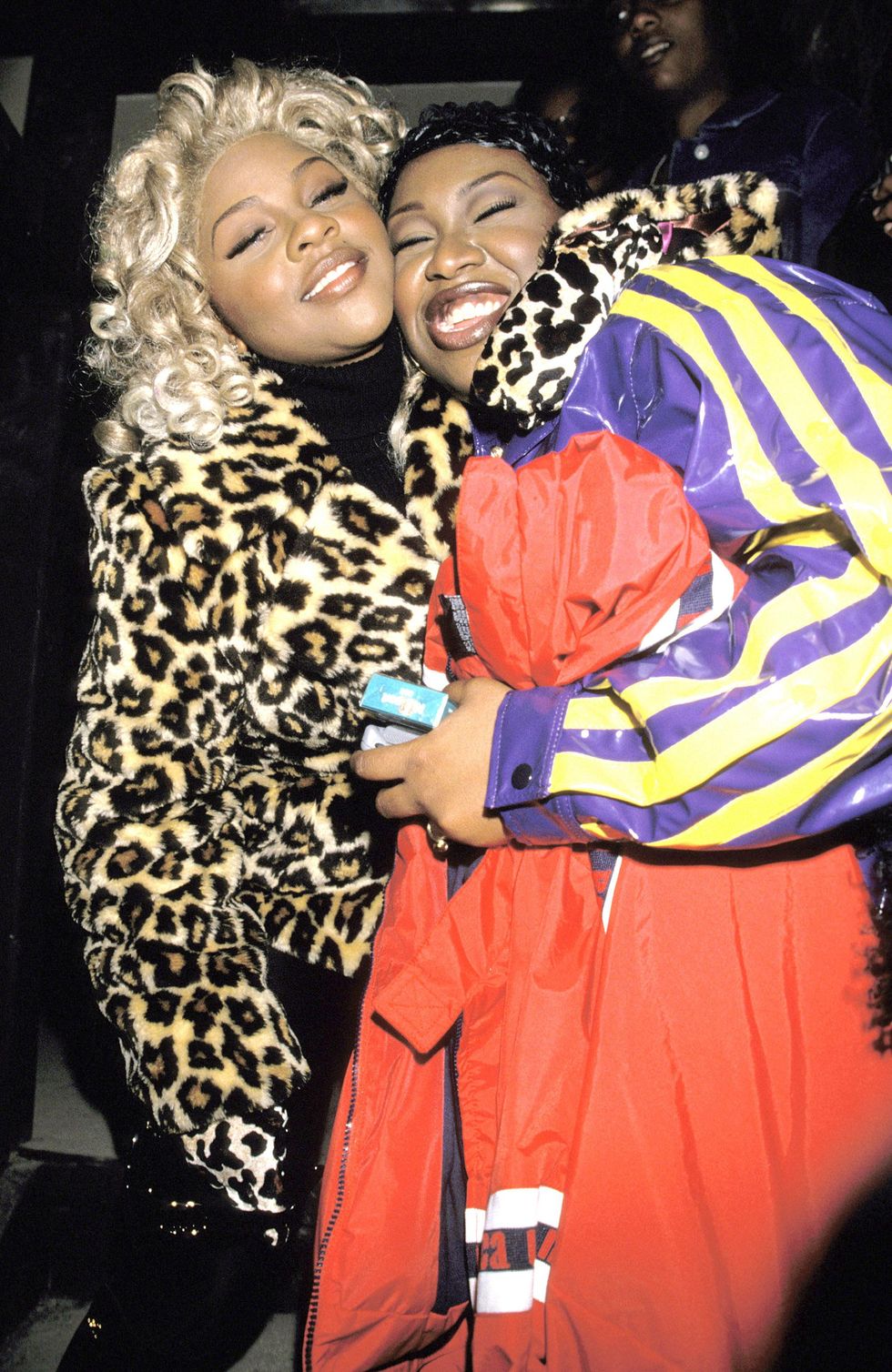
 Hypersexuality orchestrated by female hip-hop artists has become one of today's modern-day forms of feminism — to some, it may be an illusion, and to others, it may be perceived as power. The rise of liberal feminism exploring sexual liberation stemmed from the '90s with female artists Lil' Kim and Foxy Brown, both having an aligned rise in the industry that led to a divine royal battle. They brought unapologetic power to Black women's stance in hip-hop; both of them were phenomenal rappers that everyone wanted to listen to.
If you weren't listening to Notorious K.I.M., you were listening to Chyna Doll. But their sexualized stance also subconsciously brought a lot of pressure to other Black women artists in the industry.
In the documentary, My Mic Sounds Nice: The Truth about Women and Hip-Hop, Missy Elliott talked about feeling that "maybe I gotta go a little tighter to be sexy to be more acceptable," after Kim and Foxy took over the scene.
KMazur/WireImage via Getty Images
This changed the game entirely for women emcees and has made it a lot harder for radical women rappers to have a chance at success in mainstream hip-hop because most music today is being based on sexualization and very little content that speaks to the reality of the everyday woman.
Feminist writer Ariel Levy affirmed this further by saying that such a culture isn't progressive when women are capable of acting as participants of their own objectification. So we can't just blame men for objectifying us when now we are taking part in the same perspective to convince society that Black women rappers are enough and are as valuable to their male counterparts and that we'll agree to produce what sells most, delivering a homogeneous perspective of female dominance in today's hip-hop climate.
We have to be held as accountable as our male counterparts if we want to see sustaining change.
Communications studies professor-Jared Ball of Morgan State University wrote, "Today's contemporary hip-hop from women paves a space for these women, instead, to become the representative, as they have been increasingly able to compete and succeed with the men in the same genre. Regardless of artistic intent and the artist's desire to claim agency of their own bodies, these still may not exempt them from objectification."
So though Black women rappers are finally taking up more of the spotlight, their integrity is being challenged based on how they'd like to present themselves. Do all women in the game want to show more skin, or is it encouraged by people behind the lens of those scenarios?
 twerk good form GIF by Nicki Minaj Giphy
 To paint a picture of how powerful hypersexuality is in the industry, let's think of some of the most popular Black women rappers, Nicki Minaj, Cardi B, and Megan Thee Stallion. Though Minaj may be a bit more well-versed in the content she raps about, her biggest hits stem from the hypersexual lens. Lyrics like these featured in her song "Boss Ass Bitch":
P-p-p-pussy like girls
Damn, is my pussy gay?
It's a holiday, Play-With-My-Pussy Day
Pussy this, pussy that, pussy taken
Pussy ride dick like she a Jamaican
Pussy stay warm, pussy on vacation
You loose bitches need a pussy renovation
Y-y-you could eat it with a pussy reservation
P-p-pussy 'bout to get a standin' ovation
Clap, clap, clap for this pussy, nigga
The line, "But I can't give this pussy to a pussy nigga" depicts the imagery of manipulation and power plays gained through sex.
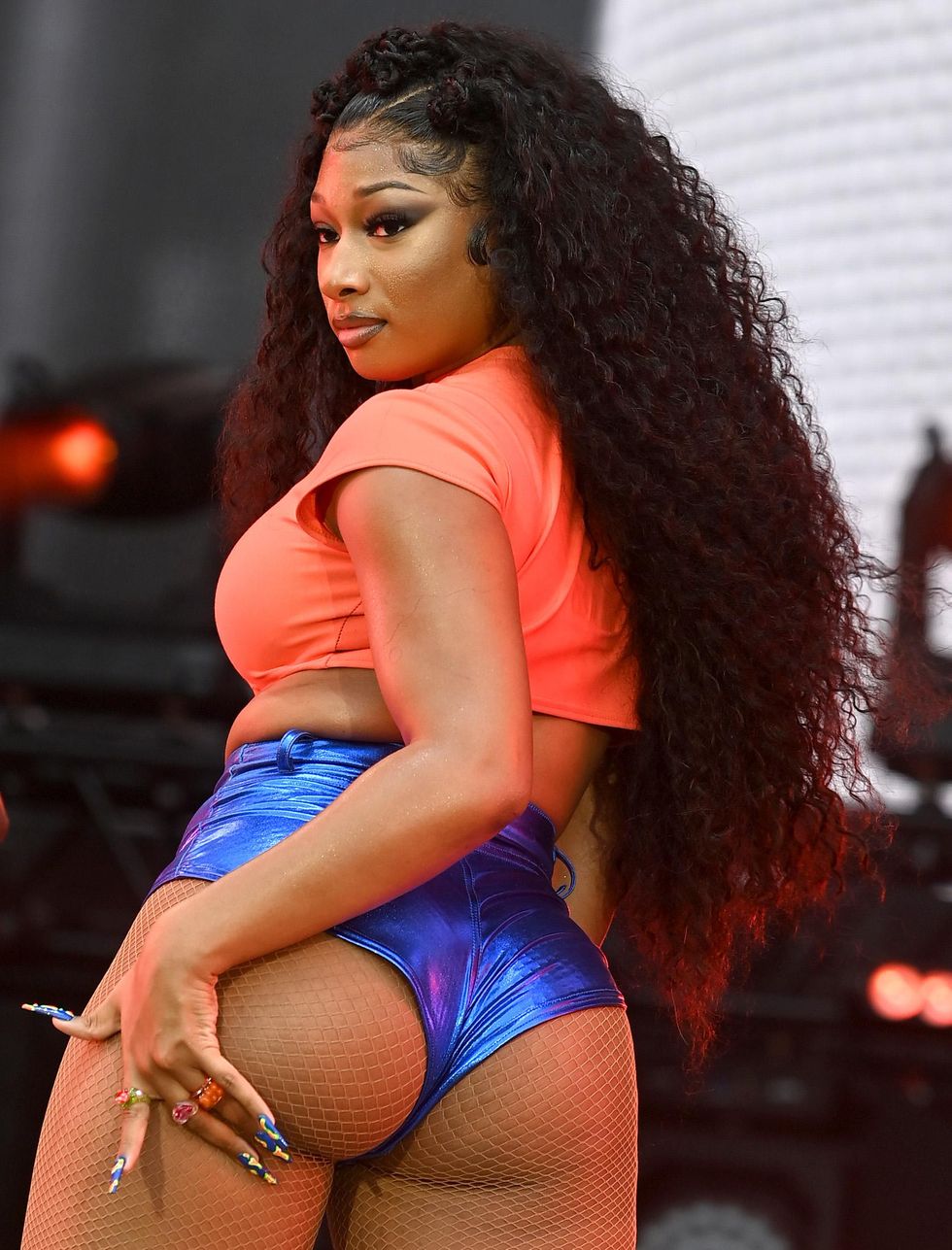
Most of Megan Thee Stallion's Billboard hits are all hypersexualized, from "Body," "Cry Baby," "Thot Shit," and "Savage," to "Hot Girl Summer."
In Stallion's song "Cry Baby," she raps:
Lay on my stomach, toot it up, do the crybaby (crybaby)
Look back, hold it open, now he annihilated (yeah)
Moaning like a bitch when he hit this pussy
Damn, he probably wanna wear my hoodie (ah)
Choke me, spank me, look at me, thank me (thank me)
If I give it to another nigga, he'll hate me (he'll hate me)
Spit, slurp, give him that work
Fell too fast for me, now the nigga hurt."
 Cardi B Booty GIF by Megan Thee Stallion Giphy
 And as a result of parading the excess liberal feminism, she was recently awarded three Grammys in 2021 for "Best New Artist," "Best Rap Song," and "Best Rap Performance"—so in more ways than one society is fully here for hypersexuality being the center of the conversation.
And Cardi B's Billboard hits like "Up," "WAP," "Wildside" have been in high demand based on the several weeks they stayed glued to the top 10 spots on the Billboard charts. So at this point, their success sets the mark for what's in demand from Black women artists compared to vice versa. Cardi B and Megan Thee Stallion's "WAP" came in at No. 2 on the staff's pick of the best rap songs for 2020, and it spent four weeks as the No.1 spot on the Billboard charts.
Then you have our good sis Nicki Minaj's "Anaconda," which spent 26 weeks at No.1 on the Billboard charts and perpetuates the image that appeals to mass audiences. Because of its success, this type of music will continue to be produced.
In that sense, liberal feminism supersedes the industry beliefs of radical feminism and its ability to sell. Sex sells, and songs about the collective do not.
Paras Griffin/Getty Images
The one-and-only Lauryn Hill's "Doo Wop (That Thing)," produced in 1998, was No. 1 on the Billboard charts for 22 weeks? The insanely talented and lyricist Missy Elliott still doesn't have a Billboard No.1 hit to this day, which is disheartening because of the impact she has had on hip-hop music, coming through with unmatched energy and bars as charismatic as any man or woman before or after her—yet it is not as valued collectively by music executives and society.
Where does the hip-hop industry allow women like Rapsody, Tierra Whack, Noname, Chika, and Little Simz the same opportunity to shine like most mainstream women artists that often project the homogeneous lens to thrive and compete in this highly ego-driven industry?
 Pretty Ugly GIF by Tierra Whack Giphy
 In many ways, we can't fully blame liberal women artists because they are trying to compete in a market that was never built for them, but the question is at what cost? Hip-hop scholars mentioned, "Many women have turned to claim or embrace their sexualities under the guise of true empowerment because they feel valued as a sexual object... But this liberal sexual empowerment, claiming the right to assert the individual agency to sexualize oneself, is only an illusion because the power given still comes from men and the male gaze."
And the biggest question of them all is why are most mainstream Black women artists light skin, bi-racial, or racially ambiguous, and the majority of the underground women rappers are dark skin women?
It's far from ironic that this is very much on script with the extensive history of colorism that affects Black women more than Black men in the music industry.
Colorism, Pretty Privilege And Body Positivity In Hip-Hop
Colorism to many ears may come off like a tiresome topic, but it's a very much-needed conversation in regards to dark skin Black women being misrepresented in the industry. And often, feelings of inadequacy crafted by colorist themes materialize in Black female rappers as well. Years ago, Lil' Kim spoke about her deep-rooted insecurities based on her complexion and body, leading to her extensive obsession with tons of cosmetic surgeries and skin bleaching.
Kim stated, "I have low self-esteem, and I always have. Guys always cheated on me with women who were European-looking. You know, the long-hair type, really beautiful women that left me thinking, 'How can I compete with that?' Being a regular black girl wasn't good enough."
Lil' Kim's struggle with being a "regular Black girl," and the apparent rejection of her Blackness by Black men even before entering the rap industry shows that America's European standards of beauty produce a proclivity for light skin by men and a lack of self-confidence in Black women, as seen in Lil' Kim.
 lil kim GIF by VH1 Hip Hop Honors Giphy
 With these European standards of beauty palpable in every part of the media and pop culture, its presence in rap is not nonplus. However, rap could change this narrative of "light is right." That toxic mindset and pretty privilege often co-exist in the hip-hop industry, allowing many individuals instant success if they fit a certain aesthetic. An interesting exception was when Saweetie went viral after she dropped her single "Icy Girl" and Hot 97's Ebro Darden didn't perpetuate the same narrative during an interview in February 2018. He described her freestyle as "basic" and mentioned she needed to work harder to "impress" him.
Regardless of his commentary, the bar is very low for certain female rappers to have easy access to success over their peers based on complexion. The industry is not as much fixated on thought-provoking lyrics and their impact. When you add the layers of additional intersectional walks of sexuality, particularly darker shades of women, and fatphobia–there is an inevitable amount of trauma and rejection to work through.
 2018 GIF by BET Hip Hop Awards Giphy
 Grammy-nominated artist Chika told The Root, "I am not the spokesperson for body positivity. I'm not the spokesperson for being dark-skinned. I'm not the spokesperson for having a nappy-ass dread head. I am none of those things. Stop asking me questions that you should figure out for yourself."
The reality is Black men aren't pressed because they are dark-skinned or wear their fades or cornrows, but Black women are often trolled for their Blackness, and the guidelines are incredibly rigid and overwhelming to maneuver through. It's like just being Black and a woman is a more significant problem.
When white women wear the same hairstyles and get the additional surgeries enhancements, it's edgy and glorified, but let a Black woman be herself, and it's a problem. In Lizzo and Cardi B's song "Rumors" the duo challenges stereotypes of their personal trauma of not ever feeling like they amount too much, Lizzo is tenaciously working through fatphobia commentary.
And Cardi B recently addressed rumors about her BBL and other surgeries to enhance her assets. The reality is, there have been underlying, deep-rooted issues in hip-hop that normalize the practice of artists suppressing their pain and insecurities.
This needs to be dismantled so Black women artists can have the space to not always feel like they need to take life-threatening measures for validation or to compete.
The Future For Black Women In Hip-Hop
 Saweetie Dojacat GIF by Trés She Giphy
 The moral of the story: We need the balance of both worlds—radical and liberal feminism. There is room for both conversations to be had; everything does not revolve around sex, we can also make space to address the other hundreds of topics that we face as women. The market is currently too fixated on one area over another. And it continually takes away many opportunities from radical artists and leaves women questioning their integrity regarding showing more skin than they're comfortable with to be competitive in this market.
Some of the things women mainstream rappers can do to help shed light on rappers opposite of them is to seek them out and propose a collaboration. Whether it be a single, being an opener at their show, or just promoting their work to change the narrative of there being only one main type of women rapper in today's hip-hop.
The world may have found ways to commodify the sound, but there is power in unity and sculpting a new art form of hip-hop music.
Featured Image via Giphy
- Saweetie Quavo Success - xoNecole: Women's Interest, Love ... ›
- The 'Fits You Missed From The 2021 BET Hip Hop Awards Red ... ›
- This Hip-Hop Medium Became A Self-Made Millionaire By Walking ... ›
- Meet The Hip-Hop Herbalist That's Merging Trap Music & Holistic ... ›
- History of Women In Hip-Hop - xoNecole ›