


6 Things To Consider Before Getting Into An Interfaith Relationship

Being that I am a marriage life coach, I often get asked if I subscribe to interfaith marriages. Well, being that I am also a Bible follower (not an evangelical by any stretch, but I do strive for discipleship—John 8:31-32), I have to take into account that the Bible has interfaith couples. One that immediately comes to mind is Boaz and Ruth. He was Hebrew, she was a Moabite—there you have it; an interfaith relationship. (By the way, if you read the story, you might change your tune about "I'm waiting on my Boaz."
If you want to be pursued, you're not waiting on a Boaz kind of man. Ruth—and Naomi—did a significant amount of the work in that love story. Check the records.) So were Moses and Zipporah and King Xerses and Esther. I think you get the gist. So no, I can't say, right off the rip, that interfaith relationships or marriages are "bad" or wrong.
Apparently, I'm not the only one to think that either. While in the United States, around 69 percent of married people say that their spouse shares their faith, there is a remaining 31 percent whose spouse does not; that number continues to climb too. As I did some additional digging around, I also discovered that while about one-third of all evangelical marriages end in divorce, that number jumps up to 50 percent if the union is an interfaith one. Also, if an evangelical marries someone who isn't religious at all, that divorce rate jumps to 62 percent. So clearly, although a lot of people are dating and marrying someone who doesn't share their faith, there are some risks that come with making the decision to do so.
That's why, if you're currently seeing someone who has a different faith than you or you're single and considering getting into an interfaith relationship, while it's not something that you should automatically write off, there are some things that you should think long and hard about before moving forward.
Is Your Goal Dating or Courtship?

If you're someone who "dates to marry", then this first point doesn't really apply to you. But since I know that there are a ton of people who can totally relate to articles like "Single Minded: So, What If You Like Dating But DON'T Desire Marriage?", that's why I thought this was a good starting point. While a lot of religious people, of any faith, feel that there is no need to date if you're not looking for something long-term, I know that some individuals do it for other reasons than to find a serious partner. Some people date in order to meet new people and gain fresh perspectives. Some people date simply because they enjoy the company of others. Some people date in order to figure out what they ultimately do want for their future. This is why it's so important to know why you do the things that you do. Are you dating simply to create some memories and have a good time in the moment? Or are you hoping that dating will turn into courtship (because no, dating and courtship aren't one in the same)?
I personally know of some couples who ended up breaking up because they did not ask themselves this question before getting into an interfaith relationship. Six months to a year in, they ended up coming to the decision that their different faith perspectives were too much to try and make their relationship go the distance. Feelings were deeply hurt because of it. This happens more than a lil' bit, so definitely ask yourself if you would go into an interfaith dynamic for casual reasons or, if it is long-term, if you are prepared to make some serious compromises in order to keep the connection intact (see "Interfaith Marriages Can Require Big Compromises").
Are Your Core Values and Principles Going to Be Compromised in Any Way?

Speaking of compromise, since I know that there are a lot of Christian women who support our site, and since I'm also aware of the fact that there are literally dozens and dozens of different denominations within the Christian "umbrella" (several sources say that there are around 200; you can cite that info here and here), it's worth mentioning that you can date a Christian but if they aren't apart of the same denomination as you, there can still be conflict. I've dated a Muslim before and honestly, when it came down to our core values and principles, we got along pretty well. Oh, but when I dated someone who was a Christian but wasn't the same denomination as I was—back when I was a part of one—pardon the pun but all hell broke loose. While we're here, please don't believe that non-denominational or interdenominational don't have strong denominational influences. I attended a "non-denominational church" for years but the influence was clearly what the first lady was—COGIC.
My point is this—when it comes to our core values and principles, if you're looking for the kind of relationship that is going to be long-term, you need to be with someone who complements both of those. How do you prioritize your career? How important is family to you? What are your views on sex? Where do you stand when it comes to political and social justice issues? What qualities do you value most in a relationship? What place do you give to boundaries and self-care? And yes, how important is religion to you? Don't assume that if you're Baptist who is dating someone who is Church of Christ or even is also Baptist that the relationship will automatically be smooth sailing. At the same time, don't assume that someone who is Buddhist or Bahá'í won't align with you in some unexpected ways.
The key is to know where you stand and then not to compromise on those things if you feel like you will be sacrificing the core of who you are in order to do so. At the end of the day, one of the articles that I read stated something that I agree with—"80% of those who are in an interfaith marriage believe that having similar values is more important than having a similar faith." Values over faith. Definitely not something that needs to be underestimated.
Will You Both Respect Each Other’s Beliefs?
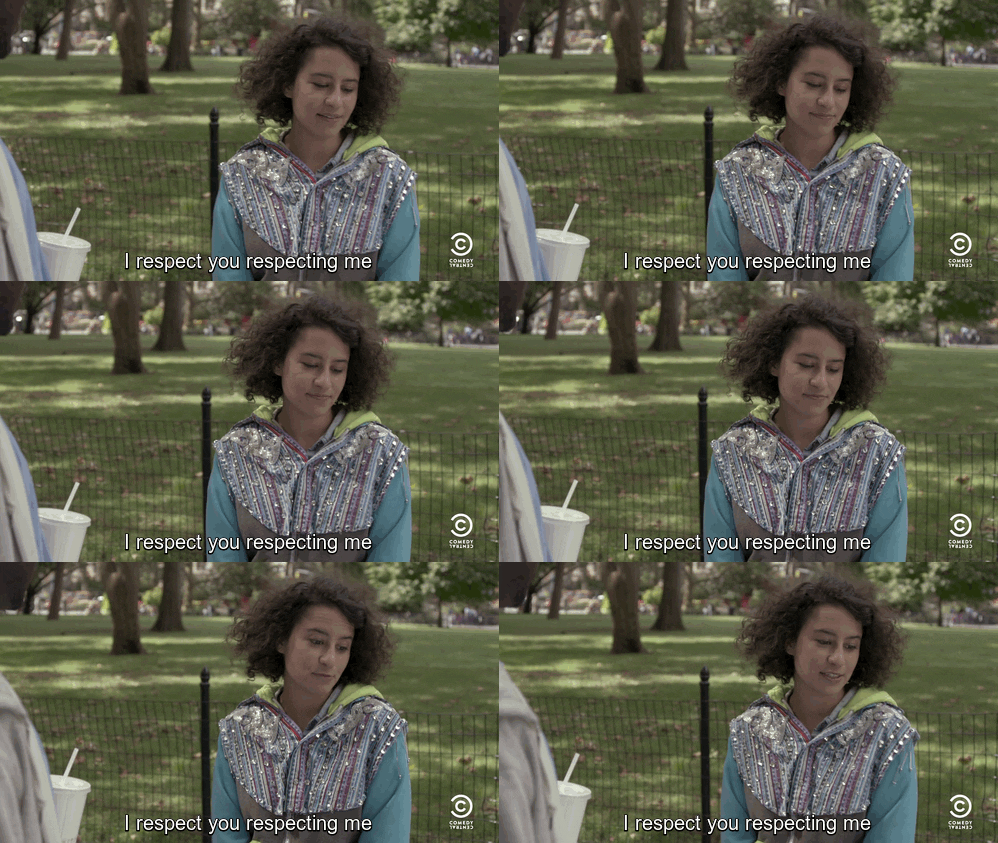
I won't lie. Some of my most heated discussions involve the topic of religion. Hmph. Don't even get me started on Kanye. See, I'm already triggered. It's cool to have people in my world who are Christian, Jewish, Muslim, Buddhist, Bahai, Catholic, agnostic, atheist—I've even had some interesting conversations with Satanists before (heads up—Satanists don't subscribe to worshipping Satan but self; a lot of people don't know that). The reason is they can provide insights and perspectives that 1) I've probably never considered before and 2) can help to either strengthen my own faith or compel me to do more studying and researching. Y'all, you can't end up coming to this conclusion if you don't respect the religious views of others—first.
If you're not hearing someone else out, you're being disrespectful. If you think you've got so much "truth" that you are condescending and patronizing (I am floored by how many people of one faith try and actually tell someone of another faith what that person's faith is all about instead of listening to them), you're being disrespectful. On the dating tip, if what you're actually doing is "missionary dating"—meaning, you claim it's dating but really what you're doing is trying to convert someone—you're being disrespectful. If all you seem to be able to do is see the good in your faith and the "bad" in someone else's, you're being disrespectful. If you're trying to invoke—or provoke—fear into someone in order for them to see things your way, you are being disrespectful. If you are flippant and dismissive about how someone else views God or a higher power, yep—you are being disrespectful.
I'll tell you what—if there is an irony that comes out of interfaith relationships, it's the fact that it has the ability to reveal to people if they are as "godly" and "loving" as they think that they are. Because if you are dating someone of a different faith and you are rude, offensive and intolerant—what kind of religion are you in? You might want to seek another one. Real talk.
If the Desire Is Marriage and Kids, How Will You Raise Them?

When it comes to this particular point, the person who immediately comes to my mind is Bill Maher. No matter what you think about him, if you're considering or are already in an interfaith relationship, I encourage you to watch (or re-watch) his documentary from back in the day entitled Religulous. Not only does it touch on some points that are definitely worth pondering, it also provides a great example for why I brought up this part of the article up. Bill? He had one parent who was Catholic and one who was Jewish. Geeze. I'm not sure if it gets more extreme than that, just on the Christ points alone. That's why I can see how he struggles with issues of faith, religion and spirituality; why he's always looking for contradictions. Just look at how his upbringing had its own set of 'em.
There are some people close to me who have two young children. The mother is a Christian and the father isn't; he doesn't really affiliate with any faith. That has caused some real challenges when it comes to how they see church-going, holiday observances and even how the home should function when it comes to gender roles, spirituality and a host of other things. When it was just the couple, while they were both a little irritated by a few differences in perspectives, it wasn't that big of a deal. Now that they are raising little humans, though, they are in counseling more than they've ever been.
Moral to the story. If you are already in an interfaith relationship and you are contemplating marriage, have some serious conversations about if you both desire to have children and, if so, how they should be raised. Don't be out here in la-la-land thinking that you'll just cross that bridge when you get to it. If you wait until then, you might end up with a child who is super confused (and perhaps also mad disinterested) when it comes to the issue of faith. Not because of faith itself but because of all of the contradictions they witnessed while growing up…in your household.
Do You Get That You Can Be “Unequally Yoked” Beyond One’s Faith?

The kind of Christians I know who think that an article like this is totally ridiculous, they tend to feel that way due to a Scripture in the Bible that says, "Do not be unequally yoked together with unbelievers. For what fellowship has righteousness with lawlessness? And what communion has light with darkness?" (2 Corinthians 6:14—NKJV) It's in the Scriptures, no question.
To that, I just want to present something for you to consider. Is an "unbeliever" only someone who doesn't share your religious perspective? Could it quite possibly also speak to someone who doesn't complement your life, in general? Could it be someone who actually doesn't believe…in you?
Sharing the same religious or spiritual beliefs with someone is important; there is no debating that. But Christians actually divorce more than any other faith in the world. And that kind of actually proves the point that I'm trying to make here. Don't be out here thinking that if you share the same faith with someone that you are automatically in sync with them. In order to walk together in a true partnership, make sure you are on the same page about if you believe in one another too.
Can You Truly Agree to Disagree?

Ask any married couple who has any real time under their belt and they're going to tell you that if you want to have peace in your household, there are going to be some things that you will simply need to "agree to disagree" on. And boy, no greater words could be spoken than when it applies to an interfaith relationship. Take the holidays, for example. I once interviewed a wife on the topic of interfaith unions. Because she was Jewish and her husband was Christian, Christmas used to be a nightmare in her house because she thought that celebrating the birth of what her faith sees as a prophet vs. what her husband sees as the Savior of mankind couldn't be more blasphemous. She said that she finally got OK with some of the things that her husband wanted to do, simply because of the peace and joy that his attitude brought into their home that time of the year. "Christmas irks me, but it's only for a day. I can deal with all of the hoopla for 24 hours."
If you want to make your own interfaith marriage work and last, this is the kind of attitude that you need to be prepared to have about a lot of things. Again, even if you are both in the same faith but are a part of different denominations. I am a Sabbath observer. Tons of the people I've dated go to church on Sunday. We both are Bible believers, but that one thing alone can still cause conflict. See what I mean?
As I bring this to a close, this final point is a great reminder that, in the midst of your pondering, keep in mind that if you are controlling, intolerant or impatient, an interfaith relationship is absolutely not for you. Because in order to make that type of relationship work and last, you need to be the opposite of each of those traits. You need to have faith that two different faiths have enough mutual love and respect to work through the differences. If you don't honestly believe that, it's a big world out here. Opt for someone who shares your faith—so that hopefully joy, peace and harmony will be at you and yours' foundation. After all, that should be the ultimate goal. Whether two people share the same faith—or not.
Want more stories like this? Sign up for our newsletter here and check out the related reads below:
If Your Man Is Missing These Things, Wait Before Marrying Him
The 'Pre-Commitment Interview' Every Dating Couple Should Have
How To Ground Yourself Spiritually
These 8 Scriptures Are Spiritual Game-Changers For Single Women
Feature image by Shutterstock
- Interfaith Relationships: The Path to Truth | Ghazala Hayat ... ›
- Ecumenical and Interfaith Marriages - For Your Marriage ›
- 7 Ways To Make Interfaith Relationships Work ›
- The Life Cycle of an Interfaith Relationship: Having a Baby ... ›
- Interfaith Marriage Mistakes You Need to Avoid ›
- 4 Questions Every Interfaith Couple Should Ask Before Getting Serious ›

This Is How To Keep 'Holiday Season Stress' From Infecting Your Relationship
Hmph. Maybe it’s just me, but it seems like there is something really weird happening in the fall season air (because winter doesn’t officially begin until December 21) that cuddle season is in full swing while break-up season is as well. In fact, did you know that break-ups are so popular during the holiday season that December 11 is deemed Break-Up Day?
The reasons why relationships shift around this time vary; however, I did both roll my eyes and chuckle when I read that a very popular one is because it’s an easy way to get out of getting one’s significant other a Christmas present. SMDH.
Anyway, I personally think that the less shallow folks out here may contemplate calling things “quits” or they at least distance themselves a bit from their partner (and what I’m referring to is serious relationships) due to all of the stress and strain that oftentimes comes with the holidays whether it be financial, familial, due to their tight schedules or something else.
Listen, I would hate for you and your man to miss the fun and happiness of experiencing this time of year, all because you are so overwhelmed or irritated that you can’t really enjoy it. That’s why I have a few practical tips for how to avoid allowing the typical holiday season stress from INFECTING your relationship.
Manage Your Expectations
GiphyUnmanaged expectations. If there is a main reason why the holiday season tends to be so stress-filled for so many people, I’d bet good money that this is the cause. And when you’re in a long-term relationship, expectations can manifest themselves in all sorts of cryptic and/or unexpected ways. You might have relatives who assume that you are going to be with them for Thanksgiving or Christmas when you have other plans in mind. You might be thinking that you are going to spend one amount for presents while your man is thinking something totally different. When it comes to scheduling, your signals may be crossed.
And you know what? To all of these scenarios, this is where clear and consistent communication come in. Don’t assume anything. Don’t dictate anything either. From now until New Year’s, mutually decide to check in once a week, just to make sure that you are both on the same page as it relates to the holidays and what you both are thinking will come along with it. The less blindsided you both feel, the less stressed out you will be. Trust me on this.
Set (and Keep) a Budget
GiphyOkay, so I read that last year, 36 percent of Americans incurred some type of holiday-related debt. Hmph. Last year, there was still some sense of normalcy in this country, chile, so I can only imagine what finances are gonna look like over the next several weeks. That said, since I don’t know a lot of people who don’t find being broke stressful, make sure that you and your bae set a budget and then stick to it this year — no ifs, ands or buts.
Because really, y’all — it doesn’t make sense to deplete savings and/or max out credit cards for a few days of giggles only to be damn near losing your mind because you don’t know how to make ends meet come Dr. Martin Luther King, Jr. Day.
And by the way, this tip doesn’t just speak to things like food and gifts; I also mean travel. If it doesn’t make a ton of sense (or cents) to be all over the place this year — DON’T BE.
Keep Matthew 5:37 at the Forefront
GiphyIf off the top of your head, you don’t know what Matthew 5:37 says, no worries, here ya go: “But let your ‘Yes’ be ‘Yes,’ and your ‘No,’ ‘No.’ For whatever is more than these is from the evil one.” That verse right there? Oh, it’s a boundaries lifesaver! I say that because do you see “maybe” or “I’ll think about it” in there? Nope. LOL. It says that you should tell people “yes” or “no” and leave it at that — and that complements Anne Lamott’s quote, “’No’ is a complete sentence” impeccably well. Yeah, you’ve got to remember that anything beyond a yes or no to a request is privileged information; you don’t owe anyone details or an explanation.
Besides, if you are really honest with yourself, when someone asks you something and you give a “Umm, let me think about it” kind of reply, more times than not, you already know what your answer is going to be — so why not let you both off of the hook? Give your response. Commit to that. And let everyone (including yourself) get on with their lives and schedules.
I promise you that when it comes to those holiday parties, you are pissing more folks off by not RSVP’ing or doing so and not showing up than just saying, “Thank you but not this year” off the rip.
Remember That Your Personal Space Is Privilege Not a Right
GiphyA friend of mine recently bought a new house and invited me over to come see it. He’s a single man with no children, so as I was taking in all of the space that he had, especially as I walked through his finished basement, I joked about relatives coming to live with him. “Hell no” and “absolutely not” were pretty much his immediate responses as he went on to say that some folks even had the nerve to be offended when he told them that he had no intentions on taking DNA in.
Ain’t it wild how people think that your stuff is their right? And yes, that brings me to my next point. Your home is your sanctuary space. If you want to host folks this year — cool. If not, ALSO COOL. Please don’t let folks (family included) guilt you into how they want you to act or even into what they would do if the shoe was on the other foot. You are not them — and as one of my favorite quotes states, “If two people were exactly alike, one of them would be unnecessary.” (A man by the name Larry Dixon said that.)
Hell, my friends? They know that I am good for sending them random things that they need or even want all throughout the year. Coming over to hang out at my pace, though. Uh-uh. Chalk it up to being a card-carrying member of the ambivert club yet I like keeping my living space personal — and I sleep like a baby, each and every night, for feeling that way.
Always remember that your space, your time, your resources, your energy and shoot, yourself period (including your relationship), are all things that are your own. You get to choose how, when and why you want to share them. The holiday season is certainly no exception.
Cultivate Some “You Two Only” Traditions
GiphyIt’s not uncommon for some couples to hit me up after the holiday season to “detox.” Sometimes it’s due to the financial drama (and sometimes trauma) that they experienced. Sometimes it’s because they allowed their relatives (especially in-laws) to get more into their personal business than they should’ve. More than anything, though, it tends to be because they didn’t get enough quality time together and so ended up feeling “disconnected.”
Please don’t let that happen. Listen, I’m not even a holidays kind of woman and yet, I will absolutely sit myself down with some hot chocolate and chocolate chip cookies to enjoy a Hallmark holiday film or two. Aside from the fact that most of them are lighthearted and sweet, I also like that they usually focus on couples loving on each other amidst all of the holiday beauty and ambiance — which is something that all couples should set aside some time to do.
Maybe it’s a vacation. Maybe it’s a staycation. Or maybe it’s my personal favorite, A SEXCATION. Whether it’s for a few days, the weekend or even overnight — don’t you let the holidays go by without setting aside time for you and your man to celebrate one another. Don’t you dare (check out “Are You Ready To Have Some Very Merry 'Christmas Sex'?”).
GET. SOME. REST.
GiphyI once read that 8 out of 10 people get stressed out over the holidays and 3 out of 10 lose sleep during to it — and when you’re stress-filled and sleep-deprived, that can absolutely lead to hypersensitivity, making mountains out of molehills and even not being in the mood for sex.
Your relationship can’t afford to go through any of this, so definitely make sure to prioritize rest. I don’t care how unrealistic it might seem during this time, sleep should never be seen as a luxury; it will always and forever be a great necessity.
That said, try to get no less than six hours of shut-eye in (check out “6 Fascinating Ways Sex And Sleep Definitely Go Hand In Hand”) and even ask your bae to take a nap with you sometimes (check out “Wanna Have Some Next-Level Sex? Take A Nap, Sis.”). Not only will sleep help to restore your mind, body and spirit but, when it’s with your partner, it’s an act of intimacy that can make you both feel super connected, even in the midst of what might feel like chaos.
___
Holiday season stress is real. Still, never give it the permission or power to throw your relationship off. Put you and your man first and let the holidays be what they are gonna be, chile.
Let’s make things inbox official! Sign up for the xoNecole newsletter for love, wellness, career, and exclusive content delivered straight to your inbox.
Featured image by Shutterstock
How To Avoid Being An Emotionally Impulsive Spender This Holiday Season
Geeze. Can you believe that we are just a few days out from another Christmas? Yeah, me neither. In fact, because I’m not a holidays person myself (check out “So, What If You Don't Observe Holidays?”), it wasn’t until one of my clients was venting about how stressed out she was due to all of the holiday season procrastinating that she had been doing that I realized just how fast December is actually flying by.
If, like her, you’re feeling frazzled because, although you told yourself last year that you weren’t going to wait until the last minute to “handle your business,” you ended up doing exactly that, fret not. I’ve got 10 tips that can keep you from making emotionally-triggered decisions as far as your financial expenses are concerned. Merry Christmas. #wink
1. Create a Budget. Stick to It.
GiphyBudgets, boy. I recently read that one of the reasons why they don’t work for a lot of people is because many folks don’t have a clue about how much money they spend on a monthly basis to begin with. SMDH. That said, at the end of the day, it’s important to remember that a budget is simply setting boundaries/limits on your spending — and being intentional about moving in this fashion is always a wise move; especially when it comes to this time of the year…especially being that it’s typical for half of all Americans to take on some type of holiday season debt with 17 percent needing six (or more) months to pay it off.
Know what can prevent this kind of financial chaos? A SPENDING BUDGET. Tips for how to create one of your own this year can be found here.
2. Never Shop When You’re Stressed or Pressed
GiphyYou know how they say that it’s not a good idea to go grocery shopping when you’re hungry? Although the holiday season can be a stressful time, avoid shopping for gifts (or décor or food for recipes) when you are feeling stressed out or pressed for time. More times than not, that cultivates anxiety which could cause you to either purchase things that you don’t really want or to spend money that you don’t really have (P.S. If you’re relying on credit cards, that qualifies as money that you don’t really have. Just sayin’).
3. Don’t Keep Up with the Joneses
GiphyKnow something else that can stress you out: trying to keep up with the Joneses. And y’all, now that we have social media, the reality is that envy is at an all-time high. That’s because it can be really easy to watch holiday engagements, holiday trips and folks bragging about the things that they’ve received in times past, only for you to find yourself wishing that you were them — or putting pressure on yourself and those in your world to keep up.
Listen, it is King Solomon who once said, “So are the ways of everyone who is greedy for gain; It takes away the life of its owners” (Proverbs 1:19 — NKJV) and “A sound heart is life to the body, but envy is rottenness to the bones” (Proverbs 14:30 — NKJV) and he’s considered to be the wisest man who ever lived (during his time — I Kings 4:30). Yeah, both of these verses are a spiritual reminder that whatever you are planning to do or give, do it out of the goodness of your heart — not so that you can low-key “outdo” the next guy.
4. No Need to “Tit-for-Tat”
GiphyThis one might be a bit controversial yet I’m totally okay with that. I don’t care what the occasion is, no one is OWED a present. A gift is a voluntary token of one’s appreciation or affection. That said, if you decide to give someone a present this year, don’t automatically expect something in return. If you get something, cool. If not, if you were giving for the right reasons, it really shouldn’t matter (RIGHT?). On the flip side, if someone decides to get you something and you don’t have something to offer in return, also cool.
Other than going to someone’s home for a holiday dinner or party, for anyone to feel like they should have something in hand because someone else does…that’s not giving, that’s competing — and that absolutely should not be the spirit that you are in (or around) during this time of year.
Again, a gift is not an obligatory thing. If you’ve always thought otherwise, it’s time to do some serious reprogramming.
5. Avoid the Pressure to Buy for Lots of Adults
GiphyLast month, Newsweek published an article that said it’s wise to not spend a ton of money purchasing gifts for adults. A financial expert in the piece said that it’s best to buy for kids because, more times than not, you’re going to get adults something that they already have a lot of, they don’t really need or they’re not going to use (beyond maybe regifting) anyway.
If you’re not feeling that insight, my take would be to exchange names and set a price cap for the grown folks. I say that because, I don’t think that people ever outgrow wanting something over Christmas. It’s just that the over-the-top energy should be reserved for the kiddies — and even then, the “4-gift rule” (want, need, read, experience) is probably your best bet for them…financially and otherwise.
6. Go for Thoughtful over Expensive
GiphyIt’s kind of wild how much close-to-torture folks send themselves through to purchase gifts that, a good 6-8 months now, most folks aren’t even going to remember. That’s why it’s also a good idea to purpose in your mind to get something thoughtful over expensive.
Honestly, that’s a big part of the reason why Etsy continues to be a go-to for gifts (for every occasion) for me. It’s because you can oftentimes get things customized/personalized which ends up meaning so much more to people than something that you bought at a generic department store that might have a high price tag yet still lacks in sentimentality and deep meaning.
7. Use Coupons and Promo Codes
GiphyCoupons (and promo codes) are a slippery slope in the sense that…they remind me of when I used to go overboard while thrift store shopping. I say that because, just because I might find several bomb dresses for under $20, what am I going to do with 50 of ‘em (over time)? It’s just as much of a waste of money as buying couture if neither option gets much use.
And that’s kind of the thing about coupons and promo codes. Some people end up overspending because they rationalize that so long as there are discounts attached, it’s all good. At the same time, this doesn’t mean that you should forego coupons and promo codes altogether. The key is to put together your shopping list (and budget) and then use discounts specifically for those items. If you do this, you could save well over $1,000 annually (at least, depending on what you decide to buy).
8. Avoid Add-Ons
GiphyYeah. Dodge add-on expenses. Add-ons like what? The first thing that comes to my mind is a warranty. What’s the chance that someone is actually going to need that? Another example is paying for things to be “professionally” gift wrapped. Chile, throw that stuff in a gift bag with some tissue paper and go on about your day. All good.
9. Rethink Gift Cards
GiphyIf there is any time of the year when there is a noticeable hike in gift card purchases, now would be it. And although they are a convenient approach to gift giving, at the same time, many come with hidden fees, the full amount oftentimes goes unused (which ends up being a waste of money) and they do come with expiration dates that are oftentimes forgotten.
So, if you’re someone who likes to wait until the last minute to do your holiday shopping, resist the urge to impulsively pick up a handful of gift cards. Unless it’s to a place that you know someone is going to use within the next few months, they could end up in somebody’s kitchen drawer for the next couple of years. And what a waste that would be.
10. They’ll Get It When They Do. And That’s Okay.

=
GiphyOne more. Although it is super thoughtful and proactive to get people their gifts in time for whatever occasion you purchased them for, if trying to reach that goal is going to require paying for rush shipping that is damn near as high as the price of gift or spending a lot of gas money that you don’t have at the moment to drive miles and miles away — take the pressure off to spend a ton of cash just to make sure that something arrives at December 25. Listen, through doing business with Etsy, I have learned that through this administration, there are all sorts of tariff issues going on and the USPS is slower than ever too, so paying more may not guarantee much.
The hack? Send a message that something special is coming…soon enough. The thought really is what counts (more times than not); plus, it builds anticipation of something good coming, even if it’s after all of the Christmas Day hoopla. And no one (with sense) is going to have a problem with that.
Now don’t you feel better? Happy Holiday Shopping, sis.
Let’s make things inbox official! Sign up for the xoNecole newsletter for love, wellness, career, and exclusive content delivered straight to your inbox.
Featured image by Shutterstock