




Question. Do you know what your triggers are? Before getting into that, do you know what a trigger is? I'm not trying to patronize you. I get that you understand what the basic concept of one is (something that is prone to irritate you at best, make you pop off at worst). What I mean is do you know where triggers stem from?
If you were to ask a psychologist to break it down for you, they'd probably tell that a trigger is something that is tied to past trauma. When you see, smell, or experience something in real time, it can lead to feelings like sadness, anxiety, or even anger because, whether consciously or subconsciously, it causes you to have flashbacks to when something or one, hurt or offended you.

For the past several months, something that I've been intentional about is deactivating my triggers. And you know what? It has been a total game-changer! Now that I'm able to pinpoint certain actions that totally piss me off (gaslighting, passive aggressiveness, and deflecting are some of my biggest triggers), not only has it helped me to be so much calmer in my day-to-day life, it's also helped me to know how to better handle people in both my personal and professional life. Because once you know where your triggers stem from and you recognize what certain common triggers are, you can stop giving your power away by reacting—or worse, overreacting—to things.
And just how do you train yourself to emotionally detonate certain triggers in your life? The first step is becoming aware of what certain triggers are (such as the list of really popular ones below). The next move is to heal the trauma (i.e., backstory) associated with your triggers. Finally, set firm boundaries with the people in your life who try to trigger—retraumatize—you. Even if that means leaving them completely alone.
What are some of the most common relationship triggers around? Let's name some:
7 Common Emotional Triggers In Relationships
1.Gaslighting
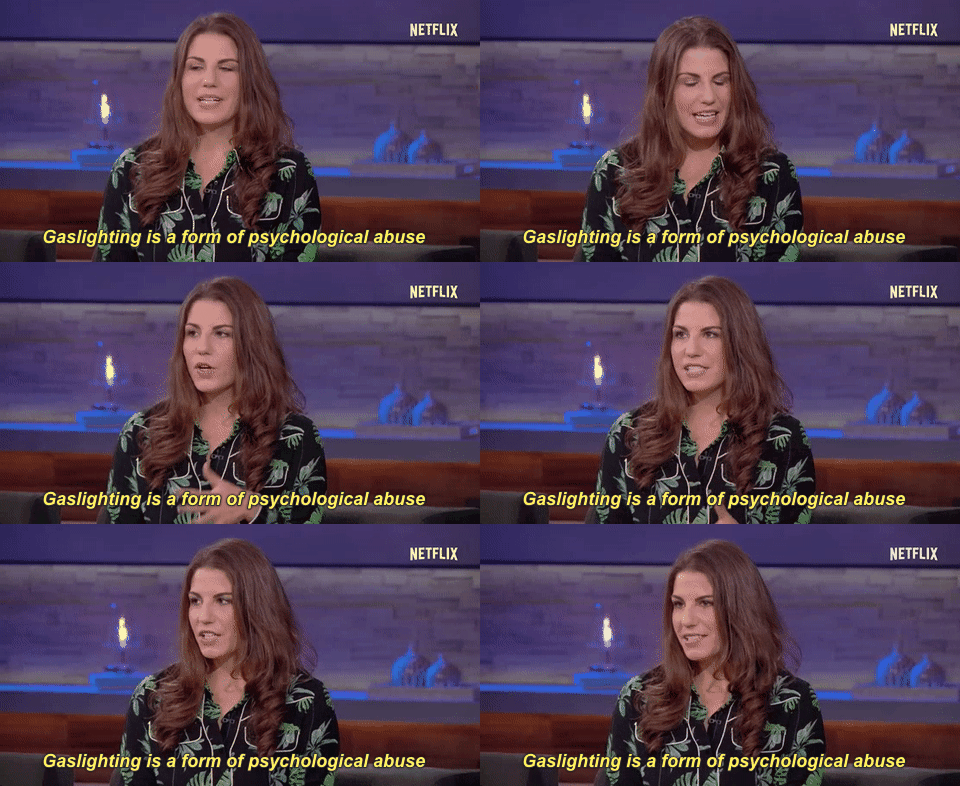
Just about all of us have had someone in our world who was so manipulative that we couldn't help but ask ourselves, "Wait a minute. Am I the one who is crazy here?" They are called gaslighters and they would have it no other way. Their objective is to get you to question your own sanity as it relates to them, even if you have proof and facts to back up your perspective on just how toxic they actually are.
How gaslighters do this is by lying and/or telling you that they didn't say something that you know that they did and/or saying one thing and doing something else (in other words, their words and actions don't add up) and/or insulting you and then complimenting you (they build you up to tear you down) and/or accusing you of things that you know you didn't do.
Basically, they make it their mission to keep you in a state of confusion and uneasiness so that you appear emotionally unstable. The more you question yourself, the more they can take advantage of you. Therein lies their power.
2.Love Bombing

Whew, chile. The love language of a true narcissist is love bombing. At first, they pour it on thick—compliments, gifts, dates, anything that will make you feel totally adored. Although it would be nice if they did that simply because you deserve it (and you do), their ultimate objective is to get you to feel like you need them as a source of love and affection. Then, once your guard is down, the puppet strings begin to come out.
Once you start to show signs of interest in anything or one more than them, they stop complimenting you and start berating you. Now you're the one who is selfish and not worthy of all of the love they are offering, so they pull away, hoping you will feel abandoned and alone.
What the heck does a narcissist (or any other kind of love bomber) get out of doing this? It's a form of "training" you. When you act the way they want you to act, you get rewarded. When you don't, you get criticized; perhaps even ghosted. Ugh. Just ugh.
3.Passive Aggressiveness

Getty Images
The silent treatment. Making excuses. Having a selective memory. Making you feel guilty for what they know is their fault. Not keeping their word. Stubbornness. Making simple things complicated. Playing the victim (when they are actually "the offender"). Living by the phrase "hurt people hurt people". These are all telltale signs of a passive aggressive individual. I personally don't know if I detest any trigger more.
A passive aggressive person doesn't like accountability nor do they want to accept responsibility for their own actions. Just recently, I confronted someone about something they did that was dead wrong. Their response was how much stress they were under at the time. We all have things to feel stressed about. It doesn't take away from us needing to follow through on what we said we would do (and at the very least, apologize when we don't).
If you've got folks in your life where you find yourself apologizing for what they did wrong (it happens more than you think), you've got a passive aggressive individual on your hands. No doubt about it.
4.Perspecticide

A healthy relationship—whether it's a romantic, platonic, or even a professional one—is going to celebrate the authenticity of who you are. They are not going to try and change you or get you to question your self-worth and value.
That said, if you're involved with anyone who doesn't make you feel very good about yourself (this includes them avoiding slick statements and backhanded compliments), if they create "rules" for how you are to be in your relationship with them (although you don't get to have any expectations from them at all) and/or if you somehow feel micromanaged all of the time—these are all indications that you are a victim of perspecticide.
It's not that what you are or aren't doing is wrong. It's that you've allowed someone to have so much power over your life that their perspective of you trumps your very own. (Scary, isn't?)
5.Trauma Bonding

One of my all-time favorite quotes is, "We're all looking for someone whose demons play well with our own." Creepy I know, but basically, it means that sometimes we're in toxic relationships and don't even know it. It's because what we have in common with certain individuals is our weaknesses, not our strengths.
Although this isn't the exact definition of trauma bonding, I personally believe it is a cryptic form of it. So, make sure that you're not connecting with someone simply because you can relate to one another's crap. If that's all you have going on, all you're doing is—as my mother puts it—emotionally throwing-up on each other. And making each other sick in the process.
As far as the clinical definition of trauma bonding, it's when you're caught up in the cycle of idealization, devaluation, and discarding with someone. They build you up, then they make you question your value, and then they discard you like you were nothing without rhyme, reason, or warning. But since the good times were so good, you sometimes let them do this to you on multiple occasions before finally breaking things off.
Why would someone put up with trauma bonding? Because they don't realize that's what's happening to them. But if someone in your life is always making promises they don't keep, if they give you the silent treatment when you displease them, if your friends are constantly telling you that you could do better than the foolishness you're tolerating with an individual and/or if you keep saying you know that you should leave BUT YOU DON'T—these are all signs that point to being in a trauma bond.
The bad times outweigh the good, but you stick around for the next cycle of good times anyway. That is trauma bonding at its finest. And ugliest.
6.Dismissiveness

A dismissive person is a disrespectful individual—point blank and period. If I were to think of someone who immediately falls into this category, ghosters would have to be one of them. Other examples include people who don't deal with confrontation well, folks who don't like to express emotion, individuals who choose to multi-task while you are trying to have a serious conversation with them, people who are vague when you ask direct questions—oh and commitment-phobes. Some trigger statements that dismissive people tend to make is "Are you still on that?", "When are you gonna get over it?" or "Just move on."
Personally, I think the most frustrating thing about dismissive people is they treat you and your emotions like they are disposable. Or like you are a human ACT test. I say that because some of you might recall how some preppers told us to take it—Scan, Select, Discard, Move On.
You are not a high school proficiency exam. Don't tolerate anyone treating you as such.
7.Deflecting

Giphy
Next to passive aggressiveness, deflecting is one of my other biggest triggers. I used to have a lot of deflectors in my personal space (I nipped that) and I see it quite a bit in marriage life coaching sessions too. It's basically when someone is wrong—dead wrong—but they try and find a way to get your mind off of it, oftentimes by changing the subject, pointing out that you do the same thing, or bringing up what they think is worse.
Example. You might say, "I really hate that you waste my time by always showing up late." A non-deflector would say something like, "I'm sorry. I'll work to get better at that." A deflector? They're gonna say something immature like (cue the nah-nah-nah-nah-nah voice), "You're late sometimes too" or worse, "Well, I hate that you cut me off when I'm talking."
OK. But if you hated whatever it is that I'm doing so much, why are you waiting until I bring up something that irritates me in order to discuss it? A deflector doesn't want to deal with their stuff. And it's really hard to be in a healthy relationship with anyone who refuses to face things head on.
8.LWS: Last Word Syndrome

Getty Images
I used to be this girl and I realize it was because, while growing up, I didn't feel like my voice was heard or respected very much. So, as an adult, I made sure that it would be—no matter how annoying this approach might've been.
About 9.5 times out of 10, a person who suffers from last word syndrome isn't even one-eighth as interested in what you have to say as what they've already said or what they plan on saying next. It's feeling like your insights and perspectives aren't respected or even appreciated that tends to be the source of your frustration while interacting with them. I get it but take it from someone who has gotten fully free from this—people who need to have the last word are insecure; they are still working through how to embrace the internal power that they have, both with and without a sounding board.
One of my favorite proverbs is, "Don't speak unless you can improve upon the silence." It's one of the best ways to handle someone with this particular syndrome. And once you call out all of these triggers—and trigger-ers—it's also one of the best ways to internally detonate how you react in the future to these kinds of people too.
Related Articles:
3 Warning Signs You're In Love With A Narcissist - Read More
Here Are The Dating Trends That You Need To Avoid At All Costs - Read More
Seven 2019 Dating Terms That You Should Definitely Be Aware Of - Read More
- Like, Love & In Love: How To Really Know The Differences - xoNecole ›
- 6 Ways To Tell Someone Is Gaslighting You - xoNecole: Women's Interest, Love, Wellness, Beauty ›
- Like, Love & In Love Meaning - xoNecole: Women's Interest, Love, Wellness, Beauty ›
- Signs Someone Is Gaslighting You - xoNecole: Women's Interest, Love, Wellness, Beauty ›
- What Exactly Is Toxic Masculinity? - xoNecole: Women's Interest, Love, Wellness, Beauty ›
- Breadcrumbing 2022 Dating Trend, What Is It? - xoNecole: Women's Interest, Love, Wellness, Beauty ›
- What Exactly Is Broken Heart Syndrome? - xoNecole: Women's Interest, Love, Wellness, Beauty ›
- 10 Phrases To Avoid Saying To Your Partner In Relationships - xoNecole: Women's Interest, Love, Wellness, Beauty ›
- 8 Different Types Of Relationships - xoNecole ›
- Get to Know the Signs of Trauma Bonding - xoNecole ›
- I Scream, You Scream: Finding A Voice After Trauma - xoNecole ›
- 5 Signs Your SO Respects Your Triggers, Because Your Mental ... ›
- Ask for feedback but first learn how to receive it — Quartz at Work ›
- Getting Comfortable with Discomfort: Relationship Triggers ›
- 14 Biggest Triggers That Arise In Relationships — And How To Deal ... ›
- If Your Relationship Triggers You, Here's Why... — Center for Soulful ... ›
- 9 Most Common Triggers for Bipolar Mood Episodes | Everyday Health ›
- Understanding Borderline Personality Disorder Triggers ›
- Releasing Emotional Triggers in Relationships - The Overwhelmed ... ›
- 5 Steps for Managing Your Emotional Triggers | Psychology Today ›
- What Are Emotional Triggers + Why You Need To Understand Them ... ›