
Back when I wrote my first book, I coined a phrase called "sexual misuse". Being that I went through quite a bit of sexual trauma while growing up, I thought it was important to find a way to separate the difference between sexual abuse (what was done to me) and sexual misuse (poor decisions that I made on my own). That phrase came back to my mind a few days ago as I read a term I had personally never heard of before—intimacy anorexia.
Before I get into what that is and how it can both affect and infect a couple's sex life, let me first say that I know quite a few women—including Black women—who have dealt with the eating disorder anorexia (although reportedly, bulimia tends to be more common within our community). I don't want to make light of how that affects so many and so, for the record, I just want to share that one definition of anorexia is "loss of appetite"; what we're going to explore today is how a loss of an appetite for intimacy can ruin sex overall.
With that being said, if you're also not familiar with the phrase intimacy anorexia, let me take a moment to explain signs of this "disorder", along with what you can do to address it if you happen to recognize some of these signs in your own relationship.
How Can You Know If You or Your Partner Has Intimacy Anorexia?
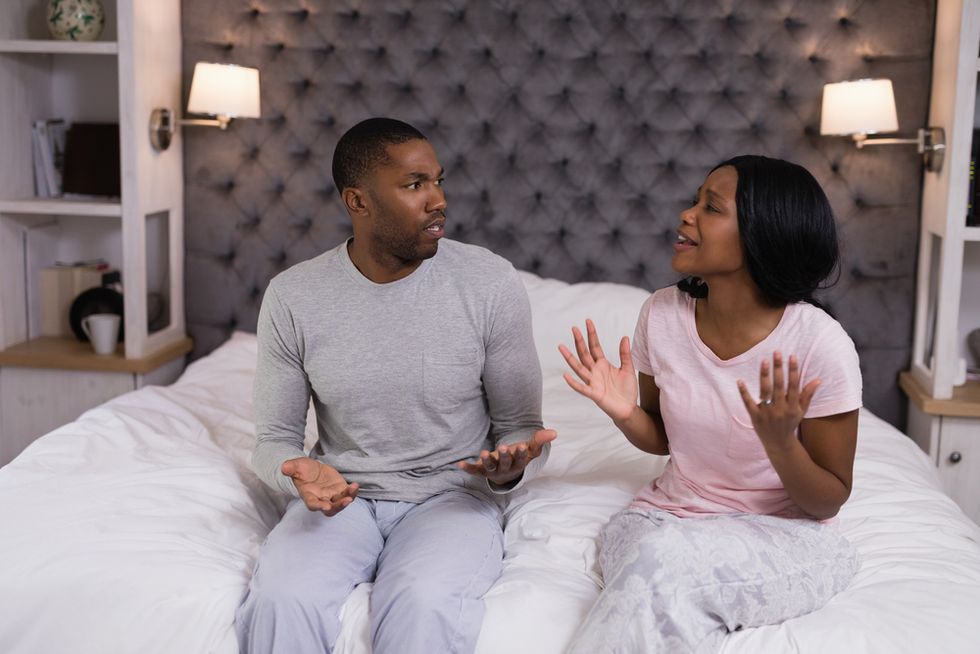
I gotta admit that when I did some research on who came up with this term and read some of the signs that are directly linked to intimacy anorexia, I immediately sent Dr. Douglas Weiss's site to a married couple I know. It's a husband and wife who has basically been in a sexless marriage for close to five years now (to be real, things weren't going all that well even before then). The reason why I thought the site would be helpful is because, two years before an affair (by the husband) transpired, there had still been no sex going on. And although I've shared with the wife that she might want to look into how that played a direct role in the infidelity, she still refuses to see it. To her, withholding sex isn't nearly as "bad" as infidelity. Meanwhile, I'm over here like, even the Bible says, "Do not deprive one another except with consent for a time, that you may give yourselves to fasting and prayer; and come together again so that Satan does not tempt you because of your lack of self-control." (I Corinthians 7:5—NKJV) Withholding sex deprives. Withholding sex tempts. Withholding sex ain't a good look—point, blank and period. A big part of the reason why is found in the word "withhold". Can anything healthy or beneficial be rooted in choosing to refrain from giving or granting sexual intimacy to your partner? Man.
The reason why I was so grateful to Dr. Weiss's breakdown is because it provides quite a bit of insight into how a couple can end up having sex less than 10-15 times a year (which is the textbook definition of what a sexless marriage is). According to him, this is how you know that you or your partner (if not both of you) are suffering from intimacy anorexia:
- You're too busy to make time for your spouse
- You constantly blame them for the problems in your relationship
- You refuse to express love in the way that your partner needs it
- You neglect to praise your partner so that they will feel respected and appreciated by you
- You consciously withhold sex and/or intimacy during sex
- You don't make it a point to spiritually connect with your partner
- You do not express your feelings with your partner
- You constantly criticize your partner
- You use money to either shame or control your partner
- Due to a lack of emotional bonding, you and your partner are basically like roommates
I must say that reviewing this list actually confirms what I once heard and totally believe—what goes on in a couple's bedroom sets the tone for what's happening in the rest of the house.
Because, think about it—if your partner doesn't make time for you, refuses to fluently speak your love language or is always on your back complaining about any and everything, why would you want to be sexual with them? And if they are treating you this way, doesn't it seem like they are sending not-so-cryptic messages that they don't want to be intimate with you either?
Now let me just say this, also for the record. If you just looked at the list of warning signs and thought to yourself, "well damn", don't write yourself off as having this disorder—one that the founder of it actually refers to as an addiction—just yet. For better or for worse, virtually all couples experience at least a couple of these red flags. According to Dr. Weiss, the way to know if it's full-blown intimacy anorexia or not is if you or your partner display five or more of these traits at the same time (you can confirm this by taking the only test here). If you do, that is somewhat of a cause for alarm.
The good news is knowing is half of the battle and there are things that you can do to start healing in this area.
Pinpoint What the Specific Issues Are. Then Discuss Them.
There's another married couple I know who've been together for well over a decade now. The wife says that they pretty much only have sex when she initiates it and, her husband sucks at foreplay. During an impromptu session with them, when I asked the husband what the deal was, he said that his wife's constant yelling and berating totally turns him off. Meanwhile, she said that the selfishness that she felt in the bedroom seemed to be pretty indicative of how he is towards her, period. Do you see what's going on? His ego is bruised and she is resentful. Who's having good sex in that kind of space?
So yeah, if you do recognize that you or your partner are experiencing some of the flags that I shared, it's important to not only acknowledge that with one another, but to try and see where these issues derived from. Then, be open and patient enough to listen to what both of you think can—and should—be done in order to remedy the matters at hand.
See a Therapist/Counselor/Life Coach
I watched T.I. and Tiny's Red Table Talk about their marriage. There is A LOT that I could say; for now, I'll just go with "good for them" when it comes to the fact that they went to counseling in order to save their union.
Personally, I don't think that married couples should wait until they're at the brink of divorce before they see someone. After all, it's one thing to get help when you smell smoke; it's another matter entirely to want someone to save your house when one-half of it is already burned to the ground. Yeah, I definitely believe that counseling should be treated like marital maintenance more than a last-ditch effort.
That said, once you and your partner have realized what the root of your intimacy anorexia is, sometimes that can make things worse, long before they start to become better. A professional can help the two of you navigate how to address your problems and also how to find real and lasting solutions. I know a lot of folks tend to give push back on counseling, but look at it this way—if you could handle things well on your own…they'd be handled. Right?
Work on Restoring Emotional Intimacy Before Revising Your Sex Life

Did you notice how the list of signs that point to intimacy anorexia only mentioned sex once? Things like a lack of a spiritual connection, feeling like you're roommates with your partner and not taking ownership for your own actions have nothing to do with physical intimacy; what they do speak to is how much of a mental and emotional breakdown that there is, though.
If there's a "loss of appetite" for sex itself, spend some time getting back to the basics in the sense of restoring your intimacy via going on dates, being affectionate without being sexual, affirming your partner, being supportive and yes—making them feel loved in the way they need to feel it vs. the way you wish to receive it from them. If you don't know what that way is, ask. A lot of drama can be avoided in a relationship if we'd stop being so busy thinking that we know more about our partner than they know about themselves.
One of the reasons why I'm grateful for insights like this one is, I can't tell you how many couples have tried to convince me that sexless marriages aren't "that bad" or aren't a "big deal". If you are in a long-term committed relationship, you're physically capable of having sex but you're not having it is—it is a big deal. Sexual intimacy is not to be treated as a perk; it should be seen as a necessary staple. Thanks to terms like intimacy anorexia, hopefully more sexless relationships can get to the root cause of their situation so that sexual intimacy can be restored.
If you're just realizing that intimacy anorexia is what you and/or your partner suffer from, it's nothing to be embarrassed about or ashamed of. Now you know more of where your loss of appetite is coming from; now you can start on your journey to getting your groove back. Give thanks. A really good thing just happened—to you and your relationship. It really did.
Want more stories like this? Sign up for our newsletter here and check out the related reads below:
The Signs Of A Truly Intimate Relationship
This Is How To Feel Emotionally Safe In Your Relationship
10 Wonderful Reasons Why Consistent Sex In Marriage Is So Important
10 Things Couples Who (Consistently) Have Great Sex Do
Feature image by Shutterstock
Did you know that xoNecole has a podcast? Subscribe on Apple Podcasts or Spotify to join us for weekly convos over cocktails (without the early morning hangover.)
- Get to Know the Signs of Trauma Bonding - xoNecole: Women's Interest, Love, Wellness, Beauty ›
- Why Writing Love Letters Is A Surefire Way To Revive Your Marriage - xoNecole: Women's Interest, Love, Wellness, Beauty ›
- How To Talk About Intimacy Issues With Your Partner - xoNecole: Women's Interest, Love, Wellness, Beauty ›
- Here's How Trauma May be Affecting Your Sex Life - xoNecole: Lifestyle, Culture, Love, & Wellness ›
- Sex Problems Ruining Sex And Possibly Your Relationship - xoNecole: Lifestyle, Culture, Love, & Wellness ›
- How Do You Manage To Make Time For Sex? Ways To Make Time - xoNecole ›
- Intimacy Anorexia - Characteristics, Treatments & Resources ›
- What's Intimacy Anorexia? ›
- What is Intimacy Anorexia? - The 10 Signs of Intimacy Anorexia and ... ›
- Intimacy Anorexia: Healing the Hidden Addiction in Your Marriage ... ›
- Intimacy Anorexia: The Workbook: Douglas Weiss, Ph.D ... ›
- Intimacy Anorexia - YouTube ›
- 7 Tell-Tale Signs Your Partner Has "Intimacy Anorexia" | Argie ... ›
- Intimacy anorexia - Wikipedia ›
- Doctors say 'intimacy anorexia' may be the leading cause behind ... ›
- What Is Intimacy Anorexia? | Heart to Heart Counseling Center ›

Exclusive: Viral It Girl Kayla Nicole Is Reclaiming The Mic—And The Narrative
It’s nice to have a podcast when you’re constantly trending online. One week after setting timelines ablaze on Halloween, Kayla Nicole released an episode of her Dear Media pop culture podcast, The Pre-Game, where she took listeners behind the scenes of her viral costume.
The 34-year-old had been torn between dressing up as Beyoncé or Toni Braxton, she says in the episode. She couldn’t decide which version of Bey she’d be, though. Two days before the holiday, she locked in her choice, filming a short recreation of Braxton’s “He Wasn’t Man Enough for Me” music video that has since garnered nearly 6.5M views on TikTok.
Kayla Nicole says she wore a dress that was once worn by Braxton herself for the Halloween costume. “It’s not a secret Toni is more on the petite side. I’m obsessed with all 5’2” of her,” she tells xoNecole via email. “But I’m 5’10'' and not missing any meals, honey, so to my surprise, when I got the dress and it actually fit, I knew it was destiny.”
The episode was the perfect way for the multihyphenate to take control of her own narrative. By addressing the viral moment on her own platform, she was able to stir the conversation and keep the focus on her adoration for Braxton, an artist she says she grew up listening to and who still makes her most-played playlist every year. Elsewhere, she likely would’ve received questions about whether or not the costume was a subliminal aimed at her ex-boyfriend and his pop star fiancée. “I think that people will try to project their own narratives, right?” she said, hinting at this in the episode. “But, for me personally – I think it’s very important to say this in this moment – I’m not in the business of tearing other women down. I’m in the business of celebrating them.”
Kayla Nicole is among xoNecole’s It Girl 100 Class of 2025, powered by SheaMoisture, recognized in the Viral Voices category for her work in media and the trends she sets on our timelines, all while prioritizing her own mental and physical health. As she puts it: “Yes, I’m curating conversations on my podcast The Pre-Game, and cultivating community with my wellness brand Tribe Therepē.”
Despite being the frequent topic of conversation online, Kayla Nicole says she’s learning to take advantage of her growing social media platform without becoming consumed by it. “I refuse to let the internet consume me. It’s supposed to be a resource and tool for connection, so if it becomes anything beyond that I will log out,” she says.
On The Pre-Game, which launched earlier this year, she has positioned herself as listeners “homegirl.” “There’s definitely a delicate dance between being genuine and oversharing, and I’ve had to learn that the hard way. Now I share from a place of reflection, not reaction,” she says. “If it can help someone feel seen or less alone, I’ll talk about it within reason. But I’ve certainly learned to protect parts of my life that I cherish most. I share what serves connection but doesn’t cost me peace.
"I refuse to let the internet consume me. It’s supposed to be a resource and tool for connection, so if it becomes anything beyond that I will log out."

Credit: Malcolm Roberson
Throughout each episode, she sips a cocktail and addresses trending topics (even when they involve herself). It’s a platform the Pepperdine University alumnus has been preparing to have since she graduated with a degree in broadcast journalism, with a concentration in political science.
“I just knew I was going to end up on a local news network at the head anchor table, breaking high speed chases, and tossing it to the weather girl,” she says. Instead, she ended up working as an assistant at TMZ before covering sports as a freelance reporter. (She’s said she didn’t work for ESPN, despite previous reports saying otherwise.) The Pre-Game combines her love for pop culture and sports in a way that once felt inaccessible to her in traditional media.
She’s not just a podcaster, though. When she’s not behind the mic, taking acting classes or making her New York Fashion Week debut, Kayla Nicole is also busy elevating her wellness brand Tribe Therepē, where she shares her workouts and the workout equipment that helps her look chic while staying fit. She says the brand will add apparel to its line up in early 2026.
“Tribe Therepē has evolved into exactly what I have always envisioned. A community of women who care about being fit not just for the aesthetic, but for their mental and emotional well-being too. It’s grounded. It’s feminine. It’s strong,” she says. “And honestly, it's a reflection of where I am in my life right now. I feel so damn good - mentally, emotionally, and physically. And I am grateful to be in a space where I can pour that love and light back into the community that continues to pour into me.”
Tap into the full It Girl 100 Class of 2025 and meet all the women changing game this year and beyond. See the full list here.
Featured image by Malcolm Roberson
There is a very specific reason why I decided to write this article before the holiday season officially gets underway. It’s because I once read a study that said it’s quite common for most Americans to double the amount of alcohol that they consume between Thanksgiving and New Year’s Day.
It makes sense when you stop to think about all of the holiday parties, time off, and moments spent with loved ones that transpire around this time of year. And while there is certainly nothing wrong with enjoying some mulled wine, real-deal eggnog, or peppermint martinis, because your health is something that never “takes a vacation,” I thought it was important to share with you some of the benefits (pros) and challenges (cons) that can arise from alcohol consumption.
My main motive? Mostly, I hope that it will serve as a solid reminder to embrace all of the things that you adore about this time of year, so long as you do it in moderation and you weigh the costs.
Especially as far as drinking alcohol is concerned.
PRO: Manages Blood Sugar Levels
GiphyHere’s something that you may have never seen coming. Were you aware of the fact that alcohol can actually help to stabilize your blood sugar? Yep, according to the American Diabetes Association, so long as you leave it to no more than 1-2 cocktails a day, alcohol may be able to lower your A1C levels. Pretty cool, right?
CON: It’s a Carcinogen
GiphyAlcohol is a carcinogen. The reason why this should somewhat alarm you is because carcinogens are things (like tobacco, UV rays, processed meats, etc.) that can increase your chances of being diagnosed with cancer (especially mouth, throat, esophagus, stomach and breast cancer). There are various ways this happens including the fact that alcohol, specifically, can hinder your body from breaking down certain nutrients, it can cause your estrogen levels to spike and alcohol can also cause certain toxins to damage your DNA and certain bodily proteins over time.
PRO: Cultivates Euphoric Feelings
GiphyIf you find yourself feeling more euphoric while you’re enjoying a drink, it’s not all up in your head. Although, for the more part, alcohol is considered to be a depressant, when consumed in small amounts, it can provide a stimulant effect. This happens due to the fact that when you first start to consume alcohol, it causes the production of the feel-good hormone known as dopamine to increase — and since dopamine makes us all feel more relaxed and confident while heightening our senses of pleasure too…well, there you have it.
CON: May Increase Anxiety/Depression
GiphyAs they say, “what goes up, most come down” at some point — and that is what you have to be careful of when it comes to alcohol consumption. For instance, when you drink alcohol, although it tends to initially cause your dopamine levels to uptick, because it is a temporary bodily response, sometimes the dips are lower than the rises…and that is when anxiety starts to kick in. A similar point is made with depression because oftentimes, people with depression-related symptoms, will use alcohol as a way to deflect from what’s really going on with them — and that can make them feel even worse than ever once the buzz of alcohol starts to wear off.
PRO: Has Some Heart-Related Benefits
GiphyWhen it comes to your heart, there are interesting findings surrounding its relationship to alcohol. For instance, some research states that, so long as the consumption is moderate, alcohol can actually help to increase the good cholesterol in your system while also breaking down proteins that can potentially lead to blood clots; both of these factors alone can reduce your chances of dying from heart disease.
CON: Packs on Pounds
GiphyIt’s no secret that alcohol tends to contain quite a few calories. That’s why, it’s not uncommon for people who’ve lost weight to mention “I’ve stopped drinking” as one of the causes for the shed pounds. That’s not to say that there aren’t some alcoholic beverages that have less calories than others including vodka (133 calories per serving), white wine (148 calories per serving) and tequila (99 calories per shot). Just keep in mind that the more you drink, the more calories get into your system and the more weight you stand to gain.
PRO: Lowers Inhibitions
GiphyAlthough you really should only be uninhibited around people who you absolutely trust, if that person is your partner and you’re looking to have a pretty — eh hem — active evening, alcohol can certainly help to make that happen. The science of it all is the prefrontal cortex of your brain is what regulates your inhibitions and levels of self-control. Meanwhile, alcohol suppresses your inhibitions which can cause you to be more spontaneous and open to trying things that you might not immediately do if you were sober. And with the right individual, that can be sexually beneficial (emphasis on “right person”).
CON: Makes It Harder to Orgasm
GiphyOn the other hand, as odd as it may seem (in light of what I just said), if you have too much alcohol in your system, it could make climaxing difficult. That’s because orgasms happen, in part, due to your nervous system being stimulated — and since alcohol is technically a depressant…well, it could reduce nerve sensitivity (especially as far as your clitoris goes) for you while making it challenging for your partner to remain erect or have consistent stamina. And yeah, that sucks.
____
‘Tis the season. And with that, if some wassails or hot buttered rums are in your immediate future — hey, don’t let me stop you — not even a lil’ bit.
All I’m saying is now that you know what alcoholic drinks have to offer (both ways), you can know exactly how to incorporate them into your holiday plans. Enjoy!
Let’s make things inbox official! Sign up for the xoNecole newsletter for love, wellness, career, and exclusive content delivered straight to your inbox.
Featured image by Unsplash