



The ability to advocate for oneself can be one of the greatest tools in our arsenal of personal and professional growth. For Black women in the corporate world, specifically, this is a unique rite of passage earned through speaking up on your behalf for promotions, negotiating salaries, or even overcoming workplace bias and discrimination. This process, though challenging, can reveal to us the inner voice that will serve as both a guide and champion for our upward mobility. Thankfully, women like Watchen Nyanue, founder and CEO of I Choose the Ladder, are creating space for Black women to find their voice in the workplace to climb the ladder of success on their own terms.
Watchen grew up in Liberia during a time of civil war and national unrest. From the ages of six to eight, she watched as her country was tugged between war and peace, exposing her to the worst of what the world could be, and ultimately reshaping her views on fear. "I think living through that trauma gave me an appreciation for life, but it took fear away from me. Life can be very fleeting, so I always tell myself, 'Why not just try it?'"
After her family emigrated to the US, music and television served as a guide for who Watchen saw herself becoming. Unlike most traditional immigrant households where becoming a doctor or lawyer is revered, Watchen's parents gave her the license to discover her passions and explore her skills outside of these trades. "My dad is an engineer, and because he understood what it took to become that, he would say, 'Go find what you want to do and be the best at that.'"

Courtesy of Watchen Nyanue
This freedom to explore granted Watchen the space to gain clarity on the purpose of her work and the legacy she would shape in the long run to impact women like her. Because of her tenacity and the relationships she built along the way, Watchen has a resume that extends from companies like Comedy Central, Johnson Publishing Company, and now serves as the Senior Vice President of the WNBA, Chicago Sky; one of the youngest Black women to hold that position.
Today, Watchen applies the wisdom she's gained in her professional career to her work as the founder of the career summit, The Climb, and career consulting company, I Choose The Ladder, which bridge the gap between ambitious Black women and the corporate elevation that awaits them.
"I love us for real. If you get us in position to win, we're always going to make sure that we all win."
On reshaping the Women’s Empowerment/Conference space and launching the Climb Summit.
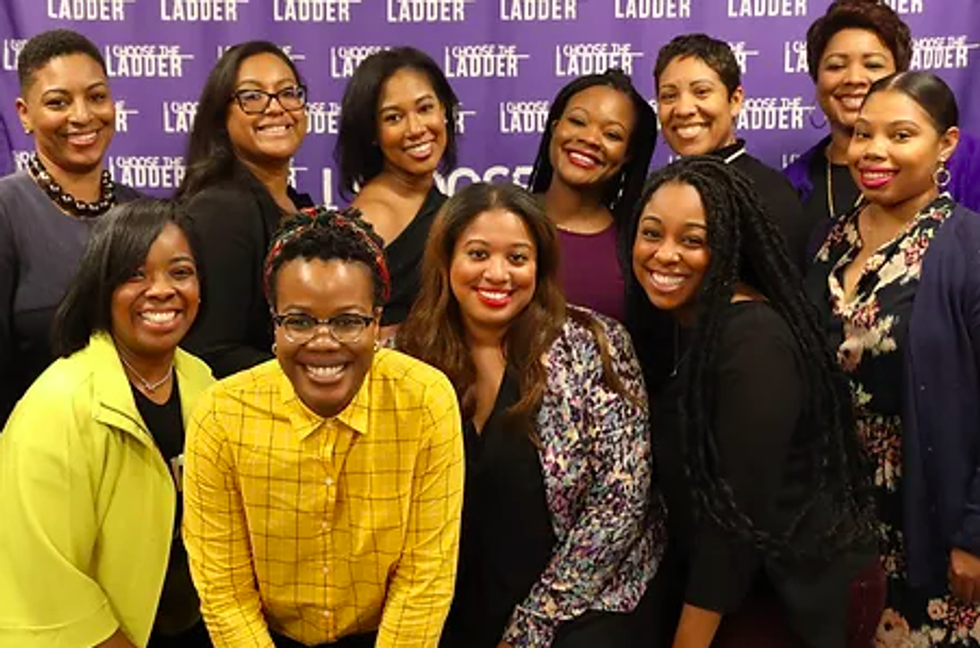
"For me, I tend to create what I need. If I need it, there are probably other people who need it too. There was a level of frustration that came with conferences. I'd receive all this information, but I don't know what the first step was to do with it. At the I Climb Summit, we take away all the fluff. We make sure we're intentional about the women who are leading and teaching and make sure they identify as Black women and feel comfortable talking about their journey as Black women because the challenges that we face are very unique to us. We don't need to see the highlight reel, we need to pull back the curtain a bit to show what it's really going to take to succeed."
Courtesy of Watchen Nyanue
"We don't need to see the highlight reel, we need to pull back the curtain a bit to show what it's really going to take to succeed."
On giving Black women the tools to advocate for themselves in the workplace.
"We launched our latest product, The Review Planner, because I feel like our annual reviews don't always get maximized. For me, it's always been about keeping receipts and having clarity around how my success is being measured. The planner helps you track your progress all year long so when it's time for your performance review, it's not your manager telling you what they think you did or you telling them what you remember, it's actual data that backs you up. It's your job to bring to their attention how much of a boss you are and what you bring to the table. If you don't find ways to infuse that into conversation with your managers, they may never know."
On how to navigate spaces when you’re the “only” in the room.
"My goal with I Choose the Ladder isn't to convince Black women to leave corporate, it's to make sure that once you do, you leave with as much as you gave. There's a price we pay to be in these spaces, so we need to make sure we're getting the benefits, which can't just be our title or salary because those things can be easily taken away.
"If you plan to be senior in any industry, most of the time, you're going to be the 'only'. But perspective matters: what do you want to get from the people in these rooms? Yes, it's going to be tough, but what reward do you want to receive for having to pay that price? Be very strategic about how you spend your time in these spaces."
"There's a price we pay to be in these spaces, so we need to make sure we're getting the benefits, which can't just be our title or salary because those things can be easily taken away."
On strategic networking and the power of building organic relationships.
"I have a solid squad of mentors and sponsors and everyone that I have, I found doing work -- whether on a committee or volunteering my time. So when they say 'be organic', don't put yourself in spaces because you have an ulterior motive. When you are engaged in the things that you care about, you tend to work harder, people see you as your best self, and you naturally gravitate towards each other.
"Another thing is, I have a natural curiosity about people; people are interesting. Ask folks about themselves, the books they're reading, the art in their office. It doesn't always have to be career advice. Figuring out your intercepting points of interest can take a lot of the pressure off and be a jumping-off point for a conversation that can lead to a relationship."
"When you are engaged in the things that you care about, you tend to work harder, people see you as your best self, and you naturally gravitate towards each other."
On denouncing shame around unemployment and how to pivot during a pandemic.
"If you're in this economy and find yourself unemployed, underemployed or just doing what you need to do to pay your bills, there's no shame in that. Give yourself some grace; it takes time to pivot. You can't control that you got laid off or if a company hires you. What you can control is how prepared you are for your interviews, how intentional you are about growing your network, and how much work you're putting into yourself to develop new skills for when, not if, that new role comes."
On the one piece of advice that shaped her the most in your career.
"Most of the things we fear never happen. And sometimes we don't try things because of fear of the unknown. Whenever I'm feeling uncertain about a decision, I do an exercise called, 'What if? What is?' I write out all my 'what if's' and in the 'what is' column, I balance it out with what's true. By the time you reach the end, you'll see that you've already handled a version of what you're afraid of. I tell people all the time that you have all that you need right now to do what you need, right now. Just trust the process."
To connect with Watchen, follow her endeavors on Instagram @ichoosetheladder, and tune into her podcast, I Choose the Ladder.
Featured image courtesy of Watchen Nyanue