
Depending on what side of TikTok you’re on, you’ve been seeing an uptick in content about the 4B Movement. In response to South Korea having the world’s lowest birth rate, TikTok user @denimchromosome gave a brief synopsis of the movement on February 16. “Korean women are so done with Korean men that they’re literally just deciding to die out," she said in her post.
Decoding the 4B Movement
While the video is only 30 seconds, this user broke the movement down to its essence and sparked a broader conversation for people to fully dive into knowledge about the movement and why some Korean women have decided to fully commit to this push for gender equality and social justice.
What Is the 4B Movement?
The 4B Movement gained notoriety and prevalence in 2019 when a collective of Korean feminists decided they would no longer marry men (비혼 bihon), have children (비출산 bichulsan), date men (비연애 biyeonae), or have sex with men (비섹스 bisekseu). The name of the movement came from all four agreements, starting with the letter B in Korean. The women who have chosen to participate in this movement are doing so as a result of the blatant misogyny that exists in their society.
They are challenging the cultural norms of their country by removing themselves from the dating scene, ignoring the beauty standards and consumerism propagated toward women, and calling out the pay disparity in the Korean job market.
Go Min Hee, a political professor at Ewha Women's University in Seoul, told NPR, "Gender gap in education has disappeared with the declining number of children and growing attention to education.” As of 2003, women’s college enrollment rates in the region have surpassed men’s.
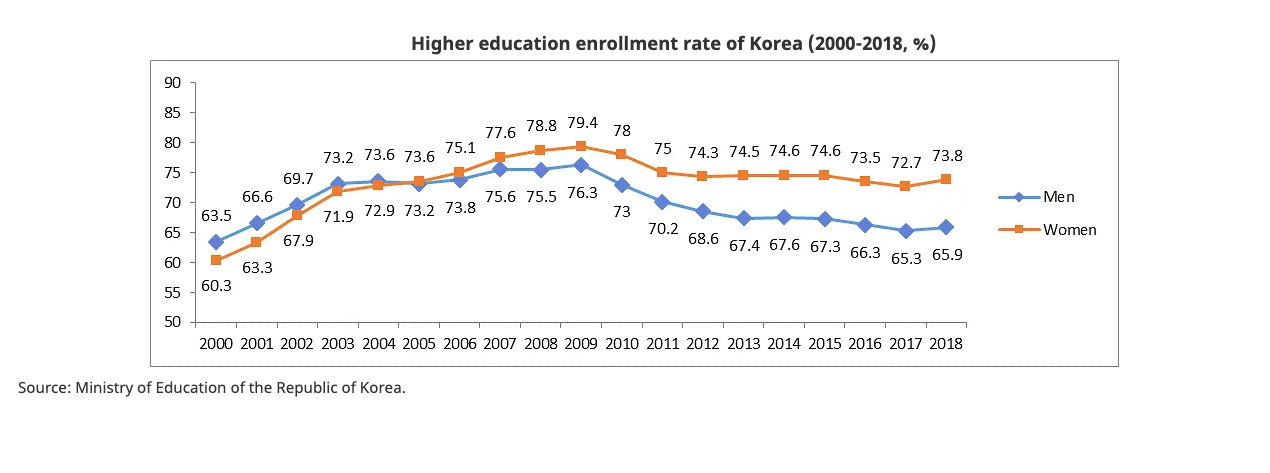
“But the income gap in the post-education labor market hasn't closed," she continued. South Korea has the largest gender pay gap in the developed world, as of 2022, women still made 31% less than their male counterparts.
In the same report, Jeong Han-Wool, head of the Research Institute of Korean People, shared “For a long time, patriarchal norms governed South Korean society. But those social norms dissolved with democratization, and I don't think we have established new norms that can fill the vacuum.”
Han-Wool said the 4B movement was ignited by the Me Too movement here in the U.S., which he said sparked a new wave of young feminists in South Korea.
While others don’t connect it directly to the movement, they do acknowledge that 4B emerged after multiple incidents of high-profile murders of Korean women, a rampant culture of revenge porn, and spy cam sex crimes were at an all-time high.
Additionally, there is blatant discrimination against women in the workplace; married women are often subjected to gender-based violence, and women are expected to take on the majority of household and child-rearing responsibilities.
The 4B Movement: Tackling Gender-Based Bias
sexual assaultDigital creator Ryan Carriger said, “Through amplifying the voices and the experiences of the movement, it can illuminate the far-reaching nature of gender-based bias and challenge the social structures that reinforce inequality.”
However, some, such as Anna Lee, have said that the Western media is sensationalizing this movement in South Korea. Despite the fact that reports from the country’s Ministry of Education support the quickly diminishing juvenile population, which many argue is a direct result of feminism. As of February 2024, 157 elementary schools throughout the country will have zero first graders. The lowest reported since the ministry began keeping records in 1970.
Likewise, because of the uptick in feminist voices, young men have shared their feelings of “reverse discrimination” and want the government to get rid of the Gender Equality Ministry in large part because it’s making the job market even more competitive.
Yet, this government entity focuses on more than career equity. One of its main purposes is to protect Korean women who are victims of gender-based crimes such as sexual assault and rape. Opponents of the government’s desire to dismantle this ministry believe it is a dangerous idea and will only lead to more harm toward women in the future.
As the online dialogue continues to build around the 4B Movement, many women from across the world are standing in solidarity with the women of South Korea. Some American women online are sharing a similar sentiment that they’ve already committed to the agreements of the 4B Movement in their personal lives without knowing it was associated with any deliberate social activism.
@wtfaleisa Replying to @user9720585462941 ♬ original sound - wtfaleisa
The 4B Movement: Decentering Men and Toxic Patriarchy
As many women’s studies scholars have found throughout history, to truly gain gender equality, you have to destabilize patriarchal systems and institutions. Activist, feminist, and author bell hooks once wrote, "Feminism is a movement to end sexism, sexist exploitation, and oppression. Decentering men is a central aspect of this movement." Judith Butler, a gender studies scholar, has further added that decentering men "does not mean erasing men or their experiences, but rather acknowledging that our social and political structures have been built around a narrow understanding of masculinity."
Yet, in true social media form, some of the discussions that are emerging online are demonizing, shaming, and insulting women who are choosing to distance themselves from men, that are collectively harmful to their overall well-being. Proponents of the movement are providing counterarguments to these videos.
Some people can’t seem to wrap their heads around the fact that there are women who would rather be single, have full autonomy over their bodies, and build a life that they want for themselves. Many naysayers of the 4B Movement are calling these actions misandry.
Carrieger disagrees with the notion that the movement is discriminatory against men and says, “Just as Black individuals have long fought against systemic racism and oppression, women have faced their own battles against gender-based discrimination and inequality.” He continues, “The 4B movement's call to challenge traditional gender roles and advocate for the empowerment of women reflects the struggle for equality that resonates within the Black community.”
The 4B Movement: Finding Common Ground for Social Justice
Historically, any oppressed group looking to gain equal citizenship in a society is always met with pushback, violence, shame, and blame. We saw it with America's civil rights and women's suffrage movements. We saw it with the anti-apartheid movement in South Africa and, most recently, with the women’s movement in Iran. This conversation could continue for hours upon hours, and the debates on whether women hate men could rage on for millennia.
The one piece of the conversation that some people are failing to address is that women, not only in Korea but globally, have decided they’d rather be single, child-free, and at peace than have to be subjected to constant trauma, discrimination, and abuse.
It goes without saying that not all men fall in line with patriarchal beliefs or disagree that there are toxic men in the world. However, this conversation is about a collective experience women around the globe share when it comes to their roles in a misogynistic world.
Even women who are in loving relationships and happy to be mothers have shared their understanding of why women would not want to have anything to do with men. Women standing up for themselves and not wanting to feel like second-class citizens isn’t an attack on men, but a call for them to be held accountable for their behavior, both past and present.
And for men to acknowledge that women play just as important a part in society as they do.
I’ll leave you with this quote from activist and scholar Angela Davis: "Decentering men is not about diminishing men or their contributions, but about recognizing that true liberation requires challenging all forms of oppression, including patriarchy."
This quote fully embodies the essence of the 4B Movement and similar movements that aim to decentralize men in our global society.
Let’s make things inbox official! Sign up for the xoNecole newsletter for love, wellness, career, and exclusive content delivered straight to your inbox.
Featured image by Delmaine Donson/Getty Images

Because We Are Still IT, Girl: It Girl 100 Returns
Last year, when our xoNecole team dropped our inaugural It Girl 100 honoree list, the world felt, ahem, a bit brighter.
It was March 2024, and we still had a Black woman as the Vice President of the United States. DEI rollbacks weren’t being tossed around like confetti. And more than 300,000 Black women were still gainfully employed in the workforce.
Though that was just nineteen months ago, things were different. Perhaps the world then felt more receptive to our light as Black women.
At the time, we launched It Girl 100 to spotlight the huge motion we were making as dope, GenZennial Black women leaving our mark on culture. The girls were on the rise, flourishing, drinking their water, minding their business, leading companies, and learning to do it all softly, in rest. We wanted to celebrate that momentum—because we love that for us.
So, we handpicked one hundred It Girls who embody that palpable It Factor moving through us as young Black women, the kind of motion lighting up the world both IRL and across the internet.
It Girl 100 became xoNecole’s most successful program, with the hashtag organically reaching more than forty million impressions on Instagram in just twenty-four hours. Yes, it caught on like wildfire because we celebrated some of the most brilliant and influential GenZennial women of color setting trends and shaping culture. But more than that, it resonated because the women we celebrated felt seen.
Many were already known in their industries for keeping this generation fly and lit, but rarely received recognition or flowers. It Girl 100 became a safe space to be uplifted, and for us as Black women to bask in what felt like an era of our brilliance, beauty, and boundless influence on full display.
And then, almost overnight, it was as if the rug was pulled from under us as Black women, as the It Girls of the world.
Our much-needed, much-deserved season of ease and soft living quickly metamorphosed into a time of self-preservation and survival. Our motion and economic progression seemed strategically slowed, our light under siege.
The air feels heavier now. The headlines colder. Our Black girl magic is being picked apart and politicized for simply existing.
With that climate shift, as we prepare to launch our second annual It Girl 100 honoree list, our team has had to dig deep on the purpose and intention behind this year’s list. Knowing the spirit of It Girl 100 is about motion, sauce, strides, and progression, how do we celebrate amid uncertainty and collective grief when the juice feels like it is being squeezed out of us?
As we wrestled with that question, we were reminded that this tension isn’t new. Black women have always had to find joy in the midst of struggle, to create light even in the darkest corners. We have carried the weight of scrutiny for generations, expected to be strong, to serve, to smile through the sting. But this moment feels different. It feels deeply personal.
We are living at the intersection of liberation and backlash. We are learning to take off our capes, to say no when we are tired, to embrace softness without apology.
And somehow, the world has found new ways to punish us for it.

In lifestyle, women like Kayla Nicole and Ayesha Curry have been ridiculed for daring to choose themselves. Tracee Ellis Ross was labeled bitter for speaking her truth about love. Meghan Markle, still, cannot breathe without critique.
In politics, Kamala Harris, Letitia James, and Jasmine Crockett are dragged through the mud for standing tall in rooms not built for them.
In sports, Angel Reese, Coco Gauff, and Taylor Townsend have been reminded that even excellence will not shield you from racism or judgment.

In business, visionaries like Diarrha N’Diaye-Mbaye and Melissa Butler are fighting to keep their dreams alive in an economy that too often forgets us first.
Even our icons, Beyoncé, Serena, and SZA, have faced criticism simply for evolving beyond the boxes society tried to keep them in.
From everyday women to cultural phenoms, the pattern is the same. Our light is being tested.

And yet, somehow, through it all, we are still showing up as that girl, and that deserves to be celebrated.
Because while the world debates our worth, we keep raising our value. And that proof is all around us.
This year alone, Naomi Osaka returned from motherhood and mental health challenges to reach the semifinals of the US Open. A’ja Wilson claimed another MVP, reminding us that beauty and dominance can coexist. Brandy and Monica are snatching our edges on tour. Kahlana Barfield Brown sold out her new line in the face of a retailer that had been canceled. And Melissa Butler’s company, The Lip Bar, is projecting a forty percent surge in sales.

We are no longer defining strength by how much pain we can endure. We are defining it by the unbreakable light we continue to radiate.
We are the women walking our daily steps and also continuing to run solid businesses. We are growing in love, taking solo trips, laughing until it hurts, raising babies and ideas, drinking our green juice, and praying our peace back into existence.
We are rediscovering the joy of rest and realizing that softness is not weakness, it is strategy.
And through it all, we continue to lift one another. Emma Grede is creating seats at the table. Valeisha Butterfield has started a fund for jobless Black women. Arian Simone is leading in media with fearless conviction. We are pouring into each other in ways the world rarely sees but always feels.

So yes, we are in the midst of societal warfare. Yes, we are being tested. Yes, we are facing economic strain, political targeting, and public scrutiny. But even war cannot dim a light that is divinely ours.
And we are still shining.
And we are still softening.
And we are still creating.
And we are still It.

That is the quiet magic of Black womanhood, our ability to hold both truth and triumph in the same breath, to say yes, and to life’s contradictions.
It is no coincidence that this year, as SheaMoisture embraces the message “Yes, And,” they stand beside us as partners in celebrating this class of It Girls. Because that phrase, those two simple words, capture the very essence of this moment.
Yes, we are tired. And we are still rising.
Yes, we are questioned. And we are the answer.
Yes, we are bruised. And we are still beautiful.

This year’s It Girl 100 is more than a list. It is a love letter to every Black woman who dares to live out loud in a world that would rather she whisper. This year’s class is living proof of “Yes, And,” women who are finding ways to thrive and to heal, to build and to rest, to lead and to love, all at once.
It is proof that our joy is not naive, our success not accidental. It is the reminder that our light has never needed permission.
So without further ado, we celebrate the It Girl 100 Class of 2025–2026.
We celebrate the millions of us who keep doing it with grace, grit, and glory.
Because despite it all, we still shine.
Because we are still her.
Because we are still IT, girl.
Meet all 100 women shaping culture in the It Girl 100 Class of 2025. View the complete list of honorees here.
Featured image by xoStaff
Someone's Trying To Hook You Up? Ask These 6 Questions First
As we all know, it’s cuffing season. We’re also on the cusp of the holiday season, and that happens to be the time of year when a lot of people get engaged. And that’s why the fall and winter seasons are the times of the year when folks wanna play matchmaker.
And so, sis, if at least one person in your life is currently trying to set you up with someone they know right now — charge it to it being “tis the season” more than anything else. Because let’s be real — folks tend to be more lovey-dovey than ever right about now, and that is usually what inspires them to try to get as many people boo/bae’d up as possible. Chile…CHILE.
It’s not like it has to be a bad thing. In fact, studies say that somewhere around 15 percent of engaged couples actually met through a friend. All I’m saying is, before you entertain someone’s “I’ve got someone I want you to meet” invitation, it would benefit you to interview them first — for the sake of all parties involved.
The questions that I recommend asking? The following six are what I think can get everyone on the same page, so that there is more pleasure than regret from the hook-up attempt.
1. Why Are They So Invested?
GiphyTwo things that I recently watched over again are the series Survivor’s Remorse (the writing is so damn good) and a movie called Trapped in Temptation (both are currently on Tubi). Something that both of them made me think about is the fact that motive reveals a lot when it comes to why people say and do the things that they do.
When it comes to the movie, specifically, without giving the film away — let me just say that, if you are in a relationship, be really careful about listening to individuals who try to talk you out of maintaining it. More times than not, the motive is shady as hell. And honestly, sometimes people who are close to obsessed with you being in one deserve a bit of side-eye too.
Now, if it’s someone who loves all things love, they are in love and they want you to experience something similar — that’s sweet. Just make sure that they are approaching the set up from a healthy space. What I mean by that is they don’t see singleness as some sort of relational handicap or they aren’t trying to override what you want for your life as if they somehow know better (there are so many ways to be a control freak, y’all).
Hmph. Now that I think about it — make sure that the set-up crew isn’t trying to use you to “save” some male friend or relative of theirs. I say that because I once knew a mother whose son had — count ‘em — 10 kids and she was FOREVER trying to get me to date him. Girl, that wasn’t for me. She was looking for a Holy Ghost Jr. for that child of hers. I’ll pass. HARD PASS.
Bottom line with this one — if someone wants to set you up with someone else, the first thing to ask is why? Make sure to really listen to what their answer is. Then pay attention to if your mind, body and spirit are at peace with their answer(s).
2. Do They Know What You Want?
GiphyI don’t know about y’all, but the people (and let’s be honest, by far, it’s usually women) who have tried to set me up with someone? They didn’t even know what my preferences or type was. Hell, they didn’t even know my thoughts or timeline as it relates to being in a serious relationship were either. And what that boils down to is they were trying to hook me up based on their agenda, not mine — and that usually meant that the guys who they came up with? Yeah…I was good on them. LOL.
Yeah, if someone wants to hook you up, you definitely should ask them if they know what you are looking for in a guy when it comes to his looks, personality, passions, spirituality, relational desires and goals, location, etc. Because, indeed, what is the point in going out with someone who is fine as hell and yet, you want kids and he doesn’t (or vice versa) or who has a great personality yet he isn’t even in the same ballpark of your spiritual beliefs?
If your friend really wants to help you out, valuing your time should come with that — and that means bringing someone into your life who complements your lifestyle. No wiggle room here.
3. Are They Aware of Your Deal-Breakers?
GiphyLast year, I wrote an article for the platform entitled, “Should Bad Sex Actually Be A Relationship Deal-Breaker?” The thing that I think needs to go on record about deal-breakers is they aren’t exactly standards that you have. No, a deal-breaker is something that can’t be worked out even after trying to negotiate or compromise. When it comes to relationships, a deal-breaker might be how long two people should date before becoming exclusive or getting engaged. Another deal-breaker might be if being religious is more important than being spiritual and how that manifests itself (church or no church, etc.). And yes, another deal-breaker may be what each other’s sexual needs and expectations are.
When someone is setting you up, it is imperative that they know about your standards. For instance, for me, I am not interested in dating a divorced person, pretty much ever (I Corinthians 7:10-11). I’ve had friends who have tried to hook me up with that demographic before and it has always been a moot effort. The fact that some of them have gotten frustrated with my convictions has absolutely nothing to do with me. Some have tried to get me to compromise my deal-breakers too — like a long-distance relationship. Is it a firm “naw”? No. However, it’s not really something that I am interested in, so why not just…recommend someone local?
Yeah, if someone thinks that they know you well enough to hook you up, they absolutely should be well-versed in what your deal-breakers are before they do. And if they’ve never asked, all they are doing is assuming — and we know what that typically means. LOL.
4. What Is Their Track Record?
GiphyIt’s kind of wild that we now live in a time when more couples meet online than they do through “old-fashioned ways” like via their friends (although some reports say that Gen Z is getting back to that) — and yet, here we are. Still, if you are willing to let someone play pseudo matchmaker in your life, you are well within your rights to inquire about their track record in that department. Have they hooked others up, successfully, before? Has any of their “Cupid work” caused both people to get exactly what they wanted out of the situation? If/when things went awry, why was that?
I know someone who is constantly trying to hook people up. Thing is, maybe 10-15 percent (no joke) of their efforts have proven to be positive and fruitful — and we’re talking about close to close to two decades of them doing it. Listen, time is too precious to be out here doing stuff ONLY to please other people. That said, if someone wants you to devote some time to one of their grand ideas, you are well within your rights to ask about their past and current success score when it comes to it.
5. Can They Keep Their Own Feelings Out of It?
GiphyWanna know if someone who is offering to do something for you is actually doing it more for themselves? If they try to make it be about them when things don’t go the way they would like, that is a dead ringer. An example? They post a message about you on social media and then question you about why you didn’t do the same thing in return. Another example? They do something for you and then throw it in your face during an argument. Still another example? They set you up with someone, it doesn’t work out, and suddenly you’ve put them in a weird spot. No dear — you put your own self in that position by trying to hook two people up in the first place.
I promise you, it will spare everyone unnecessary energy spent (or even drama experienced) if, before you agree to be hooked up, you get the matchmaker on record stating that they will keep their emotions out of it as much as possible. MEANING — they will do the introductions and then let the chips fall where they may. If they can’t do this, my two cents (save it or spend it) would be to decline the offer. Because all you need is someone texting you about why you haven’t called their cousin back or having an attitude with you when you break up with some guy at their church who they thought was the perfect catch (P.S. These aren’t hypothetical examples — LOL).
6. Will They Respect Your Boundaries? Start to Finish?
GiphyYeah, this final one is a biggie. Just because someone sets you up with another person, that doesn’t automatically or necessarily mean that they should have the right to the details of the dynamic. I don’t care if it’s the first date or the 10th date. I don’t care if you decide to just be sex buddies or to have a full-blown relationship. I don’t care if you stay together or break-up — it’s your relationship which makes it your business. Whatever you share is privileged data.
Yeah, I would say that probably the most challenging thing about being hooked up by someone you know is they have a tendency to think that they are a part of the relationship too — and that is a lie. If things go well beyond a couple of dates, you and the guy should discuss what you will both share with the person who introduced you and then agree to stick to that boundary, no matter what. It’s a great way to protect the dynamic, to keep “outside voices” from influencing the growth and to navigate how you want to move, moving forward.
Someone who hooked you up for the right reasons and knows how to honor limits? They will understand. Will they ask questions? Absolutely. Will they pry? Nah.
___
Should you sit and let someone hook you up? I mean, you never know how your blessing will come. Just make sure that they are prepared for you to do some digging into their mindset before they start sweetly meddling into your love life.
It’s only fair. Hell, and right. LOL.
Let’s make things inbox official! Sign up for the xoNecole newsletter for love, wellness, career, and exclusive content delivered straight to your inbox.
Featured image by PeopleImages/Shutterstock