
By now you’ve heard about Will Smith slapping Chris Rock at the Oscars after Rock told a bad joke related to Jada Pinkett Smith’s alopecia.
I’m less interested in talking about The Slap™ however and more interested in talking about something that happened mere moments later. A photo captured Will Smith being spoken to by Denzel Washington and Tyler Perry a few feet away from the Oscars stage during the first commercial break that came after the altercation.
There’s not much known to the public about what was said during the conversation aside from what Smith said during this acceptance speech when told the audience that Washington said “At your highest moment, be careful. That’s when the devil comes for you.” Reportedly Washington also went to comfort Pinkett Smith after speaking with Smith.
READ MORE: THE 94TH OSCARS BLACK HISTORY MOMENTS WE SHOULDN'T FORGET
It's a moment that’s gotten lost in all the chaos of the discourse that’s been generated after the events that unfolded. A moment of tenderness and love that resembles so much of what’s missing from the current conversation around Smith’s actions.
Regardless of how you feel about Smith’s action – disappointed, elated, angry, bemused – I’ve been frustrated about certain reactions that have fixated on wanting the actor to receive carceral punishment. Many people both in and outside the legal system view hitting someone without physical provocation to be illegal, punishable by imprisonment or at least some form of state sanctioned penalty such as probation or community service. But the calls to incarcerate Smith seem to ignore the fact that Rock has reportedly already declined to press charges against Smith, thus begging the question: who is it that we are protecting by insisting on carceral solutions if the person harmed here is not interested in pursuing any legal recourse?
The supposed violence people seem to be reacting to is not even the violence that allows for Rock to make a joke minimizing Jada’s health and using it as comedic fodder for a (mostly) white audience. The harm they’re reacting to has even less to do with Smith’s hand swiftly connecting to Rock’s face. It’s about forcing people to contend with impolite emotions and reactions in public. It’s the violence of violating the rule of civility in the face of oppression that white institutions such as the Oscars cloak themselves in. It’s evident by how many people have suggested that Smith should’ve just confronted Rock behind the scenes instead of on stage for all to see. Or how people who claim “violence is never the answer” can so easily suggest an inherently violent place like prison as a solution for every single problem that arises in our society. “Prisons do not disappear social problems, they disappear human beings,” as Angela Davis wrote.
If a Black man who has had a professional and personal reputation of being one of the nicest men in Hollywood for over the course of his three-decade career can immediately be villainized, I shudder at the thought of the way people are treating the Black boys and Black men in their everyday lives with considerably less social and monetary capital. Even the way white people continue to reconfigure Rock as a white person (“what if he were Betty White?!” What if he were Bob Saget?!”) in their supposed defense of Rock shows the limits of their concern and that they can’t even summon sympathy for the Black man that they’re claiming was harmed without casting themselves as the victims.
People struggle to imagine what accountability looks like without prisons but we must. Accountability in this situation could look like Smith, Pinkett-Smith, and Rock coming together to have a private conversation about what transpired and then bringing it to a public platform like Pinkett-Smith’s talk show Red Table Talk to have a discussion about alopecia, as well as ableism and misogynoir in comedy. And sometimes accountability looks like being pulled to the side by an elder like Washington that will gently but firmly correct you. Accountability is an act of love and community. And Sunday night showed us a brief glimpse of what that looks like.

Because We Are Still IT, Girl: It Girl 100 Returns
Last year, when our xoNecole team dropped our inaugural It Girl 100 honoree list, the world felt, ahem, a bit brighter.
It was March 2024, and we still had a Black woman as the Vice President of the United States. DEI rollbacks weren’t being tossed around like confetti. And more than 300,000 Black women were still gainfully employed in the workforce.
Though that was just nineteen months ago, things were different. Perhaps the world then felt more receptive to our light as Black women.
At the time, we launched It Girl 100 to spotlight the huge motion we were making as dope, GenZennial Black women leaving our mark on culture. The girls were on the rise, flourishing, drinking their water, minding their business, leading companies, and learning to do it all softly, in rest. We wanted to celebrate that momentum—because we love that for us.
So, we handpicked one hundred It Girls who embody that palpable It Factor moving through us as young Black women, the kind of motion lighting up the world both IRL and across the internet.
It Girl 100 became xoNecole’s most successful program, with the hashtag organically reaching more than forty million impressions on Instagram in just twenty-four hours. Yes, it caught on like wildfire because we celebrated some of the most brilliant and influential GenZennial women of color setting trends and shaping culture. But more than that, it resonated because the women we celebrated felt seen.
Many were already known in their industries for keeping this generation fly and lit, but rarely received recognition or flowers. It Girl 100 became a safe space to be uplifted, and for us as Black women to bask in what felt like an era of our brilliance, beauty, and boundless influence on full display.
And then, almost overnight, it was as if the rug was pulled from under us as Black women, as the It Girls of the world.
Our much-needed, much-deserved season of ease and soft living quickly metamorphosed into a time of self-preservation and survival. Our motion and economic progression seemed strategically slowed, our light under siege.
The air feels heavier now. The headlines colder. Our Black girl magic is being picked apart and politicized for simply existing.
With that climate shift, as we prepare to launch our second annual It Girl 100 honoree list, our team has had to dig deep on the purpose and intention behind this year’s list. Knowing the spirit of It Girl 100 is about motion, sauce, strides, and progression, how do we celebrate amid uncertainty and collective grief when the juice feels like it is being squeezed out of us?
As we wrestled with that question, we were reminded that this tension isn’t new. Black women have always had to find joy in the midst of struggle, to create light even in the darkest corners. We have carried the weight of scrutiny for generations, expected to be strong, to serve, to smile through the sting. But this moment feels different. It feels deeply personal.
We are living at the intersection of liberation and backlash. We are learning to take off our capes, to say no when we are tired, to embrace softness without apology.
And somehow, the world has found new ways to punish us for it.

In lifestyle, women like Kayla Nicole and Ayesha Curry have been ridiculed for daring to choose themselves. Tracee Ellis Ross was labeled bitter for speaking her truth about love. Meghan Markle, still, cannot breathe without critique.
In politics, Kamala Harris, Letitia James, and Jasmine Crockett are dragged through the mud for standing tall in rooms not built for them.
In sports, Angel Reese, Coco Gauff, and Taylor Townsend have been reminded that even excellence will not shield you from racism or judgment.

In business, visionaries like Diarrha N’Diaye-Mbaye and Melissa Butler are fighting to keep their dreams alive in an economy that too often forgets us first.
Even our icons, Beyoncé, Serena, and SZA, have faced criticism simply for evolving beyond the boxes society tried to keep them in.
From everyday women to cultural phenoms, the pattern is the same. Our light is being tested.

And yet, somehow, through it all, we are still showing up as that girl, and that deserves to be celebrated.
Because while the world debates our worth, we keep raising our value. And that proof is all around us.
This year alone, Naomi Osaka returned from motherhood and mental health challenges to reach the semifinals of the US Open. A’ja Wilson claimed another MVP, reminding us that beauty and dominance can coexist. Brandy and Monica are snatching our edges on tour. Kahlana Barfield Brown sold out her new line in the face of a retailer that had been canceled. And Melissa Butler’s company, The Lip Bar, is projecting a forty percent surge in sales.

We are no longer defining strength by how much pain we can endure. We are defining it by the unbreakable light we continue to radiate.
We are the women walking our daily steps and also continuing to run solid businesses. We are growing in love, taking solo trips, laughing until it hurts, raising babies and ideas, drinking our green juice, and praying our peace back into existence.
We are rediscovering the joy of rest and realizing that softness is not weakness, it is strategy.
And through it all, we continue to lift one another. Emma Grede is creating seats at the table. Valeisha Butterfield has started a fund for jobless Black women. Arian Simone is leading in media with fearless conviction. We are pouring into each other in ways the world rarely sees but always feels.

So yes, we are in the midst of societal warfare. Yes, we are being tested. Yes, we are facing economic strain, political targeting, and public scrutiny. But even war cannot dim a light that is divinely ours.
And we are still shining.
And we are still softening.
And we are still creating.
And we are still It.

That is the quiet magic of Black womanhood, our ability to hold both truth and triumph in the same breath, to say yes, and to life’s contradictions.
It is no coincidence that this year, as SheaMoisture embraces the message “Yes, And,” they stand beside us as partners in celebrating this class of It Girls. Because that phrase, those two simple words, capture the very essence of this moment.
Yes, we are tired. And we are still rising.
Yes, we are questioned. And we are the answer.
Yes, we are bruised. And we are still beautiful.

This year’s It Girl 100 is more than a list. It is a love letter to every Black woman who dares to live out loud in a world that would rather she whisper. This year’s class is living proof of “Yes, And,” women who are finding ways to thrive and to heal, to build and to rest, to lead and to love, all at once.
It is proof that our joy is not naive, our success not accidental. It is the reminder that our light has never needed permission.
So without further ado, we celebrate the It Girl 100 Class of 2025–2026.
We celebrate the millions of us who keep doing it with grace, grit, and glory.
Because despite it all, we still shine.
Because we are still her.
Because we are still IT, girl.
Meet all 100 women shaping culture in the It Girl 100 Class of 2025. View the complete list of honorees here.
Featured image by xoStaff
'You Both Are Going To Change': Tabitha & Chance Brown On Their New Body Collection & Successful Partnership
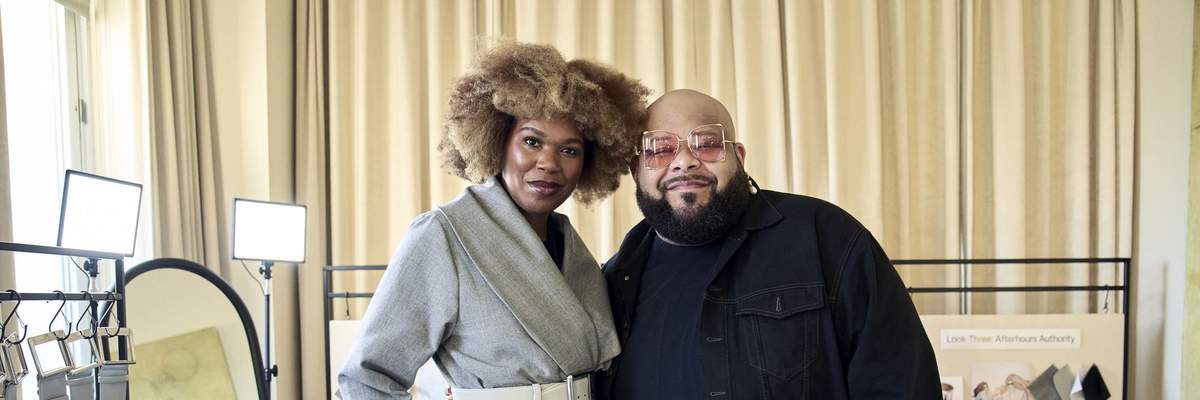
Tabitha and Chance Brown are the epitome of Black love. They've been married for 22 years after first meeting in middle school and share a beautiful blended family. The beloved couple is no stranger to talking about their journey to the altar and the ups and downs they've faced together on their show, Fridays with Tab & Chance. Now, they have taken the name Fridays and expanded it into a body collection.
The new collection, which dropped on November 14, features a body wash and a body lotion that complement their fragrances, Her Business and His Business. "We had such a huge success with the fragrance launch, and it’s because of our customers and fans," Tabitha shares in an exclusive interview with xoNecole.
"They asked for body products and we wanted to make sure we listened. But also layering fragrance begins with the body routine." The body wash is $33, and the body lotion is $35. Keep reading below to hear more about Tabitha and Chance's new collection, their body rituals, and what makes their partnership successful.

Fridays with Tab and Chance body collection
Marcus Owens
xoNecole: How did you come up with the scents for the collection?
Tabitha Brown: We love warm scents that make you feel sexy and loved. [We’re] both fans of gourmand [scents], including bergamot, vanilla, tonka and chocolate.
xoN: If you could describe your working relationship in one word, what would it be and why?
Tabitha: It's our first time building a product line together and our first time working with fragrance. So having patience with the process and each other has been the best way to build.
xoN: What is your body care ritual?
Tabitha: Exfoliate with a scrub a few times a week, but using a moisturizing body wash daily. After a shower, I spray a body mist that compliments what scent I am choosing for the day. Most times vanilla mist wins because it’s a perfect base for layering. I then hydrate [my] skin with lotion. Then, once dressed, I layer my favorite fragrance, Her Business, first and then His Business on top.
Chance: [I’m] way more simple. Just body wash and lotion and then my cologne and I’m good to go.
xoN: We enjoy watching you two together online, whose idea was it to start 'Fridays with Tab & Chance'?
Tabitha: It actually happened by accident. Back in 2018, my fans had just been asking about how we met, so we did a video answering questions one Friday and people in the comments [asked], will y’all do it again next Friday? And so we did and the next thing you know Fridays with Tab & Chance was born.
xoN: In what other ways do you plan to expand Fridays? Restart the podcast? TV show?
Tabitha: We are working on a lifestyle content show vs the traditional Fridays podcast. More to come soon.
xoN: You do many things together, but what would you say is your favorite quality time activity and why?
Tabitha: We are really simple. We love watching movies or TV series together on the couch or in bed. It’s really one of our favorite things to do together.
xoN: What is your favorite thing about the other person?
Tabitha: I love that he makes me feel safe and how hard he works to be an amazing father.
Chance: I love that she is crazy enough to pursue her wildest dreams.
xoN: What is the key to a successful partnership in business and personal?
Tabitha: The key is knowing that you both are going to change, and giving each other grace, patience, and understanding during those changes.
See more on tabandchance.com.
Feature image Marcus Owens