
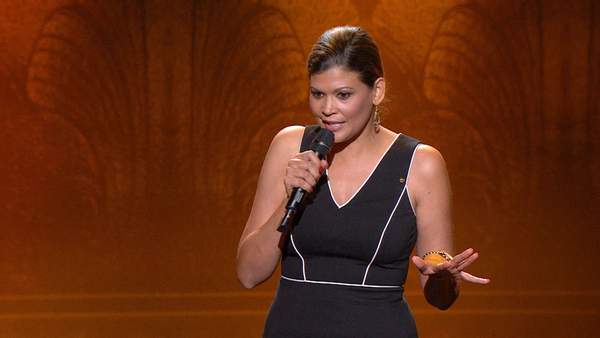
Actress and comedienne Aida Rodriguez is funny as hell.
The Puerto Rican/Dominican "Last Comic Standing" alum rarely holds her tongue about subjects that tick her off, especially when it comes to being a single parent and working in Hollywood. But there's something else that she's been very vocal about lately, and that's leaving Latina women out of conversations about race and racism.
Don't get it twisted: she's of the African diaspora, and she will read you your rights for thinking otherwise in a hot, stinking minute. She's appeared on the OWN TV show Light Girls addressing the same issues, which is why what she had to say about Zoe Saldana playing Nina Simone engaging.

The funny girl took to Facebook to discuss the not-so-funny subject matter, where she began the conversation by breaking down why Latinas have the right to talk about race, while also telling several of her followers to have a seat if they think that she's not "black enough" to discuss these things.
*Warning: Make sure your wigs are secured, because she's going to snatch them.
Let me explain something to you: I am a Puerto Rican/Dominican woman. I am a DIASPORA negro. My grandmother, great-great grandmother, great-great-great grandmother, have all been affected by slavery because guess what: They had those in Puerto Rico and the Dominican Republic too. And I don't appreciate you telling me trying to put me in my place, because obviously you've let the system put you in your place. I know who I am, you don't know who you are, you need to find out. You don't have to be here either.
Whew!
She went on to discuss why it was wrong of Zoe to play Nina in her new feature film, where she said that there were plenty of African American women who could have played the role without tarnishing Nina's legacy.
I'm Puerto Rican/Dominican just like Zoe. And I'm going to say this at the risk of being shunned by some of my Hollywood friends, but I just don't think it's cool...some people are making the argument that she's a black woman. She is, but she's not African American. She is Puerto Rican and Dominican. And when I say that I say, yes, we were affected by slavery, and we've been effected by the same things, but we also have a country to go back to if we don't want to be here, we have our own language, we have a flag, we have our own food...We are not a displaced people. Yet we are people of color, but we are not African American. Our experiences is not rooted in that of the American experience. Also, let's be real: this woman [Nina] fought against colorism. What a slap in the face to put a woman that you have to put a prosthetic nose, and color black, when there are so many black women who could play the role.
Aida went off! She was snatching wigs like Aretha Franklin feeling the Holy Ghost in concert.

If anything, I'm glad that she addressed these issues, and she definitely hit the nail on the head in all of her points.
What a lot of people forget is that of the 11 million people who survived the Middle Passage during the Trans-Atlantic Slave Trade, only 450,000 of those Africans made it to the U.S. The Latin Post broke down the numbers following the airing of Henry Louis Gates' PBS documentary "Black in Latin America,"
Five million went to Brazil, several million were taken to Venezuela and hundreds of thousands where spread among many other nations. Brazil became the second "blackest" nation in the world, second only to Nigeria. Brazil, then, underwent mass "whitening," receiving 5,435,735 immigrants from Europe and the Middle East. The conscious policy was instituted in each nation Professor Gates visited except for Haiti. And the goal was to blend or bury African roots, creating racial heritage that was "blackish," at best.
What's even worse is that Latinos have also experienced the erasure of their culture just by living in the United States, which is why they belong in these conversations to begin with. The Latin Post reported that less than three percent of Latinos identify racially as black, even though many of them statistically have African ancestry. They also said,
The Census Bureau doesn't reflect this because it works to erase diversity in order to better slot the entire raza [race] into one group. But, racial visibility is also important. Exposing the histories and backgrounds of individual group creates recognition when it comes to faith, race, language and nationalities. Multiculturalism must be honored, not ignored.
Take a look at Aida's full video below where she talks about Hollywood actors not allowing their privilege to shun the same people who made them famous.