You gotta love Black love, especially when it's shown in its full, hot, sticky, magical lusciousness on the big screen through Black sex scenes. When we see ourselves loving on one another in ways that are passionate and real, we get the feels, not just because it's great to fantasize about replicating in real life---but because it humanizes our experiences and showcases a side of us that's not always fighting, suffering, or traumatized.
The memories of classic Black sex scenes on film and TV live forever. Here are 15 Black sex scenes to take you back and reignite the love and passion in your life:
'Moonlight'
When Kevin and Chiron shared their first kiss, validating feelings they'd had for each other and taking unspoken bonds to the next level, it was passionate and endearing. Kevin then pleasured Chiron via a hand job, which is another act of endearment that further solidified a gift of freedom in sexual identity that they could not fully reveal in their everyday lives. That scene from the 2016 Academy Award-winning film reminded us all of our own first time with a deep crush or connection from our teen years.
'The Photograph'
You gotta love a story of instant attraction between two creatives, and Micheal and Mae don't disappoint in this film. The journalist and art curator (respectively) enjoy a steamy romp during a New York City rainstorm, reminding us all how deliciously fun having a storm bae can be. And the fact that their love has a backdrop of Mae's mother's affair with the father she never knew adds that much more allure. (A close second in the favorite love scene category for this film is the one with her mother and father in 1980s New Orleans enjoying their first time to Luther Vandross and Cheryl Lynn's "If This World Were Mine.")
'Belly'
You've got thug-loving at its finest in this scene, and DMX showed us that doggy style means more than just barking in a rap song. Though his character in the film, Tommy Buns, had a very toxic relationship with his live-in bae Kiesha, played by the beautiful Taral Hicks, this scene made us all---OK maybe just me---think back on that one street dude you had to let go but who could have you climbing the walls and answering his calls a little longer than you should have.
'School Daze'
Tisha Campbell played Jane Toussaint, an HBCU student, and leader of the Gamma Rays, a social group that supported the fictional fraternity in the film, Gamma Phi Gamma. The frat's leader, Julian, was her bae (played by Giancarlo Esposito). There's a spicy scene in the film where the two take a break from stepping, party-planning, and being messy to get their freak on. Speaking of freaky, Jane goes as far as licking Julian's parted haircut, giving a whole new meaning to fetishes among undergrads. (When my girls and I saw this film for the first time as college freshmen, some were totally grossed out, others argued the feminist implications of a young woman doing such a thing, and the rest---including me---wondered whether there was indeed a fruit-flavored hair oil on the market for ... nevermind.
'Sylvie's Love'
This film, set in the 1960s, gives Carmen Jones vibes with a bit of edge. When Sylvie meets saxophonist Robert, it's love at first sight on a Harlem street, and things get much more sensual and romantic. Their first time making love is on a rooftop, and then they meet up again, years later, at New York's iconic Plaza Hotel. What adds to the appeal of the sex scenes between the two is the legendary jazz and R&B soundtrack and the nostalgic style of lingerie Sylvie wears, providing inspo for all of us to role play and get into a few 60s-inspired pieces ourselves.
'She's Gotta Have It'
We are so here for artist Nola, who identifies as a polyamorous bisexual, and her relationships with men and women that include wonderfully entertaining escapades in her "loving bed." One major relationship was the one she had with Opal, a single mother and a horticulturalist. The two explore not only physical awareness and intimacy but a deep personal connection, leading Nola to rethink her life and consider settling down. Good sex will do that to ya!
'Jason's Lyric'
When blue-collar Jason (played by Allen Payne) wanted to take Lyric (played by Jada Pinkett-Smith) out of the Houston hood and into a new life of love and infinite possibilities, we'd already fallen for him. When he commandeered a whole city bus to take her on a date, we swooned. But when we saw his chiseled back and hairy man-parts putting in work with Lyric in a field of lilac flowers, we all wet our panties and reconsidered giving that hard-working brotha at the Radio Shack a chance. (Go ahead, sis. Don't be ashamed. You know you did.)
'The Skinny'
This indie film is about a group of friends from Brown University who travel together for a weekend filled with drama, sex, and revelations. Especially sexy and sultry are the exchanges between Magnus and his boyfriend Ryan, including long, deep kissing sessions and lots of deep stroking.
'Love Jones'
This is, without a doubt, a classic favorite, and Darius Lovehall (played by the never-aging-a-day-in-his-life Larenz Tate) awakened the sapiosexual in all of us with his sensual wordplay and intellectual prowess during house-party debates. But when he and Nina Mosley (played by another actress who proves that Black indeed doesn't crack, Nia Long) finally hit the sheets, it was more than a sight for sore eyes. Add Maxwell's "Somethin' Somethin'" remix laying the vibes for lovemaking and you've got the peak to a love story that just made us all wish we had a writer boyfriend to be the "blues" in our "left thigh trying to become the funk" in our "right." Yas! That's all right!
'Power'
Flexing muscles just always does something to me, and Ghost (played by Omari Hardwick) knew just how to do that while stroking the living daylights out of Tasha (Naturi Naughton). Half the time I didn't care that it was often angry make-up sex between the hubby-and-wife crime duo because, TBH, seeing a strong Black man with a coin---and clearly great gym form---getting it on was always fine by me. The determination on his face, the multiple positions, and the look of bliss at the end of almost every scene...whew chile! Just go ahead and rewind again. We won't be mad.
'Insecure'
Issa Rae reminds us all that everyday women---even us awkward girls---can get our rocks off on the regular, and enjoy sex with some fine men to boot. From your usual comfy-couple sex on the couch with Lawrence (Jay Ellis), her soon-to-be ex, to crazy studio rendezvous with her rebound guy Daniel (Y'lan Noel), it's all about normalizing the dynamics of sex beyond love-story fairy tales and into the realm of IRL ish.
'Do the Right Thing'
Spike Lee sheds light on baby mama drama---and the love in between---as Mookie, who absolutely frustrates his boo Tina (Rosie Perez) throughout the whole film. Despite the arguments, the two end up having a playful sensual escapade. Mookie pulled out the ice trays---and got the side-eye from their son's caretaker, Tina's own mom---to give the both of them much-needed relief from the NYC heat. The dripping cubes-on-nipples action was something I probably shouldn't have been watching at the young age I was when I saw this movie for the first time, but as a grown woman, I can appreciate the combo of frozen treats and laughter to make relationship frustrations disappear.
'Baby Boy'
Now, some of you might fight me on this one, but who didn't didn't want to "make the tacos" for somebody after watching that scene? (And this movie has another hot love scene contender in Ving Rhames (who played Melvin) when he blessed Jody's mom, Juanita (A.J. Johnson), with a little standing froggy-style action.) I know, I know: Baby daddy-baby mama drama at its finest. You can't deny, though, that this scene was one to re-watch and that it was refreshing to see a young couple work through their issues to find common ground and holy matrimony in the end.
'Bessie'
Queen Latifah shines as one of the foremothers of blues, Bessie Smith, and in the film, she shares beautiful moments with her friend and lover, Lucille. The vulnerability and flirtatious exchanges between the two add an extra enchantment to watching this major part of the singer's life unfold through film.
'Creed'
Michael B. Jordan. Need I say more? OK, I'll go on. His character in the film, Adonis, falls in love with Bianca, a hearing-impaired singer-songwriter played by Tessa Thompson. In one scene, the two gain an understanding and connection via music and have a meeting of minds in how they'll both overcome inner demons to reach their life and career goals. Who doesn't love a man who can accept and love all of you? And again, Michael B. Jordan. 'Nuff said.
Featured Image Gif via Buzzfeed
Originally published on March 5, 2020
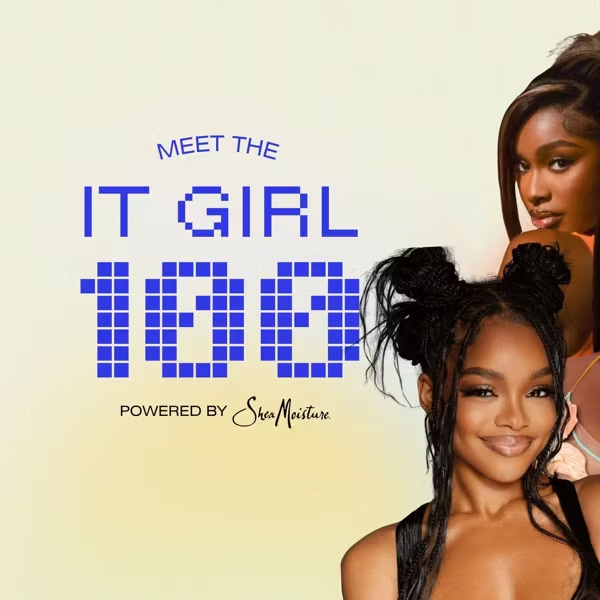
Because We Are Still IT, Girl: It Girl 100 Returns
Last year, when our xoNecole team dropped our inaugural It Girl 100 honoree list, the world felt, ahem, a bit brighter.
It was March 2024, and we still had a Black woman as the Vice President of the United States. DEI rollbacks weren’t being tossed around like confetti. And more than 300,000 Black women were still gainfully employed in the workforce.
Though that was just nineteen months ago, things were different. Perhaps the world then felt more receptive to our light as Black women.
At the time, we launched It Girl 100 to spotlight the huge motion we were making as dope, GenZennial Black women leaving our mark on culture. The girls were on the rise, flourishing, drinking their water, minding their business, leading companies, and learning to do it all softly, in rest. We wanted to celebrate that momentum—because we love that for us.
So, we handpicked one hundred It Girls who embody that palpable It Factor moving through us as young Black women, the kind of motion lighting up the world both IRL and across the internet.
It Girl 100 became xoNecole’s most successful program, with the hashtag organically reaching more than forty million impressions on Instagram in just twenty-four hours. Yes, it caught on like wildfire because we celebrated some of the most brilliant and influential GenZennial women of color setting trends and shaping culture. But more than that, it resonated because the women we celebrated felt seen.
Many were already known in their industries for keeping this generation fly and lit, but rarely received recognition or flowers. It Girl 100 became a safe space to be uplifted, and for us as Black women to bask in what felt like an era of our brilliance, beauty, and boundless influence on full display.
And then, almost overnight, it was as if the rug was pulled from under us as Black women, as the It Girls of the world.
Our much-needed, much-deserved season of ease and soft living quickly metamorphosed into a time of self-preservation and survival. Our motion and economic progression seemed strategically slowed, our light under siege.
The air feels heavier now. The headlines colder. Our Black girl magic is being picked apart and politicized for simply existing.
With that climate shift, as we prepare to launch our second annual It Girl 100 honoree list, our team has had to dig deep on the purpose and intention behind this year’s list. Knowing the spirit of It Girl 100 is about motion, sauce, strides, and progression, how do we celebrate amid uncertainty and collective grief when the juice feels like it is being squeezed out of us?
As we wrestled with that question, we were reminded that this tension isn’t new. Black women have always had to find joy in the midst of struggle, to create light even in the darkest corners. We have carried the weight of scrutiny for generations, expected to be strong, to serve, to smile through the sting. But this moment feels different. It feels deeply personal.
We are living at the intersection of liberation and backlash. We are learning to take off our capes, to say no when we are tired, to embrace softness without apology.
And somehow, the world has found new ways to punish us for it.

In lifestyle, women like Kayla Nicole and Ayesha Curry have been ridiculed for daring to choose themselves. Tracee Ellis Ross was labeled bitter for speaking her truth about love. Meghan Markle, still, cannot breathe without critique.
In politics, Kamala Harris, Letitia James, and Jasmine Crockett are dragged through the mud for standing tall in rooms not built for them.
In sports, Angel Reese, Coco Gauff, and Taylor Townsend have been reminded that even excellence will not shield you from racism or judgment.

In business, visionaries like Diarrha N’Diaye-Mbaye and Melissa Butler are fighting to keep their dreams alive in an economy that too often forgets us first.
Even our icons, Beyoncé, Serena, and SZA, have faced criticism simply for evolving beyond the boxes society tried to keep them in.
From everyday women to cultural phenoms, the pattern is the same. Our light is being tested.

And yet, somehow, through it all, we are still showing up as that girl, and that deserves to be celebrated.
Because while the world debates our worth, we keep raising our value. And that proof is all around us.
This year alone, Naomi Osaka returned from motherhood and mental health challenges to reach the semifinals of the US Open. A’ja Wilson claimed another MVP, reminding us that beauty and dominance can coexist. Brandy and Monica are snatching our edges on tour. Kahlana Barfield Brown sold out her new line in the face of a retailer that had been canceled. And Melissa Butler’s company, The Lip Bar, is projecting a forty percent surge in sales.

We are no longer defining strength by how much pain we can endure. We are defining it by the unbreakable light we continue to radiate.
We are the women walking our daily steps and also continuing to run solid businesses. We are growing in love, taking solo trips, laughing until it hurts, raising babies and ideas, drinking our green juice, and praying our peace back into existence.
We are rediscovering the joy of rest and realizing that softness is not weakness, it is strategy.
And through it all, we continue to lift one another. Emma Grede is creating seats at the table. Valeisha Butterfield has started a fund for jobless Black women. Arian Simone is leading in media with fearless conviction. We are pouring into each other in ways the world rarely sees but always feels.

So yes, we are in the midst of societal warfare. Yes, we are being tested. Yes, we are facing economic strain, political targeting, and public scrutiny. But even war cannot dim a light that is divinely ours.
And we are still shining.
And we are still softening.
And we are still creating.
And we are still It.

That is the quiet magic of Black womanhood, our ability to hold both truth and triumph in the same breath, to say yes, and to life’s contradictions.
It is no coincidence that this year, as SheaMoisture embraces the message “Yes, And,” they stand beside us as partners in celebrating this class of It Girls. Because that phrase, those two simple words, capture the very essence of this moment.
Yes, we are tired. And we are still rising.
Yes, we are questioned. And we are the answer.
Yes, we are bruised. And we are still beautiful.

This year’s It Girl 100 is more than a list. It is a love letter to every Black woman who dares to live out loud in a world that would rather she whisper. This year’s class is living proof of “Yes, And,” women who are finding ways to thrive and to heal, to build and to rest, to lead and to love, all at once.
It is proof that our joy is not naive, our success not accidental. It is the reminder that our light has never needed permission.
So without further ado, we celebrate the It Girl 100 Class of 2025–2026.
We celebrate the millions of us who keep doing it with grace, grit, and glory.
Because despite it all, we still shine.
Because we are still her.
Because we are still IT, girl.
Meet all 100 women shaping culture in the It Girl 100 Class of 2025. View the complete list of honorees here.
Featured image by xoStaff
These Black Women Left Their Jobs To Turn Their Wildest Dreams Into Reality
“I’m too big for a f***ing cubicle!” Those thoughts motivated Randi O to kiss her 9 to 5 goodbye and step into her dreams of becoming a full-time social media entrepreneur. She now owns Randi O P&R. Gabrielle, the founder of Raw Honey, was moving from state to state for her corporate job, and every time she packed her suitcases for a new zip code, she regretted the loss of community and the distance in her friendships. So she created a safe haven and village for queer Black people in New York.
Then there were those who gave up their zip code altogether and found a permanent home in the skies. After years spent recruiting students for a university, Lisa-Gaye Shakespeare became a full-time travel influencer and founded her travel company, Shakespeare Agency. And she's not alone.
These stories mirror the experiences of women across the world. For millions, the pandemic induced a seismic shift in priorities and desires. Corporate careers that were once hailed as the ultimate “I made it” moment in one's career were pushed to the back burner as women quit their jobs in search of a more self-fulfilling purpose.
xoNecole spoke to these three Black women who used the pandemic as a springboard to make their wildest dreams a reality, the lessons they learned, and posed the question of whether they’ll ever return to cubicle life.
Answers have been edited for context and length.
xoNecole: How did the pandemic lead to you leaving the cubicle?
Randi: I was becoming stagnant. I was working in mortgage and banking but I felt like my personality was too big for that job! From there, I transitioned to radio but was laid off during the pandemic. That’s what made me go full throttle with entrepreneurship.
Gabrielle: I moved around a lot for work. Five times over a span of seven years. I knew I needed a break because I had experienced so much. So, I just quit one day. Effective immediately. I didn’t know what I was going to do, I just knew I needed a break and to just regroup.
Lisa-Gaye: I was working in recruiting at a university and my dream job just kind of fell into my lap! But, I never got to fully enjoy it before the world shut down in March [2020] and I was laid off. On top of that, I was stuck in Miami because Jamaica had closed its borders due to the pandemic before I was able to return.

Randi O
xoN: Tell us about your journey after leaving Corporate America.
Randi: I do it all now! I have a podcast, I’m an on-air talent, I act, and I own a public relations company that focuses on social media engagement. It’s all from my network. When you go out and start a business, you can’t just say, “Okay I’m done with Corporate America,” and “Let me do my own thing.” If you don’t build community, if you don’t build a network it's going to be very hard to sustain.
Gabrielle: I realized in New York, there was not a lot to do for Black lesbians and queer folks. We don’t really have dedicated bars and spaces so I started doing events and it took off. I started focusing on my brand, Raw Honey. I opened a co-working space, and I was able to host an NYC Pride event in front of 100,000 people. I hit the ground running with Raw Honey. My events were all women coming to find community and come together with other lesbians and queer folks. I found my purpose in that.
Lisa-Gaye: After being laid off, I wrote out all of my passions and that’s how I came up with [my company] Shakespeare Agency. It was all of the things that I loved to do under one umbrella. The pandemic pulled that out of me. I had a very large social media following, so I pitched to hotels that I would feature them on my blog and social media. This reignited my passion for travel. I took the rest of the year to refocus my brand to focus solely on being a content creator within the travel space.

Gabrielle
xoN: What have you learned about yourself during your time as an entrepreneur?
Randi: [I learned] the importance of my network and community that I created. When I was laid off I was still keeping those relationships with people that I used to work with. So it was easy for me to transition into social media management and I didn’t have to start from scratch.
Gabrielle: The biggest thing I learned about myself was my own personal identity as a Black lesbian and how much I had assimilated into straight and corporate culture and not being myself. Now, I feel comfortable and confident being my authentic self. Now, I'm not sacrificing anything else for my career. I have a full life. I have friends. I have a social life. And when you are happy and have a full quality of life, I feel like [I] can have more longevity in my career.
Lisa-Gaye: [I'm doing] the best that I've ever done. The discipline that I’m building within myself. Nobody is saying, ‘Oh you have to be at work at this time.’ There’s no boss saying, ‘Why are you late?’ But, if I’m laying in bed at 10 a.m. then it's me saying [to myself], 'Okay, Lisa, get up, it's time for you to start working!’ That’s all on me.
xoNecole: What mistakes do you want to help people avoid when leaving Corporate America?
Randi: You have to learn about the highs and lows of entrepreneurship. You have a fast season and a slow season and I started to learn that when you're self-employed the latter season hits hard. Don't get caught up on the lows, just keep going and don't stop. I’m glad I did.
Gabrielle: I think everyone should quit their job and just figure it out for a second. You will discover so much about yourself when you take a second to just focus on you. Your skill set will always be there. You can’t be afraid of what will happen when you bet on yourself.
Lisa-Gaye: When it comes to being an influencer the field is saturated and a lot of people suffer from imposter syndrome. There is nothing wrong with being an imposter but find out how to make it yours, how to make it better. If you go to the store, you see 10 million different brands of bread! But you are choosing the brand that you like because you like that particular flavor.
So be an imposter, but be the best imposter of yourself and add your own flair, your own flavor. Make the better bread. The bread that you want.

Lisa-Gaye Shakespeare
xoNecole: Will you ever return to your 9 to 5?
Randi: I wouldn’t go back to Corporate America. But I don’t mind working under someone. A lot of people try to get into this business saying, “I can't work under anyone.” That’s not necessarily the reason to start a business because you're always going to answer to somebody. Clients, brands, there’s always someone else involved.
Gabrielle: I went back! I really needed a break and I gave myself that. But, I realized I’m a corporate girl, [and] I enjoy the work that I do. I’m good at it and I really missed that side of myself. I have different sides of me and my whole identity is not Raw Honey or my queerness. A big side of me is business and that’s why I love having my career. Now I feel like my best self.
Lisa-Gaye: I really don’t. For right now, I love working for myself. It's gratifying, it's challenging, it's exciting. It’s a big deal for me to say I own my own business. That I am my own boss, and I'm a Black woman doing it.
Let’s make things inbox official! Sign up for the xoNecole newsletter for love, wellness, career, and exclusive content delivered straight to your inbox.
Featured image courtesy of Lisa-Gaye Shakespeare
Originally published on February 6, 2023