
A dead bedroom can kill any relationship. In all long-term, committed relationships, couples experience various phases, from the initial passion to a more complex and enduring connection. Yet, as time passes, sex may decrease, which introduces an issue often referred to as "bed death."
According to Advance Psychology Partners, 'bed death' occurs when individuals in a committed relationship experience a decline in the frequency of sexual activity and fall short of the desires of both or either partner. It is sometimes labeled a "sexless relationship" due to the infrequency of sex. In the U.S., an estimated 20 million people find themselves in such relationships.
This shift is a significant change for couples. Let’s face it: no one wants to be in a sexless marriage or relationship. But how can couples effectively confront the impact of fading physical intimacy on the overall health of their enduring partnership?
"I have found that many factors influence one's desire to dive, and it is often not a majority of just one thing. Most people assume that if they don't desire [sex], they are no longer physically attracted, but in my experience, that has little to do with it most of the time," explained Brittanni Young, LMFT, CST.
"Some of the heavy contributors that I see most often include excessive goal orientation towards orgasm, people not prioritizing their own sexuality, and the landfill of ‘should’s’ that develop from toxic sexual scripts created long ago in upbringing," she added.
Furthermore, these issues are not exclusive to any particular orientation, but it does manifest differently.
Young is a licensed marriage and family therapist, sexologist, and board-certified sex therapist who practices in Georgia and Florida. She has worked in the sexology field for over a decade. Young helps couples and individuals looking to get through challenges of all facets facing sexuality and intimacy, such as desire mismatch, over-compulsion, and dysfunctions. She recently launched a deck of intimacy connection cards called "Show Me Your Cards." Young is working on another product that helps teach children to consent and negotiate appropriate touch. She sat down with xoNecole to discuss what causes the decline in the bedroom, the myth of 'lesbian bed death,' and recommendations on overcoming "bed death."
The Decline In Intimacy
Intimacy often dwindles within relationships, a phenomenon triggered by various factors such as stress, the insidious monotony of routine, and the toxicity of unresolved conflicts, to name a few. While couples manage daily life, exchanging intimate desires and concerns may take a backseat. Sadly, this gradually erodes the closeness once shared in the relationship.
"Typically, the first thing I do when working with a couple on desire challenges is rule out medical causes by referring them to their primary care physician or other provider they are working with," Young shared. "There are times when unmanaged or mismanaged conditions factor into low desire levels. Also, many medications can wreak havoc on keeping desire levels up, such as antidepressants, SSRIs, anti-anxiety, and blood pressure medications, to name a few."

Jeff Bergen/ Getty Images
"Next, I look at the state of the relationship. If there is dissatisfaction in the relationship, then it definitely affects how close and intimate one wants to be to another. There are also plenty of individual factors one can bring into the equation, such as low self-esteem, anxiety, depression, feelings of shame or guilt around one's own sexuality, and external life stressors that can get in the way. I find that life stressors can be a big one for folks, as once you get in the habit of not prioritizing sex, it tends to stick," she added.
Fortunately, there are ways to prevent "bed death." It can involve prioritizing your wants and open communication about sexual needs.
"What tends to be effective for all couples is taking an inventory of how satisfied they are with their sexual behaviors and engagement. Being truthful in this vein can be the start of unlocking inhibitions that can keep you from seeking out and being genuinely vulnerable in intimate spaces," Young explained. "Next, I suggest opening up lines of communication around these truths. When people assume that nothing can be done, hope is lost."
The Myth Of 'Lesbian Bed Death'
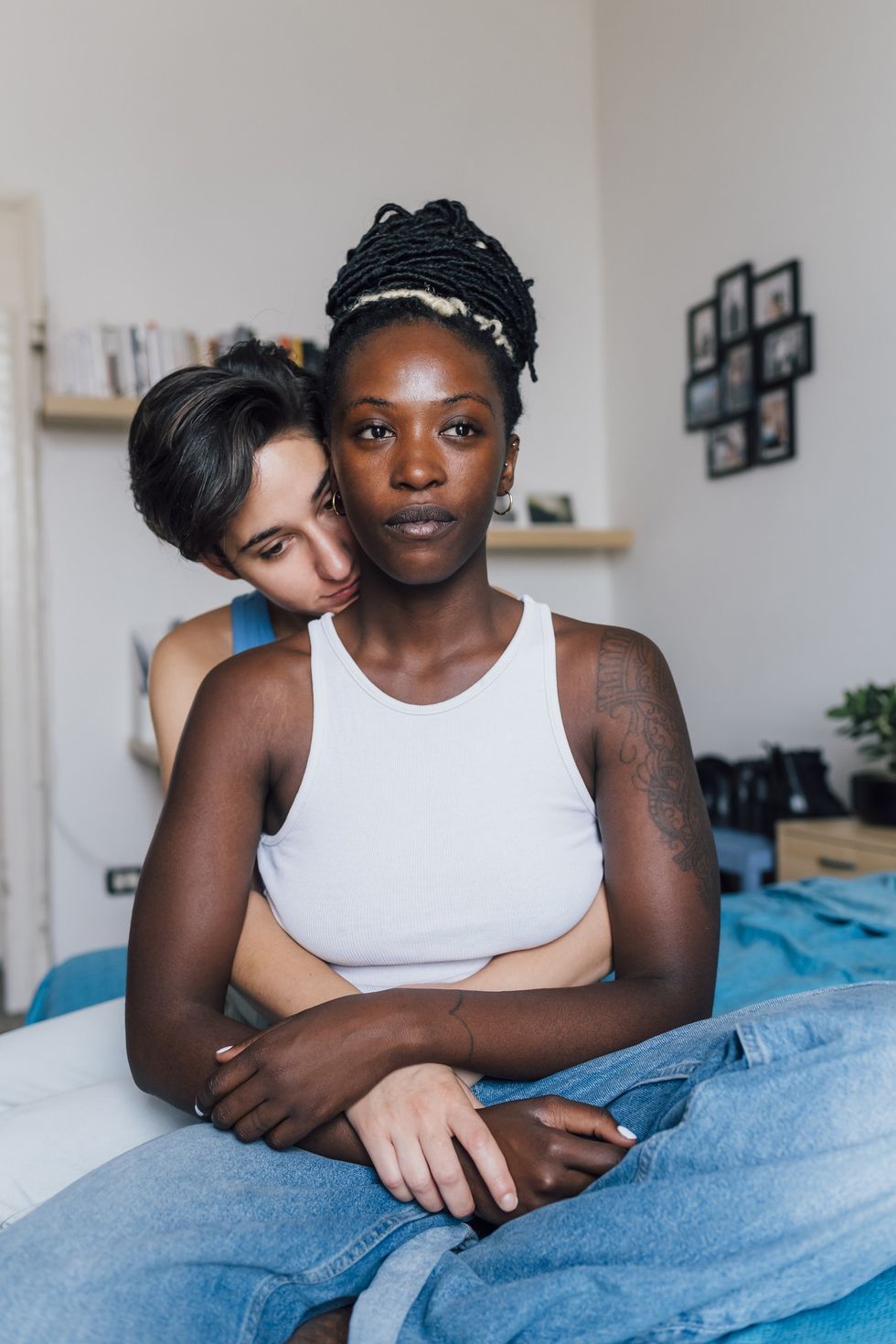
The notion of "lesbian bed death" perpetuates a simplistic and inaccurate stereotype about the sexual dynamics within lesbian relationships. Contrary to the myth, the experience of a decline in intimacy is not universal among lesbian couples. The diverse spectrum of relationships among women challenges this oversimplified narrative, emphasizing that the complexities of sexual dynamics extend beyond stereotypical assumptions.
"The notion of 'lesbian bed death' is based on a research study done by Pepper Schwartz in 1983 that found that lesbian couplings fell behind in sexual frequency compared to heterosexual and gay male couplings," Young revealed.
"Several other studies [after] have replicated these findings but give very little information about sexual satisfaction. Despite there being more research needed overall in the sexuality field, more recent research did find that when it comes to the length of sexual encounters, lesbian couples had the longest duration of encounters. To that end, sexual quality over quantity is a better marker of satisfaction, and that is what I pay most attention to in my work. With that said, dissatisfaction can happen in all couplings over time," the sexologist continued.
Factors influencing reduced intimacy among lesbian couples may include communication challenges, societal pressures, and individual variations in libido. Menstruation can also play a role, with some couples navigating discomfort or hormonal changes during this period.
"There are certainly some nuances that come into play with lesbian couples that differ from heterosexual or other-oriented couples. As I stated earlier, physiological factors can factor into the rise and fall of libido. The hormone fluctuations that come from menstruation and menopause can impact desire levels, and it is double present in lesbian couples. Another nuance is the lack of a sexual script from society on lesbian sexual behavior. There are patriarchal roots to sexual research, which have created our societal norms that tend to leave out anyone who isn't heterosexual," Young stated.
Overcoming The Challenges
Westend61/ Getty Images
While 'bed death' challenges couples, solutions are within reach. By identifying and addressing the underlying causes, couples can rekindle the flame of intimacy and ensure a healthier, more fulfilling relationship.
"In the words of Esther Perel, another sexual professional in the field, 'love enjoys knowing everything about you; desire needs mystery.' I recommend keeping it in the front of your mind, prioritizing, and keeping it interesting. Be open to learning more about your own sexuality every day, as well as your partner. You are always growing; what worked for you 20 years ago may not be the same today. Stay curious with one another and be open to exploring new ways to pleasure. You deserve it," Young said.
For instance, Young advised that couples should "keep sexual encounters light and playful." And not be afraid to introduce new elements, such as toys.
"Touch often in ways that are consensual and feel safe! I made 'Show Me Your Cards' to serve this purpose specifically. Just because you do not feel in the mood to go all the way does not mean you aren't in the mood to hold hands, exchange body massages, or dance together. Connecting often in any physical form, as long as it feels pleasurable, still counts as 'being in the mood,'" she said.
Overcoming the hurdles of "bed death" and debunking myths surrounding 'lesbian bed death' offers a unique perspective for couples grappling with the difficulties of sustaining a connection. Learning the proper ways to work through a sexless relationship can help foster a healthier, more fulfilling relationship.
Let’s make things inbox official! Sign up for the xoNecole newsletter for daily love, wellness, career, and exclusive content delivered straight to your inbox.
Feature image by Vladimir Vladimirov/ Getty Images

Because We Are Still IT, Girl: It Girl 100 Returns
Last year, when our xoNecole team dropped our inaugural It Girl 100 honoree list, the world felt, ahem, a bit brighter.
It was March 2024, and we still had a Black woman as the Vice President of the United States. DEI rollbacks weren’t being tossed around like confetti. And more than 300,000 Black women were still gainfully employed in the workforce.
Though that was just nineteen months ago, things were different. Perhaps the world then felt more receptive to our light as Black women.
At the time, we launched It Girl 100 to spotlight the huge motion we were making as dope, GenZennial Black women leaving our mark on culture. The girls were on the rise, flourishing, drinking their water, minding their business, leading companies, and learning to do it all softly, in rest. We wanted to celebrate that momentum—because we love that for us.
So, we handpicked one hundred It Girls who embody that palpable It Factor moving through us as young Black women, the kind of motion lighting up the world both IRL and across the internet.
It Girl 100 became xoNecole’s most successful program, with the hashtag organically reaching more than forty million impressions on Instagram in just twenty-four hours. Yes, it caught on like wildfire because we celebrated some of the most brilliant and influential GenZennial women of color setting trends and shaping culture. But more than that, it resonated because the women we celebrated felt seen.
Many were already known in their industries for keeping this generation fly and lit, but rarely received recognition or flowers. It Girl 100 became a safe space to be uplifted, and for us as Black women to bask in what felt like an era of our brilliance, beauty, and boundless influence on full display.
And then, almost overnight, it was as if the rug was pulled from under us as Black women, as the It Girls of the world.
Our much-needed, much-deserved season of ease and soft living quickly metamorphosed into a time of self-preservation and survival. Our motion and economic progression seemed strategically slowed, our light under siege.
The air feels heavier now. The headlines colder. Our Black girl magic is being picked apart and politicized for simply existing.
With that climate shift, as we prepare to launch our second annual It Girl 100 honoree list, our team has had to dig deep on the purpose and intention behind this year’s list. Knowing the spirit of It Girl 100 is about motion, sauce, strides, and progression, how do we celebrate amid uncertainty and collective grief when the juice feels like it is being squeezed out of us?
As we wrestled with that question, we were reminded that this tension isn’t new. Black women have always had to find joy in the midst of struggle, to create light even in the darkest corners. We have carried the weight of scrutiny for generations, expected to be strong, to serve, to smile through the sting. But this moment feels different. It feels deeply personal.
We are living at the intersection of liberation and backlash. We are learning to take off our capes, to say no when we are tired, to embrace softness without apology.
And somehow, the world has found new ways to punish us for it.

In lifestyle, women like Kayla Nicole and Ayesha Curry have been ridiculed for daring to choose themselves. Tracee Ellis Ross was labeled bitter for speaking her truth about love. Meghan Markle, still, cannot breathe without critique.
In politics, Kamala Harris, Letitia James, and Jasmine Crockett are dragged through the mud for standing tall in rooms not built for them.
In sports, Angel Reese, Coco Gauff, and Taylor Townsend have been reminded that even excellence will not shield you from racism or judgment.

In business, visionaries like Diarrha N’Diaye-Mbaye and Melissa Butler are fighting to keep their dreams alive in an economy that too often forgets us first.
Even our icons, Beyoncé, Serena, and SZA, have faced criticism simply for evolving beyond the boxes society tried to keep them in.
From everyday women to cultural phenoms, the pattern is the same. Our light is being tested.

And yet, somehow, through it all, we are still showing up as that girl, and that deserves to be celebrated.
Because while the world debates our worth, we keep raising our value. And that proof is all around us.
This year alone, Naomi Osaka returned from motherhood and mental health challenges to reach the semifinals of the US Open. A’ja Wilson claimed another MVP, reminding us that beauty and dominance can coexist. Brandy and Monica are snatching our edges on tour. Kahlana Barfield Brown sold out her new line in the face of a retailer that had been canceled. And Melissa Butler’s company, The Lip Bar, is projecting a forty percent surge in sales.

We are no longer defining strength by how much pain we can endure. We are defining it by the unbreakable light we continue to radiate.
We are the women walking our daily steps and also continuing to run solid businesses. We are growing in love, taking solo trips, laughing until it hurts, raising babies and ideas, drinking our green juice, and praying our peace back into existence.
We are rediscovering the joy of rest and realizing that softness is not weakness, it is strategy.
And through it all, we continue to lift one another. Emma Grede is creating seats at the table. Valeisha Butterfield has started a fund for jobless Black women. Arian Simone is leading in media with fearless conviction. We are pouring into each other in ways the world rarely sees but always feels.

So yes, we are in the midst of societal warfare. Yes, we are being tested. Yes, we are facing economic strain, political targeting, and public scrutiny. But even war cannot dim a light that is divinely ours.
And we are still shining.
And we are still softening.
And we are still creating.
And we are still It.

That is the quiet magic of Black womanhood, our ability to hold both truth and triumph in the same breath, to say yes, and to life’s contradictions.
It is no coincidence that this year, as SheaMoisture embraces the message “Yes, And,” they stand beside us as partners in celebrating this class of It Girls. Because that phrase, those two simple words, capture the very essence of this moment.
Yes, we are tired. And we are still rising.
Yes, we are questioned. And we are the answer.
Yes, we are bruised. And we are still beautiful.

This year’s It Girl 100 is more than a list. It is a love letter to every Black woman who dares to live out loud in a world that would rather she whisper. This year’s class is living proof of “Yes, And,” women who are finding ways to thrive and to heal, to build and to rest, to lead and to love, all at once.
It is proof that our joy is not naive, our success not accidental. It is the reminder that our light has never needed permission.
So without further ado, we celebrate the It Girl 100 Class of 2025–2026.
We celebrate the millions of us who keep doing it with grace, grit, and glory.
Because despite it all, we still shine.
Because we are still her.
Because we are still IT, girl.
Meet all 100 women shaping culture in the It Girl 100 Class of 2025. View the complete list of honorees here.
Featured image by xoStaff
I seriously doubt that it will come as a shock to anyone reading this that the “official” cold (and flu) seasons are considered to be during the fall and wintertime. However, what kinda tripped me out is that there really are only a few months of the year when we aren’t susceptible to catching a cold: May-July. SMDH.
Know what else is wild about colds? They have five stages: incubation (1-2 days); symptom onset (1-2 days); peak symptoms (1-2 days); plateau (2-3 days), and recovery (3-5 days) — and that is why, sometimes, it can seem like it takes FOREVER to get over a cold. Also, SMDH.
Luckily, there are some things that you can do to either speed up the healing process of a cold or make having one more bearable than usual. Things that are affordable, all-natural, and easy to incorporate into your daily routine.
Are you ready to know how to nip a damn cold in the bud…before you even get one?
Here ya go.
1. Fire Cider

Unsplash
Two drinks that I am gonna drink all the way down, each and every fall season, are hot chocolate and apple cider (that’s warmed up). So, when I read about something called “fire cider,” it absolutely caught my attention. If you’re not familiar with it, fire cider is a homemade drink that consists of things like apple cider vinegar, herbs and other ingredients that are specifically designed to boost your immune system.
I won’t lie to you — since some of the traditional recipes contain things like onion and garlic (sulfur has potent medicinal properties) and sometimes even hot peppers (which help to clear up congestion) — although fire cider might not be your favorite as far as your palate is concerned, the viruses (because there are reportedly somewhere around 200 of ‘em) that cause colds will lose a lot of their impact if you drink this; and that makes it worth a shot — well, swallow. Some fire cider recipes can be found here, here and here.
2. Probiotics
A few years ago, I wrote an article for the platform entitled, “80% Of Your Immunity Is In Your Gut. Take Care Of It Like This.” — and that alone should explain why and how a probiotic can help to prevent colds and make it easier to get over them. The reality is that a healthy gut is what helps to monitor how your immune system reacts and responds to harmful pathogens that may try and get into your system, including ones that cause the common cold.
And since probiotics feed your gut with “good bacteria,” this gives your gut the ability to be better (and quicker) at fighting off the bad. So yeah, take a probiotic — all of the time and definitely while you have a cold. It helps.
3. Peppermint (or Eucalyptus) Oil

Unsplash
Although I rarely get sick (praise the Lord!), when I do catch a cold, I think what I hate the most is not being able to comfortably breathe. Well, something that is proven to help with that is peppermint essential oil. That’s because it contains properties that act as a natural decongestant as well as a fever reducer. Another essential oil that can hook you up in this department is eucalyptus oil. It’s bomb because it helps to soothe a nagging cough, it can clear up chest congestion and ultimately makes it easier to breathe.
So, before turning in at night, either mix a few drops of one (or both) of these oils with a carrier oil like grapeseed, avocado or jojoba, warm it up for 10 seconds in the microwave and apply it to the sides of your nose or on your best or back. Or put the oil in a diffuser. It can quickly ease cold-related symptoms while also making it so much easier for you to rest (which is something else your body needs to get over a cold; more on that in a sec).
4. Zinc Lozenges
Zinc is a mineral that helps to keep your immune system healthy and strong — and since a weakened immunity is directly connected to having more colds (2-4 a year is considered to be “normal,” by the way), it’s always a good idea to have some zinc in your body. As it relates to colds, specifically, aside from the fact that zinc can help you from catching one to begin with, there are also studies which say that sucking on zinc lozenges can help to shorten the timespan of a cold as well.
To be fair, some people have said that zinc lozenges make them feel nauseated; however, everything has its pros and cons and so, how would you know if you’re one of these folks unless you try it? Oh, and while we are on this topic, there are also zinc supplements and foods that are high in zinc (like red meat, lentils, hemp seeds, cashews and quinoa) if you want to try and get more zinc into your system that way (although lozenges are gonna be your best bet on the shortening tip; just sayin’).
5. Foods Rich in Vitamin C

Unsplash
Speaking of foods that can fight a cold, out of all of what you’ve read here, probably what you are quite familiar with is the fact that vitamin C and colds are mortal enemies. In fact, one pretty significant study says that by taking one gram of vitamin C a day during a cold, you can reduce the severity of your symptoms by as much as 15 percent.
That’s because vitamin C is packed with antioxidants, it helps to reduce bodily inflammation and it helps to strengthen your immunity too. Foods that are full of vitamin C include chili and yellow peppers, kale, kiwi, papaya, broccoli, kale and citrus fruits.
6. Elderberry Tea
If you’re someone who likes to put preserves on your biscuits or toast, have you ever tried one that is made from elderberries (recipe here)? It’s actually pretty good — and good for you because elderberries are high in vitamin C, fiber and antioxidants. And that is why they are great whenever you are trying to hurry up and get over a cold because they also contain properties that are literally antiviral — and since a cold is a virus…well, there you have it.
One of the best ways to get elderberries into your system? Elderberry tea. If you add honey to it, honey can help to shorten symptoms like a stuffy nose, sore throat and cough by 1-2 days. Very cool.
7. REST

Unsplash
Did you know that even one day of not getting the sleep that you need to weaken your immune system and increase bodily inflammation at the same time too? That’s because one of the benefits of a good night’s rest is it rejuvenates and recharges your system, so that your immunity can work at its optimal level.
Not only that but, according to science, if you already have a cold, getting plenty of rest can benefit you on a few different levels as well. First, your cytokines (proteins that boost your immunity) are released when you sleep.
Second, your body temperature elevates enough to kill some of the bacteria and viruses that are making you sick. Finally, sleep provides you with the energy that you need in order to get through the day while you are healing from your sickness. So, if you want to get through your cold ASAP, be intentional about getting as much rest as you possibly can.
BONUS: A Humidifier
When you get a chance, please check out “10 Really Good Reasons To Get Yourself A Humidifier This Fall”. There really are all kinds of solid reasons to invest in a humidifier around this time of the year — and one of them is to make getting through the cold (and flu) season so much easier for you. Since humidifiers bring moisture into the air, that can help to loosen up congestion, soothe an irritated throat, decrease coughing, help with the healing process of respiratory infections and it can help you to sleep better — so that you can get past your cold sooner.
So, if you don’t already have a humidifier, cop one ASAP. Your future colds will absolutely hate that you did. LOL. For a list of some highly recommended humidifiers that are currently on the market, click here.
Let’s make things inbox official! Sign up for the xoNecole newsletter for love, wellness, career, and exclusive content delivered straight to your inbox.
Featured image by Casper1774 Studio/Shutterstock