

Think Homeownership Is Out Of Reach? Here's The Starter Guide To Buying A House

When it comes to homeownership, many of us might be holding some preconceived notions as well as valid fears that it's just out of reach. From the unstable housing market to rising prices, to challenges with employment and other financial factors, it might seem that owning a home was something only our grandmothers or mothers could enjoy. But all hope is not lost.
In fact, research points to Black women being the leaders behind a boost in homeownership in the past few years, and even during the pandemic, we continued on our plight to leaving renting for ownership.
If you've had some doubts or don't know where to start, here's a quick guide for prepping to make your homeownership dreams a reality:
1. Get your mind right.
A 2022 Bank of America survey found that while 48% of Black women "feel confident about their finances," only 28% actually "feel empowered to take action" fueled by this confidence.
This first step is often overlooked, but oftentimes, when we're starting any new journey, especially one that involves a big change both physically (i.e. moving to a whole new environment) and financially, you'll need to set your mind on positive thoughts, confidence, and boldness. You have to know that you can indeed be a homeowner, that you deserve the desires of your heart, and that you are more than capable of navigating the process.
With high rates of student loan debt, rental income disparities, and a lot of the home responsibilities falling on us, among other challenges, it can indeed seem like a tough feat to go the homeownership route, but it is certainly doable with the right mindset, strategy, and support.
Lean into affirmations, prayer, therapy, coaching, and real-life inspiration to clear your mind of doubts and fears and use that energy to progress toward your dream home purchase. Open your mind to all the options, resources, and programs that are afforded to you and the alternative ways to reach your goals.
2. Get real about your finances.
Many experts agree on this second step, as you'll need to know where you are financially in order to be sure of what type of house you want, where you want to live, and whether you can afford the mortgage. Usually, this includes having (or creating) a budget and getting to know your expenses versus your take-home pay. If you don't already have a budget, create one and start to really get focused on knowing exactly what money's coming in and what's going out.
Also, getting into a savings routine and looking into investing, even if it's as simple as signing up for your 401K with your job, opening a retirement account on your own via companies like Fidelity or JP Morgan, or starting brokerage accounts with platforms like Charles Schwab or Robinhood. This will allow you to get into the habit of building wealth and having multiple sources to tap into in terms of financial assets.
3. Stop counting yourself out due to reasons like "bad credit" or low income.
If you need assistance with budgeting or learning more about money management, there are free resources out there (try here or here). You can also tap into local resources like nonprofits, financial advisers, or the professionals you bank with, especially if it's a credit union.
There are also resources for strategizing how to improve your credit, boost your income, and develop better financial fitness habits, so tap into those as well. You can do this! Sit down, write out your goals, work with a coach, and start one small step at a time.
Bad credit and other financial challenges don't necessarily bar you from achieving your dreams of owning a home. Look into rent-to-own options or financiers who offer home loans to people with credit under 620. There are also federal lenders that are ideal for those with low or no credit.
Go into your current bank and get to know your options so that you'll know what's actually available to you and what's possible beyond the fears or negative self-talk. Take a free class via the National Urban League or other local resources through a quick Google search. You'd be surprised what options are out there when you simply make a few appointments, do a bit of research, network, and ask.
4. Figure out your plan for your first payment and the right mortgage fit.
A down payment is often required (or at least encouraged) when you're buying a home, so once you've gotten clear on your financial status, what type of house you want, where, and how much you can afford based on your income, think about how you'll save up (or pay) the first payment for the investment.
Twenty percent of the total cost of the home has often been mentioned as a place to start, but experts say you don't necessarily have to have that much. However, be aware that when you put down less than that, you'll have to get mortgage insurance, and it will likely add to your monthly mortgage payment, so keep that in mind. There are assistance programs on the state and federal levels that can help you navigate this and even assist with the cost, especially if you're a first-time homebuyer. (Start here for more great information on this.)

Getty Images
When it comes to your dream home and consideration of a mortgage, think outside the box. Your dream home might be a $500,000 ranch-style home in a major metro area but if that's going to have you living above your means or struggling to pay the down payment and monthly mortgage in tough times, considering an adjacent city or county in the same state or the same type of house in an area that's more up-and-coming.
There are also different types of mortgages that might be a good fit for you based on various factors. For example, conventional loans offer low minimum down payments but have more stringent qualifications, while FHA loans are mortgages backed by the Federal Housing Administration and are generally easier to qualify for but have stricter requirements related to mortgage insurance. (You can research more information on types of loans and how to qualify here and here.)
5. Start the pre-approval process and ask lots of questions before agreeing to a loan.
You'll also need to get pre-approved, so once you've found the right type of loan, do your research on who to partner with on your mortgage. Be sure, for example, that if you're going for an FHA loan, the loan provider is FHA-approved. According to NerdWallet, prospective home buyers should consider how a lender’s sample rates compare with today's mortgage rates, determine the closing costs, and "compare mortgage origination fees.” Become super-aware of the terms and timing for the loans and how these might change over time or in the future. Ask lots of questions or get help via a reputable consultant or coach.
Preapproval is necessary for getting the "real numbers," because lenders have access to detailed information about your finances. The process will include a hard credit inquiry, which shows up on your credit report, however, when you apply with multiple lenders around the same time, according to Bankrate, it only counts as one hard pull. This is because credit scoring models "take mortgage rate-shopping into account" and "group multiple inquiries together" if the credit checks all happen within a 45-day period. You'll need documents including W2s, pay stubs, and others (listed here.)
You can use the pre-approved lender at the end of the process, once you're ready to buy, or you can use a new one if, by the end of the process, you've found a better deal.
6. Research and vet your real estate agent before contracting with them.
Experts recommend interviewing multiple buyer's agents to be sure you're getting someone with your best interests at heart. Ask family, friends, and coworkers for referrals, look at the agent's online reviews, and be sure they're licensed in your state. Check out their Zillow or other professional profiles online and look at their track record. Ask them questions like "How long have you been in business," "How well do you know the area," and "How will you be corresponding with me, and how often?" (Here's a full list of interview questions for getting started.)
There’s a difference between a buyer’s agent, who represents a homebuyer in a real estate transaction, and a seller’s or listing agent, who is responsible for looking out for the seller, including pricing and marketing the home. Many agents do both, but some specialize in one or the other. Some states don’t allow dual agency, and it can there are some risks associated with that. There are referral agents who provide leads to other agents for a fee.
7. When shopping around, take your time and don't make hasty decisions.
Work with your real estate agent to view properties and think along the lines of making a long-term investment. You'll more than likely be living in the house for quite some time (even if you plan to sell and move on later) so you'll want to have some forethought on your why and how you'd like to live in the long term. Think about the community, how you'll live in the home, and what will best suit your long-term needs.
Real estate agents also recommend looking for red flags when viewing a home like poor tiling, evidence of leaks, or covering of flaws (such as "strong perfumes" or gaps in tile, for example). Be aware of potential issues like bodies of water nearby (possibility of flooding) or paint bubbling around windows (possible problems with ventilation). They also recommend looking past the aesthetics, lifting carpets, or asking about recent property maintenance.
While this guide is simply a snapshot to get you started, allow it to encourage you to go boldly for your dreams of homeownership with confidence and a plan. Be sure to utilize all resources afforded to you, do your research, and walk proudly into your next elevation to owning the home of your dreams.
Let’s make things inbox official! Sign up for the xoNecole newsletter for love, wellness, career, and exclusive content delivered straight to your inbox.
Featured image by Riska/Getty Images
- How Jamisa McIvor-Bennett Built A $3.2 Million Real Estate Portfolio At 26 ›
- I Built My Investment Property Brand In Less Than A Year ›
- Love Where You Lease: How Dopamine Decor Turned My Space Into A Self-Love Haven ›

This Is How To Keep 'Holiday Season Stress' From Infecting Your Relationship
Hmph. Maybe it’s just me, but it seems like there is something really weird happening in the fall season air (because winter doesn’t officially begin until December 21) that cuddle season is in full swing while break-up season is as well. In fact, did you know that break-ups are so popular during the holiday season that December 11 is deemed Break-Up Day?
The reasons why relationships shift around this time vary; however, I did both roll my eyes and chuckle when I read that a very popular one is because it’s an easy way to get out of getting one’s significant other a Christmas present. SMDH.
Anyway, I personally think that the less shallow folks out here may contemplate calling things “quits” or they at least distance themselves a bit from their partner (and what I’m referring to is serious relationships) due to all of the stress and strain that oftentimes comes with the holidays whether it be financial, familial, due to their tight schedules or something else.
Listen, I would hate for you and your man to miss the fun and happiness of experiencing this time of year, all because you are so overwhelmed or irritated that you can’t really enjoy it. That’s why I have a few practical tips for how to avoid allowing the typical holiday season stress from INFECTING your relationship.
Manage Your Expectations
GiphyUnmanaged expectations. If there is a main reason why the holiday season tends to be so stress-filled for so many people, I’d bet good money that this is the cause. And when you’re in a long-term relationship, expectations can manifest themselves in all sorts of cryptic and/or unexpected ways. You might have relatives who assume that you are going to be with them for Thanksgiving or Christmas when you have other plans in mind. You might be thinking that you are going to spend one amount for presents while your man is thinking something totally different. When it comes to scheduling, your signals may be crossed.
And you know what? To all of these scenarios, this is where clear and consistent communication come in. Don’t assume anything. Don’t dictate anything either. From now until New Year’s, mutually decide to check in once a week, just to make sure that you are both on the same page as it relates to the holidays and what you both are thinking will come along with it. The less blindsided you both feel, the less stressed out you will be. Trust me on this.
Set (and Keep) a Budget
GiphyOkay, so I read that last year, 36 percent of Americans incurred some type of holiday-related debt. Hmph. Last year, there was still some sense of normalcy in this country, chile, so I can only imagine what finances are gonna look like over the next several weeks. That said, since I don’t know a lot of people who don’t find being broke stressful, make sure that you and your bae set a budget and then stick to it this year — no ifs, ands or buts.
Because really, y’all — it doesn’t make sense to deplete savings and/or max out credit cards for a few days of giggles only to be damn near losing your mind because you don’t know how to make ends meet come Dr. Martin Luther King, Jr. Day.
And by the way, this tip doesn’t just speak to things like food and gifts; I also mean travel. If it doesn’t make a ton of sense (or cents) to be all over the place this year — DON’T BE.
Keep Matthew 5:37 at the Forefront
GiphyIf off the top of your head, you don’t know what Matthew 5:37 says, no worries, here ya go: “But let your ‘Yes’ be ‘Yes,’ and your ‘No,’ ‘No.’ For whatever is more than these is from the evil one.” That verse right there? Oh, it’s a boundaries lifesaver! I say that because do you see “maybe” or “I’ll think about it” in there? Nope. LOL. It says that you should tell people “yes” or “no” and leave it at that — and that complements Anne Lamott’s quote, “’No’ is a complete sentence” impeccably well. Yeah, you’ve got to remember that anything beyond a yes or no to a request is privileged information; you don’t owe anyone details or an explanation.
Besides, if you are really honest with yourself, when someone asks you something and you give a “Umm, let me think about it” kind of reply, more times than not, you already know what your answer is going to be — so why not let you both off of the hook? Give your response. Commit to that. And let everyone (including yourself) get on with their lives and schedules.
I promise you that when it comes to those holiday parties, you are pissing more folks off by not RSVP’ing or doing so and not showing up than just saying, “Thank you but not this year” off the rip.
Remember That Your Personal Space Is Privilege Not a Right
GiphyA friend of mine recently bought a new house and invited me over to come see it. He’s a single man with no children, so as I was taking in all of the space that he had, especially as I walked through his finished basement, I joked about relatives coming to live with him. “Hell no” and “absolutely not” were pretty much his immediate responses as he went on to say that some folks even had the nerve to be offended when he told them that he had no intentions on taking DNA in.
Ain’t it wild how people think that your stuff is their right? And yes, that brings me to my next point. Your home is your sanctuary space. If you want to host folks this year — cool. If not, ALSO COOL. Please don’t let folks (family included) guilt you into how they want you to act or even into what they would do if the shoe was on the other foot. You are not them — and as one of my favorite quotes states, “If two people were exactly alike, one of them would be unnecessary.” (A man by the name Larry Dixon said that.)
Hell, my friends? They know that I am good for sending them random things that they need or even want all throughout the year. Coming over to hang out at my pace, though. Uh-uh. Chalk it up to being a card-carrying member of the ambivert club yet I like keeping my living space personal — and I sleep like a baby, each and every night, for feeling that way.
Always remember that your space, your time, your resources, your energy and shoot, yourself period (including your relationship), are all things that are your own. You get to choose how, when and why you want to share them. The holiday season is certainly no exception.
Cultivate Some “You Two Only” Traditions
GiphyIt’s not uncommon for some couples to hit me up after the holiday season to “detox.” Sometimes it’s due to the financial drama (and sometimes trauma) that they experienced. Sometimes it’s because they allowed their relatives (especially in-laws) to get more into their personal business than they should’ve. More than anything, though, it tends to be because they didn’t get enough quality time together and so ended up feeling “disconnected.”
Please don’t let that happen. Listen, I’m not even a holidays kind of woman and yet, I will absolutely sit myself down with some hot chocolate and chocolate chip cookies to enjoy a Hallmark holiday film or two. Aside from the fact that most of them are lighthearted and sweet, I also like that they usually focus on couples loving on each other amidst all of the holiday beauty and ambiance — which is something that all couples should set aside some time to do.
Maybe it’s a vacation. Maybe it’s a staycation. Or maybe it’s my personal favorite, A SEXCATION. Whether it’s for a few days, the weekend or even overnight — don’t you let the holidays go by without setting aside time for you and your man to celebrate one another. Don’t you dare (check out “Are You Ready To Have Some Very Merry 'Christmas Sex'?”).
GET. SOME. REST.
GiphyI once read that 8 out of 10 people get stressed out over the holidays and 3 out of 10 lose sleep during to it — and when you’re stress-filled and sleep-deprived, that can absolutely lead to hypersensitivity, making mountains out of molehills and even not being in the mood for sex.
Your relationship can’t afford to go through any of this, so definitely make sure to prioritize rest. I don’t care how unrealistic it might seem during this time, sleep should never be seen as a luxury; it will always and forever be a great necessity.
That said, try to get no less than six hours of shut-eye in (check out “6 Fascinating Ways Sex And Sleep Definitely Go Hand In Hand”) and even ask your bae to take a nap with you sometimes (check out “Wanna Have Some Next-Level Sex? Take A Nap, Sis.”). Not only will sleep help to restore your mind, body and spirit but, when it’s with your partner, it’s an act of intimacy that can make you both feel super connected, even in the midst of what might feel like chaos.
___
Holiday season stress is real. Still, never give it the permission or power to throw your relationship off. Put you and your man first and let the holidays be what they are gonna be, chile.
Let’s make things inbox official! Sign up for the xoNecole newsletter for love, wellness, career, and exclusive content delivered straight to your inbox.
Featured image by Shutterstock
Sergio Hudson On Designing With Intention And Who Gets Left Out Of The Industry
Sergio Hudson dreamt big as a young South Carolina boy staring out of the window of his mom’s Volvo driving down the Ridgeway, South Carolina streets. Those dreams led him to design opulent tailoring that’s been worn by Beyoncé, Queen Latifah, former Vice President Kamala Harris and Forever First Lady Michelle Obama, just to name a few.
Those dreams have come full circle in a new way as he recently collaborated with Volvo for a mini capsule collection suitable for chic and stylish moments this fall. The 40-year-old designer follows a long legacy of fashion aficionados who’ve used their innovation to push the automotive industry forward, including Virgil Abloh, Eddie Bauer, Paul Smith and Jeremy Scott.
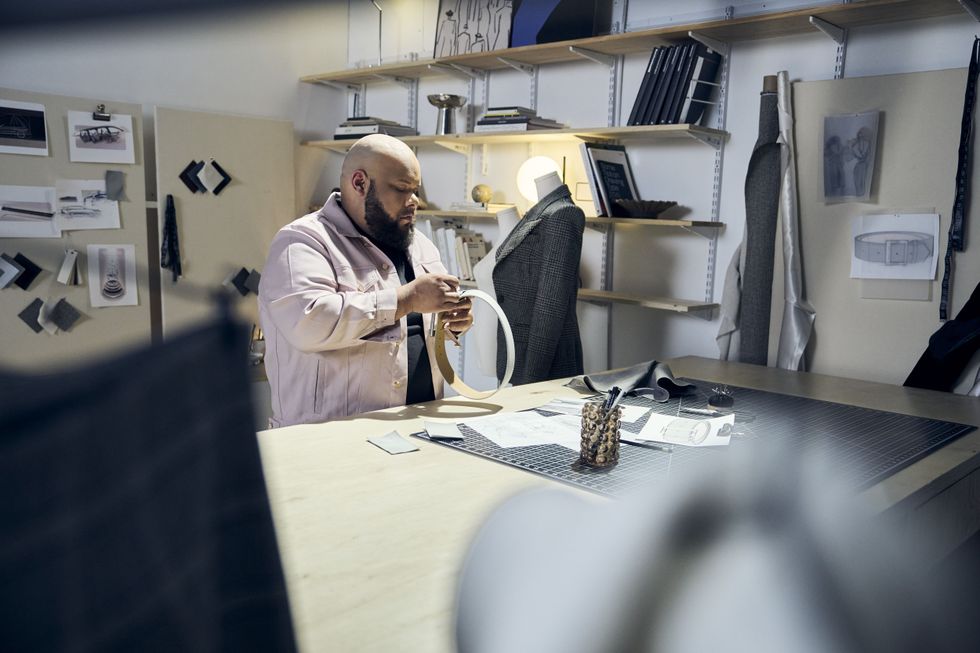
Using the same material from the interior of the Volvo EX90, Hudson crafted a wool-blend car coat and waistbelt that combine the vehicle’s Scandinavian design with his signature tailoring and intention. The exclusive collection launched on October 20, and each piece is made-to-order by Sergio Hudson Collections.

Courtesy
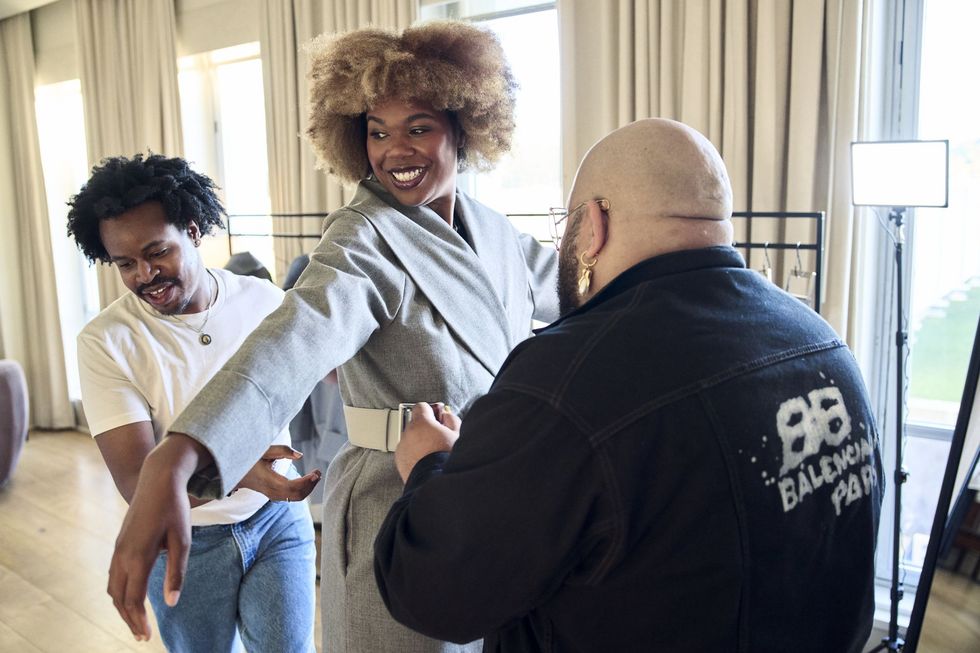
In October, I traveled to Charleston with a group of journalists to get a firsthand look at Hudson and Volvo’s location. During a fitting, Hudson said his goal is to make “great work that can stand the test of time.”
“People can look back on and say, ‘I remember when Sergio did that collaboration with Volvo,’” he continued. “Thinking about aligning yourself with classic brands that speak to where you want to go. And I think that's what this collaboration kind of means to me and my business.”
Hudson pinpoints his mom as the biggest influence for his designs. This collaboration was no different.
“This particular coat reminded me of the swing coats that my mom used to wear in the early 90s. You know, diva girls in the early 90s had Sandra suits,” he said, referring to Jackée Harry’s character in 227. “My mom wore those and she would have these matching swing coats to go over them. And that's where the initial idea came. This would be around the same time that we had our Volvo. So she would put on her suit, her swing coat, get in that red Volvo, and go to church.”

Courtesy
With this capsule and beyond, Hudson wants to see more staples rotating in and out of closets this fall. He advises fashionistas to build her closet out with essentials to mix and match that aren’t just stylish but also sustainable.
“It's just those special pieces,” he said. “You can wear the same shirt and pants every day and nobody will notice. But if you have a special boot, a special coat, a special bill, a special bag, that kind of speaks to everything that your style stands about, that is something you should focus on.”
These are the same kind of staple pieces that return to our Pinterest boards and TikTok feeds season after season. Fast fashion has never been Hudson’s aim. “I'm trying to create a special pieces that can stand the test of time,” he said in his warm, Southern accent. “I'm only creating those kind of pieces from here on out.”

Courtesy
For Hudson, this collaboration is revolutionary. It’s his first time working with a car company and experimenting outside of his wheelhouse in this way.
“This is a Scandinavian brand, and, you know, it's 70 years old. I'm an African-American boy from South Carolina that has had a brand for 10 years. So I think bridging those two worlds and seeing the similarities was the beauty of this project,” he explained.
Though Hudson and his partner and CEO of Sergio Hudson Collections Inga Beckham have made massive strides in just 10 years, Hudson said the industry is far from where he wants to see it when it comes to Black representation. He pointed to how few Black designers were at this year’s Met Gala despite the theme being Black dandyism.
“The fact that I dressed 18 people speaks to how many of us weren't there,” he said. He implored more of industries, fashion and beyond, to collaborate with Black designers often.
“Allow mentorship. Allow funding. Allow great design to shine through,” he implored. “When it comes to being a designer of African descent, when you can't get the funding that your counterparts have, you can't compete. When you get opportunities like doing a collaboration with Volvo, or you get opportunities to be at the Met Gala, that's putting us on the equal playing field, but really the funding behind it is what we need to take it to that desk level.”
Featured image courtesy