"Love never gives up. Love cares more for others than for self. Love doesn't want what it doesn't have. Love doesn't strut, doesn't have a swelled head, doesn't force itself on others, isn't always 'me first,' doesn't fly off the handle, doesn't keep score of the sins of others, doesn't revel when others grovel, takes pleasure in the flowering of truth, puts up with anything, trusts God always, always looks for the best, never looks back, but keeps going to the end. Love never dies." — I Corinthians 13:4-8 (Message)
Yeeeah buddy. If some of us were really real with ourselves, based on this definition of love, we'd admit that we've got a ton of work to do when it comes to how we love other people. But what about when it comes to self-love? Since the Word also tells us to "love your neighbor as yourself" (Matthew 22:39), what does it look like to bestow such a powerful emotion on our own being? How can we all make self-love a way of life?
This is something else that I'm kind of figuring out as life goes along. But as I'm becoming more and more intentional about loving me, I do know that the following 10 things have started to resonate in stronger, realer, and more profound ways than ever. How do you check out on the following self-love checklist?
1. Self-Care Is an Absolute Must
If you've been hanging with us long enough, you know that we are BIG on self-care over here (see "5 Self-Care Gems To Keep In Mind On Your Professional Journey," "The Fundamentals Of Self-Care When You're Young, Black & Woke" and "Self-Care Isn't Supposed To Be Pretty"). The reason why we feel that self-care should be a top priority is basically found in the word itself. Care is all about consideration, affection, and regard. Since you're the one who you are around the most, why wouldn't you want to honor yourself in these kinds of ways?
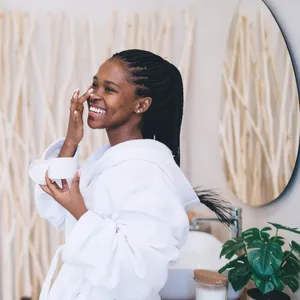
I've got friends who will be the first to help someone else out, but then they will turn around and feel guilty about getting a mani/pedi or a massage. While that might seem like humility on the surface, what it actually means is they think others should get more from them than they should give to themselves. That's not a sign of self-love; that's actually an indication that some internal love is lacking. There is nothing irresponsible, selfish, or unnecessary about self-care. If it's not already a part of your life routine, take this as a sign that it should be. Take it as a step towards loving yourself, that much more.
2. Your Intimate Circle Is Safe, Loving and Loyal
If you watched Sex & the City as much as I did back in the day, you might recall a scene where Carrie declared that she was a masochist. As she was talking about the constant roller coaster that was her and Mr. Big, she said, "He might be the one beating me, but I'm the one who keeps tying myself up." (Metaphorically-speaking, of course.) Oh, how I can relate! I tell my "love nieces" (young women who are family through love, not blood) and my goddaughters that the only thing worse than a bad boyfriend is bad platonic female friends. The. Worst. They will have you out here doing all of the work, questioning your value, and never knowing exactly where you stand. In short, they will have you being your own masochist.
When you grow up around a certain amount of toxicity, you tend to believe that dysfunction is normal, no matter how much you loathe it. That's how a lot of us end up in friendships and relationships that also mean us no good; they feel familiar even though we know we deserve better. But the more you focus on you and less on "them," the more you are willing to release what doesn't model the kind of love that you desire in your life. That leaves room for people who are committed, trustworthy, and safe. Yes, when you love yourself, your relationships reflect that love. There's no doubt about that.
3. You’re Not Addicted to Attention (Online or Off)
Although I'm not the biggest fan of the phrase "attention whore" ("whore" is a bit harsh, if you ask me), there is an article on Thought Catalog entitled "10 Signs You're A Social Media Attention Whore" that brings up some good food for thought. Some of its signs included buying followers, baiting shout-outs, pressuring your friends to like or comment on your posts, triggering folks and feeling like no picture is worthy of getting posted unless you don't have any clothes on in them.
Social media can be an awesome tool. Some of us wouldn't have been able to grow our brand or network at the level that we do without it. But it's one thing to use social media; it's another to be totally consumed by it (research reveals that 210 million people are social media addicts, by the way).
People who love themselves don't feel like the world is coming to an end if Instagram and Black Twitter were to shut down tomorrow. They can go a few days without putting up a selfie. They are able to go on social media fasts without having a nervous breakdown. And, when it comes to life, in general, they are not constantly conjuring up ways to get attention. They love themselves enough that all of the "extra" simply isn't necessary.
4. You Enjoy Spending Time Alone
On the heels of what I just said, another sign that you love yourself is you know how to be alone with you. Totally alone. That said, there's a married couple I know who hasn't been alone with one another, in their own house, for at least four years now. Whenever someone needs a place to stay, they let them stay at their home. While on the outside, that might appear to be altruistic, the couple also fights a lot, has a pretty sucky sex life, and the husband is ever rarely home. Now does it seem like a good thing? Sounds to me like the traffic in their house is a distraction from the cracks in their relationship. Single folks who don't know how to be alone may have cracks in their relationship with themselves.
People who always have to be at someone else's house or even at a club or in the mall, they could seem like an extrovert on the surface. But even healthy outgoing people will tell you that sometimes they prefer to recharge in the quiet and comfort of their own home.
The only people who don't really get how someone can spend a weekend at home without other folks being around are either the ones who've never tried it before or they are the ones who don't like, let alone love, themselves enough to sit in silence with their own thoughts. And you know what they say—"If you don't love you, why should you expect anyone else to?" I'll add to that and say, "If you don't want to spend intimate time with yourself, why should others seek it out?"
5. You Embrace Your Strengthens. You Know Your Weaknesses.
Where some people mess up in the self-love department is they lack self-awareness and/or self-compassion. This can manifest in all sorts of ways. One way is they may not know what their strengths and weaknesses are. As a direct result, other people are able to take advantage of the due to their lack of self-knowledge. For instance, I know that a strength of mine is how I give to others. A weakness of mine is not always being able to see a person's motives out of the gate. When I wasn't aware of this, I constantly found myself in codependent situations or giving more than I was getting in return. Now that I'm aware of my strength and weakness in this area, my discernment is much keener. Plus, I'm able to give more freely because I know the difference between giving to help a person out and giving to a friend who will hold me down in return.
Another benefit of knowing what your strengths and weaknesses are is you can manage your time more wisely. What I mean by that is this—a wise man once said that if you devote all of your time to trying to make your weaknesses better, you may end up only being "average" in those areas. But, if you spent that same amount of time developing your strengths instead, in those areas, you could end up being supernatural.
None of us are perfect. All of us have areas where we are phenomenal and areas where we are lacking. Self-love teaches us to embrace the strengths while still offering self-compassion (which means not beating ourselves up) as it relates to our weaknesses.
6. A Relationship Is Surplus. Not a “Void Filler”.
Some of y'all are not going to agree with what I am about to say, and that's totally okay. Hmph. Come to think of it, that actually is another sign that you love yourself—you don't need other folks to co-sign on your views and perspectives in order for you to feel good about them. That said, I'm not someone who sees anything wrong with a woman feeling like she needs a man in her life (or a man feeling like he needs a woman). In this context, a need is simply something that she wants or finds essential in order for her to be content in certain facets of her life.
What will garner major side-eye is if she is needy for a man. When you're needy, you feel destitute, and that tends to be one step away from desperation.
When you really and truly love yourself, you tend to look at a relationship from the standpoint of someone coming into your life to share all of the love that you already have. And, if that love comes tomorrow or five years from now, you're good because all a significant other will do is add to the already abundant life that you are already living. When a woman loves herself, a man doesn't fill any voids. He is coming into a space that is already overflowing. (Try not to drown in it, bruh.)
7. You’ve Got a Signature Style
Earlier this year, we did a feature on someone whose wedding I attended back when she and her husband lived in Nashville (they were both virgins, by the way. How cool is that?). Her name is Brandi Sellerz-Jackson. What we covered was Brandi's life as a doula. But what else she could've easily been interviewed on is her one-of-a-kind style.
Personally, I am a bigger fan of style than fashion. What I mean by that is I dig the kind of people who rock what they want to, regardless of what the industry says is in or out. I am drawn to the folks who are able to put things together in a way that is super-unique and then can walk with the kind of confidence that says, "I know I am an original. Deal with it."
When I say that loving yourself is about having a signature kind of style, I don't just mean when it comes to the clothes that you wear or make-up that you apply. One of my favorite definitions of style is "the way in which something is done". You've got a way that you go about doing you that is like no other. You are comfortable and confident in your individuality. And it resonates in just about everything that you do. If this ain't a form of self-love, what is?
8. You Are Envious of—and Threatened by—No One
Envy is evil. Full stop. I feel so strongly about it that I penned "5 Signs Your Closest Friends Are The Most Envious Of You" and "How To Stop Envying Your Favorite Celeb's Life." The main thing that I hate about envy is that it's all about wanting what (or who) someone else has. It's all about being discontent with your own life; so much so that you waste time, you become resentful, and you very well could end up not living out your own purpose because you're so caught up in what other people have going on.
Envy is also awful because, basically, it encourages you to act like God was looking out for others more than he was looking out for you. As if that's not bad enough, if you feed into it too much, it will have you feeling insecure, like everything is a competition and/or everyone is out here to get you. Envy is stifling. People who love themselves are intentional about avoiding it at all costs.
9. Aspiration—Not
Desperation—Motivates You
I'm pretty sure we're all heard that desperate times call for desperate measures. But more times than not, I totally disagree. I'm more in a lane of another quote that says, "Don't let desperate situations make you do desperate things." To be desperate is to be "reckless or dangerous because of despair, hopelessness, or urgency". I have done all kinds of stupid things because I was desperate when it came to "love" (that's in quotes on purpose; true love won't require you to be reckless or dangerous), finances and sometimes, even when it came to so-called friendships.
But what's amazing about the word "desperate" is it actually reveals how to avoid it via the act of self-love. When you love yourself, you do not feel like you are in a state of despair or hopelessness; there is a positiveness and optimistic state that love brings out of you that keeps you from totally going there. Something else that I've learned self-love does is it slows you down. You don't want just anything, just to say that you have something. Because you know what you are truly deserving of—both professionally and personally—you can wait for "it". Because you are worth the wait. And that is what causes you to move based on what inspires you. Because of that, desperation isn't even on your radar.
10. You Celebrate Yourself. OFTEN.
Let's end this article with, "If you don't celebrate yourself, you don't love yourself enough." Think about it. Just by the mere fact that you are the only person who ever has been or ever will be just like you, is that not enough of a reason to honor, commend, and revel in yourself? I certainly think so. But if you need more inspiration than that, when you reach a goal, celebrate it. When you make a decision in the present that you know will be right for your future, celebrate it.
When you remove toxicity from your life, celebrate it. When you take a risk, celebrate it. When you see growth in a particular area, celebrate it. Celebrate by toasting yourself with your favorite bottle of wine. Or making plans to go on a trip. Or taking a private day to do nothing but whatever it is you want to do.
You will know that you've graduated to another level of loving yourself when celebrations become the norm. When you are so proud of the woman you are, that you can help but to relish in it. This is the kind of self-love that is precious. Make sure you get to a place where it's very familiar to you. You, my friend, are worthy.
Feature image by Shutterstock
Originally published on November 3, 2019