




I’m a quotes kind of girl. Unapologetically so. I think I like them so much because they’re a way of packing in a lot of wisdom and insight without giving an entire speech (or writing an entire article). And if there’s one quote that I know I use at least three times a week, it’s “Adulthood is surviving childhood.”
It’s not a good thing either because, basically, what the quote is saying is a lot of us experience so much trauma as children that many of our adult years are actually spent trying to figure out how to survive it all. In fact, I recently read a Guardian article entitled, “Survivors of childhood trauma often grow up believing they are unworthy,” which had a line in it that summarizes a lot of why I do what I do for a living: “Jane now understands that she was conditioned as a child to see toxic relationships as almost normal.” I’m here to reprogram a lot of counterproductive stuff that a lot of us don’t realize we are doing…as best as I possibly can.
And yes, believe it or not, a part of the reason why we get into then tolerate then endure the oftentimes pure suffering of unhealthy relationships with other people — personal and professional, romantic, platonic and familial — is due to something known as unconscious contracts. Boy, when I first learned about unconscious contracts and what they entail, it was like I had a new way of helping to free up so many people from their hamster wheels of dysfunction with other individuals.
Okay, but I’m getting a little ahead of myself. If you already feel drawn to or even triggered by the intro of this article alone, please set aside some time tonight or this weekend to dive into what it means to sign an unconscious contract, how it typically ends up working against you, and what you can do to change it ASAP.
What Is an Unconscious Contract?

Getty Images
I like giving credit where credit's due, and when it comes to the entire concept of unconscious contracts, one of my instructors taught it to me. She said she learned it from a neuroscience educator by the name of Sarah Peyton.
The gist of an "unconscious contract" is it's an agreement that you made, oftentimes in order to get through living with your toxic parent (or parents), that ended up being an unhealthy habit or approach to dealing with other people as you grow and develop into adulthood (you can watch an intro video about it here that is pretty damn enlightening if I do say so myself).
According to Sarah and her findings, a lot of our full dependence on our parents (especially our mother since she's usually the primary caregiver), as far as communication goes, happens around four months of age and, without us even noticing it, we find ourselves figuring out what needs to be done in order to get along with them — even if it's ultimately to our detriment.
An article that dives deeper into all of this is "When Relationships Fall Apart: Conscious and Unconscious Agreements in Relationship." The authors speak on the fact that a conscious contract is an agreement where both parties know the commitment that they are getting into, while an unconscious contract is usually unspoken, although what transpires is one person decides to suppress their thoughts, feelings, and needs in order to make another person happy (or it at least makes getting along with them easier to do).
Now I'll already tell you that if you read this and thought, "Isn't that just compromising?" you just revealed that you are someone who definitely needs to continue on with this piece because, no, suppression is not compromise; suppression is you denying a part of who you are in order to keep the peace — or avoid abuse — and there is nothing compromising about that. It is destructive and definitely the kind of "unconscious contract" that you need to break…immediately if you can.
Before I break down how to do that, let's go a bit deeper into all of this.
How an Unconscious Contract Affected Your Childhood Development

Getty Images
Last fall, Newsweek published an article entitled "Why Adult Children Are Cutting Off Their Parents More Than Ever." Now for the record, no parent is perfect, and since some people like to throw around words like "toxic" as if they are confetti, let's look into some signs that you definitely had a toxic parent as a child/teenager — and that you may still have one now:
- They didn't respect your privacy/boundaries
- They pressured you to agree with them even when you didn't
- They were harder on you than they were on other children (especially outside of the home)
- They found a way to make everything about them
- They wouldn't let you ask questions for clarity (and/or they lashed out when you did)
- They were controlling
- They didn't shield you from trauma (and they oftentimes caused it)
- They used religion to justify their toxic behavior
- They used you as a makeshift therapist/counselor (told you too much information)
- They were verbally and/or emotionally and/or physically and/or sexually abusive
- They were emotionally unpredictable
- They weren't supportive (or you felt like they were competing with you)
- They kept you walking on eggshells
- They deflected from taking accountability for their mistakes (or poor choices)
- They either used guilt or withheld love in order to get their way
If any of this resonated with you, yes, on some level, you are a survivor of a toxic parent — again, not an imperfect parent; more like someone who put you in a position where you dealt with some level of trauma on a consistent basis. And because it's a parent's job to help you to become a holistically healthy individual, when the opposite happens, it can stifle you on some level.
For instance, I grew up with parents who didn't know how to respect a boundary or take accountability if it hit them square in the face. I don't even have the time to get into how deep it all went. For now, I'll just give one example of how it played out in my adult years — recent ones. One parent was so toxic that they really should be in prison. Because they're not, they had the nerve to email me acting like they were doing me some favor by leaving me alone…like I had told them to do for almost two decades now, that they still had moments when they would disrespect the boundary. And where did they get my contact information? From the other parent. WILD. Not you out here enabling my abuser.
Boundaries are limits, and limits (when they are not used to weaponize or manipulate) are put into place to keep us safe. People who don't respect your boundaries are unsafe individuals.
When I think about how my boundaries were constantly being dishonored as I was growing up affected me all through those years. One way is I didn't know how to set healthy boundaries with other people. As a result, I had some of the most toxic female friendships known to man (no joke). Another result is I had a tendency to be controlling to certain other people too. Control is what was modeled to me (suffocatingly so), all the while being told that it was love, and so… that's what I thought it was.
I had written an "unconscious contract" with my parents that allowed them to railroad my space, my body, and my feelings. My needs were basically the "rent" that I had to pay to live in their home and have my basic material needs met. And so, I thought that's what relationships looked like — that I had to go above and beyond while overlooking what I deserved in order to keep people around, OR I had to control the narrative in some way as a way of expressing my "love" to them. And I lived just like this for many years.
How an Unconscious Contract Affects Your Relationships Now
Getty Images
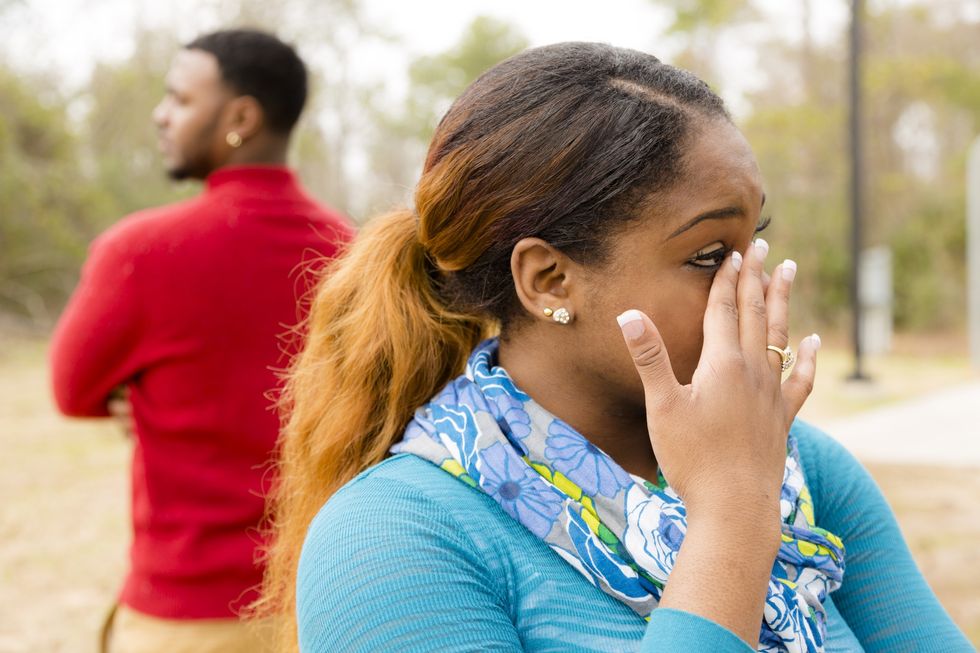
Before the end of the year is out, I'll be finishing my third book. One of the things that it's going to touch on is just how emotionally abusive one dynamic with a certain guy was. I'll give you an example. One time, I helped him put on an event. I got him the venue for free. I made the programs. I set up the slideshow. I ran the slideshow. He didn't pay me a dime. Because the venue was about an hour away and we left unbelievably late (in separate cars), I asked him if he would stay on the phone with me because I was sleepy. He yelled at me, told me that I needed to find someone else, and hung up. And the next day, what did I do? I texted him to make sure that he was okay. AMAZING. He never apologized, even when I brought it up. Instead, he deflected and justified his behavior. Also AMAZING.
In hindsight, I know this is the fallout from unconscious contracts that I had "signed" with my parents, several of them. Something in me thought that if I just loved that man enough, eventually, he would stop mistreating me. Yet, I know him well enough to know that he has his own unconscious contracts that need to be broken, so while I was over-giving, he was over-hustling. He also was being ungrateful and narcissistic (and narcissism is also oftentimes the result of a traumatic childhood; it's a cryptic way of protecting oneself). Yeah, because I still had some "live contracts" going on, folks were able to get away with all kinds of stuff.
I'll give you another example. I have a girlfriend who keeps picking materialistic and shallow women as friends (check out "7 Signs Your Friendship...Actually Isn't One"). Her mother was exactly that way. It's wearing her out now because she feels like all she has in common with her circle is shopping and, inconsequentially, debt. Yet, until I introduced the concept of unconscious contracts to her, she didn't realize that all she really had in common with her mom — and the only time her mom ever really spent quality time with her — was when money was involved (including her mom feeling entitled to her money in present time).
Again, adulthood is surviving childhood. So, take a moment and think about the list that I provided as it relates to whether or not you had a toxic parent. Where the points apply, ponder what your adult relationships look like these days. Where are there patterns? Where are there mirror reflections of the relationship that you had with your mother and/or father and/or caregiver? Where do you see the same kind of unhealthiness…even now?
When we're children, we are innocent and a blank slate. We rely on our parents to show us how we are to see ourselves, along with how we are to live out our lives. So yeah, without some serious inner work (and oftentimes therapy), the contracts that we became a part of as children will continue in our adult world — that is, until we break them.
What Can You Do to Break an Unconscious Contact

Getty Images
I already know — this is some pretty heavy stuff (which is why I implied at the beginning that it's not exactly lunchtime reading). Yet you know how the saying goes, knowledge is power, and if you could relate to any of this, how freeing is it to get to some of the roots, to receive confirmation that you're not crazy (sis, you're not) and then be provided with tips on how to get up out of these, what seem like lifelong binding agreements, that are not serving you (and never really were)?
Okay, so now that you know what an unconscious contract is, how you found yourself being a part of one, and how much damage they ended up doing, what can be done to break the contract? Good question.
A PDF that I was given (via Sarah Peyton's site) is what my instructor shared with me. I have edited it a bit so that it can make a bit more sense (if this is your first time hearing about unconscious contracts):
Step 1. Determine what the contract initially was.
“I (your name), ________________ , solemnly swear to you (parent/caregiver),___________________
to (whatever the self-defeating behavior was) ________________________ in order to protect you/honor you/survive, no matter the cost to myself. “
Step 2. Was the vow heard? (In order to feel validated in this exercise, you should get someone you trust to serve as a representative to act as the parent/caregiver you are speaking to.)
“Parent or caregiver, did you hear this vow?”
“Parent or caregiver, do you like this vow?”
Step 3. Can the vow be released? If so, release it.
If yes, the representative says, “I release you from this vow and I revoke this contract.”
(If the vow cannot be released, like your parent lives with you and they are still doing the behavior, you may want to seek therapy to figure out what boundaries need to be set up, especially if your parent tends to go full gaslight or full denial whenever you bring trauma or their past mistakes up.)
Step 4. Create a blessing to break the unconscious contract.
The representative says, “And instead of this vow, I give you my blessing to...(create the blessing)”
In a perfect world, you could talk to your parent about all of this, and no representative would be needed — yet honestly if that were the case and your parent was truly self-aware, apologetic, and willing to make amends, they would probably approach you first about the harm that they caused. That's why a representative can be helpful. They are symbolic, and while you may never get this kind of release from your actual parent, the validation and affirmation that comes from the exercise may be enough for you to fast-track your way to healing and to feel stronger in saying "no," setting limits and requiring that your needs be met from your parents — and to offer up consequences when that is not the case.
This is an exercise that can reduce fear and stagnation so that you can start to get on with how to have healthier relationships with others moving forward.
The Benefits of Ending Unconscious Contracts…and Creating New Ones
Getty Images
A wise man once said, "My word is my bond." That said, to tell you the truth, the only way that breaking an unconscious contract is going to work is if there is integrity behind your words. You need to identify them, vocally acknowledge them, and have your representative acknowledge you/them. You need to receive the blessing, and then, what I recommend is setting up a new contract — this time between you and yourself.
For instance, if your childhood unconscious contract was all about you walking on eggshells, the new contract needs to say something along the lines of, "I will no longer put my own feelings and needs aside whenever I feel bullied or even dismissed. My voice matters, especially when it comes to what directly affects me, so I will speak up when necessary." Whew. Can you see how empowering that is?
It can't be said enough that there is plenty of data out here to support the fact that at the age we are traumatized, oftentimes we remain right there emotionally until we heal — and healing can include breaking our unconscious contracts. Only, in my opinion, it's not enough to break one…you need to then replace it with another; otherwise, you could find yourself slipping back into what's familiar…even if you know it's not what's better/best for you.
___
This really is something that I could go on for days about because it’s the kind of topic that is so freeing once people are able to apply it in their own world. For now, I’ll just say that contracts are binding agreements. Yet, the good thing about unconscious contracts is you can let yourself off of the hook, knowing that you, as an adult, now have the space to live as you wish. You don’t have to “go along to get along” in the midst of super crazy, super counterproductive, super toxic ways.
You can write new contracts — ones that will strengthen you, validate you, and give you the kind of life that YOU want to live. Not the one that your toxic parent(s) made you think you had to settle for.
So, what unconscious contracts are you going to break today?
What new ones are you going to put into motion?
There’s no time like the present to start fully living YOUR life.
Amen? Hallelujah. For real.
Let’s make things inbox official! Sign up for the xoNecole newsletter for daily love, wellness, career, and exclusive content delivered straight to your inbox.
Featured image by Vladimir Vladimirov/Getty Images