Pass The CROWN: Why This Exec Is On A Mission To End Black Hair Discrimination

Okay, so, boom. In 2005, India Arie and Akon linked up to create a new negro national anthem that firmly reminded America that Black people cannot be defined by their hair, and fifteen years later, it is abundantly clear that Karen and Chad never got the memo.
I'll never forget when I was 16 years old, attending a Catholic school in Augusta, Georgia, when a teacher told me that my twists were too "ethnic" and that straighter hair made me look more "ladylike" in front of another group of students. I felt angry, hurt, and embarrassed by his not-so-micro-microaggression and had no means of retaliation or recourse. If you or someone you love is also Black AF, I'm sure that they, too, have had an experience like mine and it is for this reason that Dove and The CROWN Coalition have linked up to put an end to hair discrimination for good.
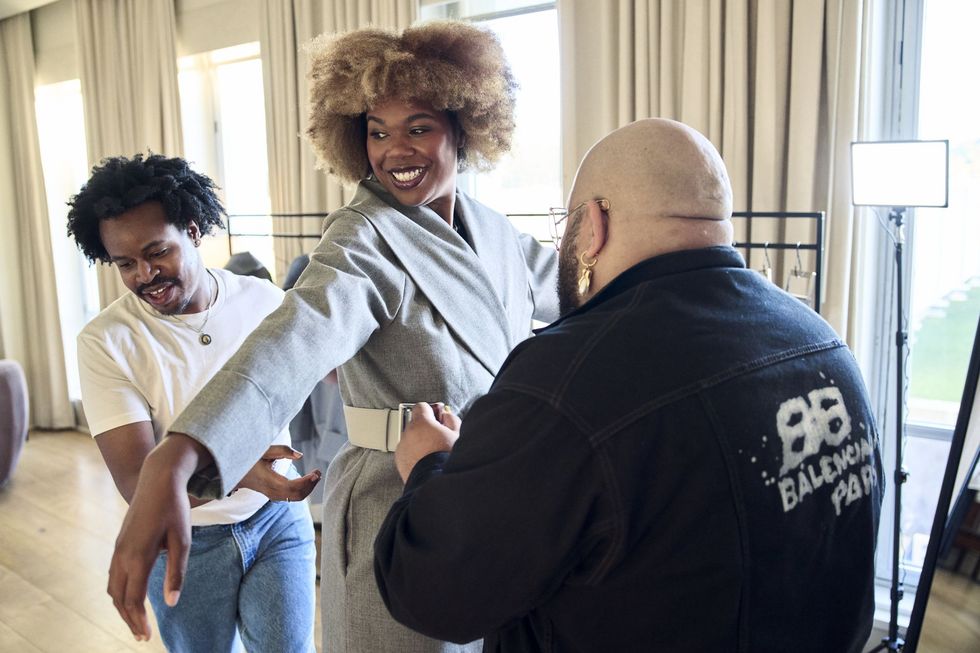
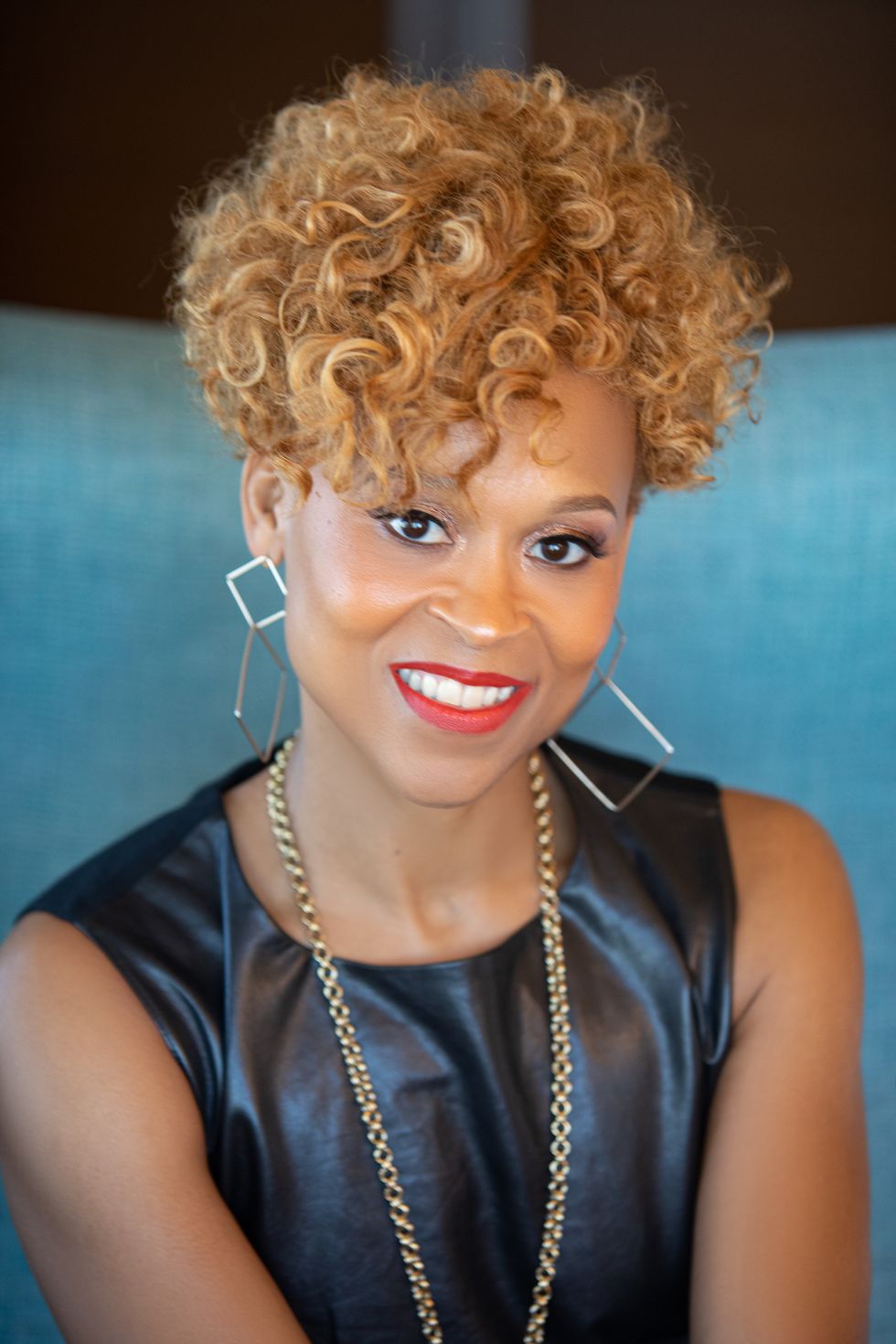
Unilever's Executive Vice President and Chief Operating Officer of North American Beauty and Personal Care, Esi Eggleston Bracey, told xoNecole:
"We know as black women, we wear our hair in many ways that are expressions of us. So we define our own professionalism. Our braids, my twists, my locs, my Afro, when I've worn [those styles], those have all been professional because I've worn those in professional settings."
Courtesy of Esi Eggleston Bracey
One year ago today, the CROWN (which stands for Create a Respectful and Open World for Natural Hair) Act was signed into legislation in California, making race-related hair discrimination illegal and triggered a domino effect that has since led seven states to follow suit. The law, initially introduced by Senator Holly J. Mitchell last January, has now been introduced as a federal bill that has the support of more than 70,000 petitioners nationwide and according to The CROWN Coalition, this is only the beginning. As of today, July 3, is officially National CROWN Day.
xoNecole recently chatted with Esi to talk more about how laws like The CROWN Act can be life-changing to the professional narrative Black men and women experience nationwide and, honey, it was a word.
Here's what she had to say.
*Some responses have been edited for length and clarity.
Here at xoNecole, we are owned by a Black woman. We are an office of Black women and hair discrimination is not a thing here. And discrimination is not tolerated at all. If there is someone who feels that they have had a discriminatory experience, what should they do to take action?
Esi Eggleston Bracey: Help us make The CROWN Act law in all 50 states so that we can all be protected because right now we only have that protection in seven states. So the answer for the recourse depends on if there's legislation passed in the state. To get it passed in your state, please go to TheCROWNAct.com and sign the petition. You can also go to TheCROWNAct.com and find out who your local officials are so that you can petition them for The Crown Act in the state. If The Crown Act is in your state, which is what we're celebrating, you have the same recourse.
You have legal action and recourse for the discrimination, the same way you would for gender or for race or other things that are protected based on civil rights legislation and the FEHA legislation. You have legal rights if you feel that there's discrimination.
When you say, what can someone do if they feel that they've been discriminated [against]? The first thing I say is, have a conversation, and say my hair is an extension of me. And in that, [say] I believe it's completely appropriate for me to wear my hair X, Y, and Z, and see where that conversation goes. If through that conversation, you're still denied employment or access to school, and you are in a CROWN Act municipality or state, then you have the right to take action.
There's a lot of intense discussions happening right now, as we know, about meaningful systemic reform versus symbolic pacifiers if you will, can you share specific ways the passing of the CROWN act legislation has directly impacted hair discrimination or the end of hair discrimination and the creation of more equitable and inclusive beauty experiences for black women and girls?
I think The CROWN Act and the work of Dove and the CROWN Coalition and championing the legislation is exactly the action that you're talking about. In our community, as we appreciate people still saying, 'I stand with the black community' [and] 'I support #BlackLivesMatter', [we] want people to go beyond just standing with us, but actually helping us change the world and changing society because we've been oppressed for centuries. It's been 401 years since slavery. And it's only been 56 years that we have been legally desegregated. So we know we have a long road to go to make meaningful change.
I believe legislation can be that meaningful change. That legislation changes lives and The CROWN Act is an example of legislative change that makes hair discrimination, not legal. And hair discrimination is a type of discrimination.
In fact, why we've been able to get it passed is because it's recognized that hair is actually a characteristic of race that is already protected. And so what The CROWN act does is supplement that and make it clear that race is a protected class and things like The Emancipation Proclamation, which is an executive order. If we think about the 13th Amendment, if we think about The Civil Rights Act, The Voting Rights Act -- all those made meaningful changes to where we are today. The CROWN Act is an example of that. It's great to take a stance, it's even better to drive systemic change. The CROWN Act is one, but there's so many other areas that we can use our voice and our influence to drive that systemic change.
You have a daughter. What conversations have you had with her or things you've done with her to help her embrace her natural beauty?
My daughter, Anura, is one of my pride and joys because I have two, my son Benoit, and there are conversations needed with the boys and the girls. She rocks her beautiful natural hair. She wears a big, let's call it an afro puff bun. And she's proud of it. And your question is what have I done? I think it's the same as many mothers do. One is, lead by example, which is be true to who I am regardless of the organizations that I'm in.
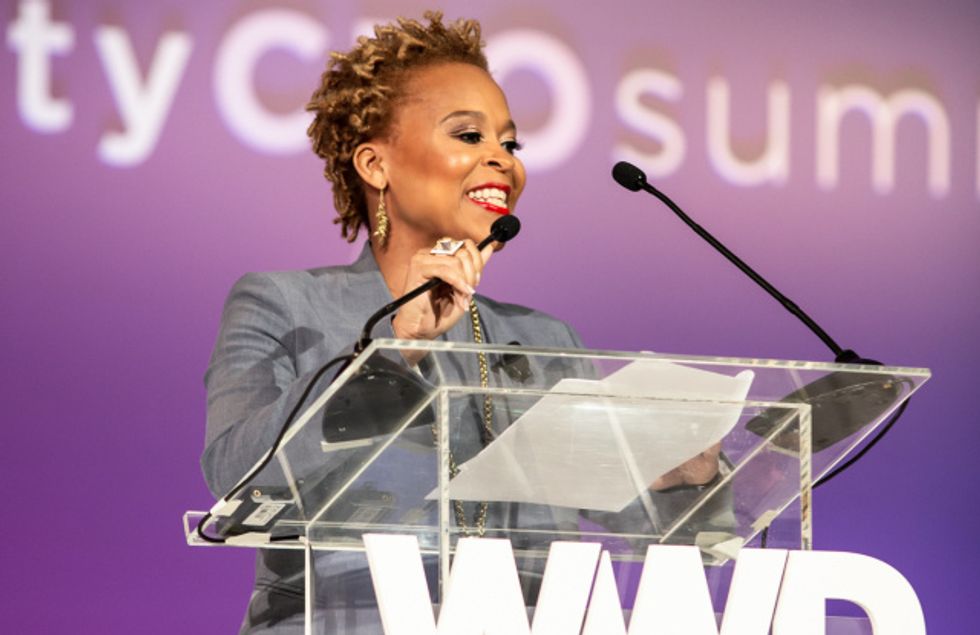
I run a $5 billion business and I work for Unilever. I have 24 brands. I've been in corporate America for nearly 30 years. When I came into corporate America, I did feel the pressure to conform. I wore a bob and a perm and straight-up little glasses, and I wanted to fit in and blend in. And then I realized that by doing that, I was perpetuating for all what that standard was. So I challenged myself to break out of that.
I cut off my perm, wore a really short afro, changed a lot to just reflect who I was in the workplace. That is what I try to show and have conversations with my daughter about. I encourage her to go past her comfort zone and be comfortable in sharing who she is, but she's on her own journey. So, I try to lead by example and try to stretch her beyond her comfort zone and then have her see that it's not just about her, it's about other people. So, when she steps out of her comfort zone, she creates a space for others to do the same.
Courtesy of WWD
Have you yourself ever experienced hair discrimination in the workplace? And if so, how did that make you feel?
That's a hard question to answer. I have not experienced a kind of discrimination that asked me to be sent home from school or had me rejected officially from a job. But we all experience what I would call is more the covert discrimination: perceptions.
As a leader, as an executive, I've had many people not assume I was an executive. They might assume I was the intern or assume that I was working to support executives. And I've seen that and it's hard to unpack. Is it because of hair? Is it because of race? Is it because of youth? Is it because of gender?
I'd say probably all of the above because it's happened many times. So, in that, I just smile when someone makes a comment and I might say something like, 'you know, I lead this business, right?' And take what I call a power stance. I've not had to legislate for myself, but I have advocated for myself.
We're currently talking about freedom quite a bit. It’s a major topic of discussion and many things for people in the black community freedom and the black community. What does being free mean to you?
Free to me means free to be. You know, how we all have mantras [and] different things that we say? One of the things I say is free to be me. That's the foundation of freedom -- freedom to be who you are now. What does that mean in the world? That's freedom to be safe. That's freedom to be respected. That's free to contribute. That's free to bring to life the impact that we inherently know that we can make.
To learn more about The CROWN Act, visit their website. Click here to sign The CROWN Act petition and help make hair discrimination illegal.
Featured image courtesy of Esi Eggleston Bracey.
Because We Are Still IT, Girl: It Girl 100 Returns
Last year, when our xoNecole team dropped our inaugural It Girl 100 honoree list, the world felt, ahem, a bit brighter.
It was March 2024, and we still had a Black woman as the Vice President of the United States. DEI rollbacks weren’t being tossed around like confetti. And more than 300,000 Black women were still gainfully employed in the workforce.
Though that was just nineteen months ago, things were different. Perhaps the world then felt more receptive to our light as Black women.
At the time, we launched It Girl 100 to spotlight the huge motion we were making as dope, GenZennial Black women leaving our mark on culture. The girls were on the rise, flourishing, drinking their water, minding their business, leading companies, and learning to do it all softly, in rest. We wanted to celebrate that momentum—because we love that for us.
So, we handpicked one hundred It Girls who embody that palpable It Factor moving through us as young Black women, the kind of motion lighting up the world both IRL and across the internet.
It Girl 100 became xoNecole’s most successful program, with the hashtag organically reaching more than forty million impressions on Instagram in just twenty-four hours. Yes, it caught on like wildfire because we celebrated some of the most brilliant and influential GenZennial women of color setting trends and shaping culture. But more than that, it resonated because the women we celebrated felt seen.
Many were already known in their industries for keeping this generation fly and lit, but rarely received recognition or flowers. It Girl 100 became a safe space to be uplifted, and for us as Black women to bask in what felt like an era of our brilliance, beauty, and boundless influence on full display.
And then, almost overnight, it was as if the rug was pulled from under us as Black women, as the It Girls of the world.
Our much-needed, much-deserved season of ease and soft living quickly metamorphosed into a time of self-preservation and survival. Our motion and economic progression seemed strategically slowed, our light under siege.
The air feels heavier now. The headlines colder. Our Black girl magic is being picked apart and politicized for simply existing.
With that climate shift, as we prepare to launch our second annual It Girl 100 honoree list, our team has had to dig deep on the purpose and intention behind this year’s list. Knowing the spirit of It Girl 100 is about motion, sauce, strides, and progression, how do we celebrate amid uncertainty and collective grief when the juice feels like it is being squeezed out of us?
As we wrestled with that question, we were reminded that this tension isn’t new. Black women have always had to find joy in the midst of struggle, to create light even in the darkest corners. We have carried the weight of scrutiny for generations, expected to be strong, to serve, to smile through the sting. But this moment feels different. It feels deeply personal.
We are living at the intersection of liberation and backlash. We are learning to take off our capes, to say no when we are tired, to embrace softness without apology.
And somehow, the world has found new ways to punish us for it.

In lifestyle, women like Kayla Nicole and Ayesha Curry have been ridiculed for daring to choose themselves. Tracee Ellis Ross was labeled bitter for speaking her truth about love. Meghan Markle, still, cannot breathe without critique.
In politics, Kamala Harris, Letitia James, and Jasmine Crockett are dragged through the mud for standing tall in rooms not built for them.
In sports, Angel Reese, Coco Gauff, and Taylor Townsend have been reminded that even excellence will not shield you from racism or judgment.

In business, visionaries like Diarrha N’Diaye-Mbaye and Melissa Butler are fighting to keep their dreams alive in an economy that too often forgets us first.
Even our icons, Beyoncé, Serena, and SZA, have faced criticism simply for evolving beyond the boxes society tried to keep them in.
From everyday women to cultural phenoms, the pattern is the same. Our light is being tested.

And yet, somehow, through it all, we are still showing up as that girl, and that deserves to be celebrated.
Because while the world debates our worth, we keep raising our value. And that proof is all around us.
This year alone, Naomi Osaka returned from motherhood and mental health challenges to reach the semifinals of the US Open. A’ja Wilson claimed another MVP, reminding us that beauty and dominance can coexist. Brandy and Monica are snatching our edges on tour. Kahlana Barfield Brown sold out her new line in the face of a retailer that had been canceled. And Melissa Butler’s company, The Lip Bar, is projecting a forty percent surge in sales.

We are no longer defining strength by how much pain we can endure. We are defining it by the unbreakable light we continue to radiate.
We are the women walking our daily steps and also continuing to run solid businesses. We are growing in love, taking solo trips, laughing until it hurts, raising babies and ideas, drinking our green juice, and praying our peace back into existence.
We are rediscovering the joy of rest and realizing that softness is not weakness, it is strategy.
And through it all, we continue to lift one another. Emma Grede is creating seats at the table. Valeisha Butterfield has started a fund for jobless Black women. Arian Simone is leading in media with fearless conviction. We are pouring into each other in ways the world rarely sees but always feels.

So yes, we are in the midst of societal warfare. Yes, we are being tested. Yes, we are facing economic strain, political targeting, and public scrutiny. But even war cannot dim a light that is divinely ours.
And we are still shining.
And we are still softening.
And we are still creating.
And we are still It.

That is the quiet magic of Black womanhood, our ability to hold both truth and triumph in the same breath, to say yes, and to life’s contradictions.
It is no coincidence that this year, as SheaMoisture embraces the message “Yes, And,” they stand beside us as partners in celebrating this class of It Girls. Because that phrase, those two simple words, capture the very essence of this moment.
Yes, we are tired. And we are still rising.
Yes, we are questioned. And we are the answer.
Yes, we are bruised. And we are still beautiful.

This year’s It Girl 100 is more than a list. It is a love letter to every Black woman who dares to live out loud in a world that would rather she whisper. This year’s class is living proof of “Yes, And,” women who are finding ways to thrive and to heal, to build and to rest, to lead and to love, all at once.
It is proof that our joy is not naive, our success not accidental. It is the reminder that our light has never needed permission.
So without further ado, we celebrate the It Girl 100 Class of 2025–2026.
We celebrate the millions of us who keep doing it with grace, grit, and glory.
Because despite it all, we still shine.
Because we are still her.
Because we are still IT, girl.
Meet all 100 women shaping culture in the It Girl 100 Class of 2025. View the complete list of honorees here.
Featured image by xoStaff
One thing that will never go out of style is the pride Black women take in showcasing and adorning our crowns. From sculpting braids to sleek bobs and curls for days, the girls are always playing with texture, color, and undeniable creativity—switching up our hairstyles like we do our moods. This season, hair is less about what's trending and more about expression. We're experimenting, evolving, and embodying every version of ourselves.
In partnership with SheaMoisture, this year's It Girl 100 celebrates the beauty of "Yes, And," an ode to the women who wear every side of themselves with confidence. These innovators remind us power and softness, heritage and reinvention, can beautifully co-exist. It's a call to own every layer of who we are. Because being an It Girl isn’t about choosing one version of yourself. It’s about saying yes to all of them.
Below, the women featured in xoNecole's It Girl 100 Class of 2025 are doing that—and then some—eloquently showing us how to say "Yes, And," to hair looks that always serve.
Luxe Layers x Serena Page
From braids and twists to platinum wigs, Love Island season six winner Serena Page continues to prove she can do it all, and do it all flawlessly. No matter the style, her hair game is undefeated. The softly layered middle-part with just the right amount of bounce is a classic Black girl hairstyle that gives inches without sacrificing body. It's a style that gives soft glam with a finish so seamless it could pass as a silk press—the kind of just-left-the-salon ease we all crave.
The Remix Cut x Ruesworld
When it comes to a short cut with attitude, Ruthann Palacios does not come to play. Known on social media by the moniker @ruesworldd, the content creator keeps her foot on our necks with the way she remixes her short cuts time and time again. Her recent sculpted, asymmetrical style is less of the "pixie" we're used to and more of a power move as she channels the bold innovation of '90s icons like Missy Elliott. This time, with extra length through her crown and right side, a sharp shorn left etched with box designs, and added length in the back, the hairstyle is equal parts edgy and architectural while being a look that's completely her own.
"I just told my stylist I wanted something cool and let them have full creative control with it," Ruthann told us of the hairstyle. "It channels my It Girl energy because I’m not afraid to take risks and show up boldly as myself, no matter the look." As a resident It Girl, it's clearly Rue's world—we're just living in it.
Fulani Flow x Kayla Nicole
Founder and podcast host Kayla Nicole's face card never declines, and neither do her statement hairstyles. One such look was her Fulani braids, a style that looked like it was made to be her signature. Originating from the Fulani people of West Africa, this traditional style features cornrows braided down the center of the head, with smaller plaits framing the face and beads or accessories woven throughout. Kayla's take on the tradition complete with center cornrows once again proved what we all know to be true: when it comes to heritage and repping for the culture, an It Girl never has to choose.
Top Tier Knot x Yana C.
Known to her followers online as @goldynaps, Yana C. is the queen of turning hair into her favorite art form. One of her latest looks feels like a love letter to '90s Black hair creativity. With Fulani-inspired cornrows braided flat and finished into bantu knots that line the center of her head like a crown, paired with a sleek straight sew-in flowing in the back, the style is equal parts nostalgic and next-level. And, of course, her signature ash blonde locks takes it all up a notch.
"This style was inspired by the ’90s—my favorite era for artistry in Black hair!” Yana shared with xoNecole. “My hair has always been such a notable part of who I am, and I love to express myself through it and make it an extension of my personal style. This style channels my It Girl energy because it’s a reminder that Black hair isn’t just hair—it’s art."
The look, which racked up major views on TikTok, is giving everything it needs to give. Because for Yana, self-expression will always make her the main character.
Sculpted Braids x Shema Love
Let Black girls be whimsical.
For content creator and creative visionary Shema Love, this hairstyle encapsulates that mood perfectly. The intricate, symmetrical design captures both the power and the playfulness defining this season's resident Black girl hair renaissance for It Girls everywhere. "I loved the whimsy of this hairstyle. I want to see Black women be allowed to experiment more with whimsy with our hair," Shema shares with xoNecole. "I love the symmetry of it and a look that shines from every angle. And of course, no style ever feels complete to me without my baby hairs laid."
Boho Boss Braids x Toni Bravo
Toni Bravo may be the "CEO of Blush," but she is also a resident slayer of hair looks. Whether she's rocking a custom install or a silk press, the content creator is making a hair moment just as often as she's putting us on to the latest beauty finds. But when she debuted her boho box braids earlier this year, she reminded us that every new hair alert hits just a little different.
Loose, free-flowing curls woven through intricate box braids add movement and softness to the tried-and-true style, creating a look that’s equal parts effortless and elevated. "I wanted something a little messy but just as intentional, and it was perfect. It channels the part of me that loves to have fun and switch it up while trying something new," Toni tells us about her look. "An It Girl knows that the best things are right outside of your comfort zone."
The low-maintenance meets high-impact style is one that channels Toni's booked, busy, and bossy era to a T.
Black Girl Bob x Maya Allen
Whether asymmetrical, curly, or blunt, there's something irrefutably It Girl about rocking a bob. With quiet confidence, it's a cut that commands attention. Beauty editor and expert Maya Allen has worn different iterations of the bob throughout the years, but this one—styled with a deep side part and cut just below her jawline—frames her face and enviable bone structure to perfection. In an interview with Cosmopolitan, Maya dubbed her signature bob "a power cut." "It’s like a power suit for my hair," she added. "It makes me feel fierce and effortlessly chic without ever having to try too hard."
Fro The Culture x Zaynah
The afro will forever be a cultural statement. It's a style that represents the most natural state of our hair, a crown that often defies gravity whenever we choose to wear it. Content creator Zaynah understands the fro's power as a symbol of Black beauty and can be seen wearing her type 4 hair unapologetically in much of her viral social media content. Whether achieved through twist-outs, braid outs, wash n' gos, or perfectly picked, Zaynah's take on the afro hairstyle is full, stretched, and beautifully shaped. With it, she embodies not just It Girl energy with pride and confidence, but the freedom to take up space.
Pony Up x Kirah Ominique
As far as we're concerned, nobody does a ponytail quite like Kirah Ominique. The It Girl's It Girl has made the sleek, added-hair ponytail as signature of hers when she's not sporting braids or a slick-back bun. With her baby hairs laid, and every strand of her hair smoothed and locked into place, the hairstyle is a clean, sculpted serve that's as chic as it is fierce. The content creator and beauty influencer's ponytails are the perfect blend of playfulness and precision, a put-together staple in every It Girl's hairstyle arsenal.
In Her Copper Era x Keke Palmer
If "blondes have more fun," then the ladies deciding to rock copper are rewriting the rules. In recent years, copper has had a bit of a resurgence as a warmer, richer take on going lighter, and nobody's been owning that energy lately quite like Keke Palmer. This year, the host and actress debuted her now-signature hue in its boldest form yet: a tousled face-framing pixie that gives the timeless allure we've come to associate with '90s icons like Nia Long and Halle Berry.
As Byrdie put it best, "We've seen the shade at every length and in every style, but this one is truly something special."
Meet all 100 women shaping culture in the It Girl 100 Class of 2025. View the complete list here.
Featured image courtesy of Ruthann Palacios